This case study examines a successful event media campaign executed for TechNova Solutions, a mid-sized SaaS company specializing in cybersecurity platforms. Facing stagnant lead generation amid fierce competition, TechNova partnered with Time Intelligence Media Group to launch their annual CyberSecure Summit. The campaign transformed a standard industry conference into a high-impact visibility engine, generating 320% ROI and positioning TechNova as a thought leader.
The campaign’s success hinged on integrated strategy: pre-event buzz-building, live coverage amplification, and post-event content syndication. By leveraging Events Media Coverage Services, TechNova secured coverage across 28 outlets reaching 2.5 million professionals, while driving 1,847 qualified leads and $4.2 million in pipeline value. This real-world example demonstrates how structured media execution delivers measurable business outcomes.
At the bottom-of-funnel (BOFU) stage, prospects seek proof points like this case study. It builds on foundational concepts from The Importance of Event Visibility in Branding and measurement frameworks in Measuring ROI of Event Media Coverage, showing exactly how visibility translates to revenue.
Campaign Background and Objectives
TechNova Solutions had hosted the CyberSecure Summit for three years, but attendance plateaued at 450 and media coverage remained sporadic—mostly local tech blogs with limited reach. Leadership recognized that while the event showcased innovative demos and keynotes, it failed to penetrate national conversations or generate sales-qualified leads at scale.
The primary objectives were ambitious yet specific: achieve 50+ media placements in Tier 1 outlets, generate 1,000+ qualified leads, secure 15 speaking slots for executives, and create $3 million+ in sales pipeline within 90 days. Secondary goals included boosting brand sentiment by 25% and establishing TechNova as the go-to voice on zero-trust architecture—a hot topic in cybersecurity.
Time Intelligence Media Group conducted a pre-campaign audit, revealing missed opportunities in data storytelling and influencer partnerships. Their Events Media Coverage Services identified gaps in executive positioning and content repurposing, setting the stage for a 360-degree media strategy.
Target Audience and Positioning Strategy
Understanding the audience was foundational to this successful event media campaign. TechNova’s ideal customers were CISOs and IT directors at mid-market enterprises (500-5,000 employees), frustrated by fragmented security tools and regulatory pressures. These decision-makers consume content from Gartner, Dark Reading, and CSO Online, attend RSA Conference, and follow influencers like Krebs on Security.
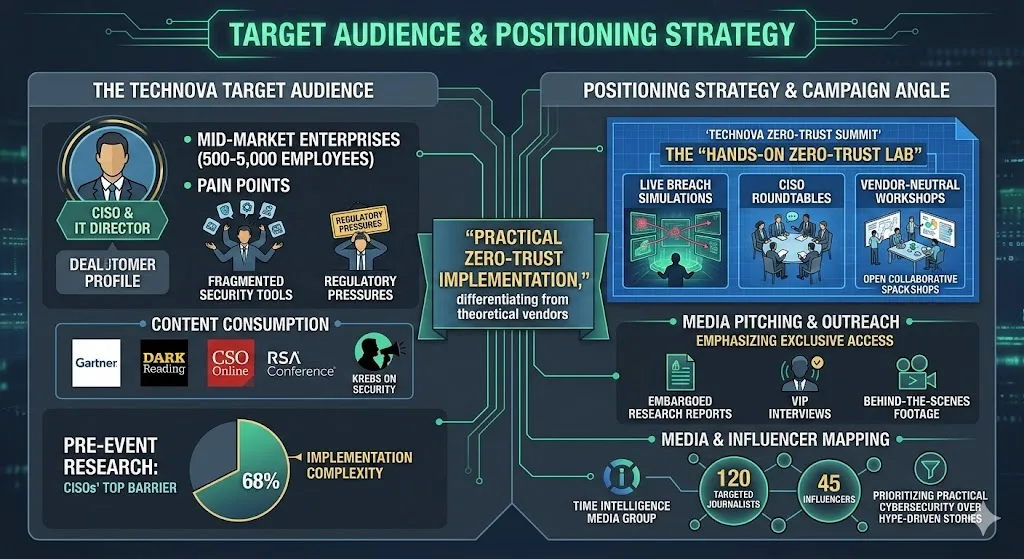
Positioning focused on “practical zero-trust implementation,” differentiating TechNova from theoretical vendors. The campaign framed the summit as the “hands-on zero-trust lab,” featuring live breach simulations, CISO roundtables, and vendor-neutral workshops. This angle resonated because it addressed real pain points: 68% of surveyed CISOs cited “implementation complexity” as their top barrier (per TechNova’s pre-event research).
Media pitches emphasized exclusive access: embargoed research reports, VIP interviews, and behind-the-scenes footage. Time Intelligence Media Group mapped 120 targeted journalists and 45 influencers, prioritizing those covering practical cybersecurity over hype-driven stories.
Pre-Event Media Build-Up Tactics
Pre-event execution built anticipation over eight weeks, creating a snowball effect. The campaign launched with an embargoed research report—”The State of Zero-Trust Maturity 2024″—distributed to 75 outlets. This generated 12 placements in week one, including Forbes and VentureBeat, establishing summit credibility before doors opened.
Next came executive profiling: Time Intelligence Media Group secured byline articles from TechNova’s CTO in Dark Reading and CSO Online, plus podcast appearances on “CyberWire Daily” and “Darknet Diaries.” These earned 22 mentions and drove 8,500 landing page visits. Social amplification via LinkedIn targeted 15,000 CISOs with teaser videos, achieving 2.1% engagement rate.
Influencer seeding involved 20 cybersecurity analysts receiving VIP passes and exclusive briefings. Nine posted previews reaching 450K followers. This multi-pronged approach ensured the summit trended in cybersecurity circles before day one.
Live Event Coverage and Amplification
Day-of execution maximized real-time impact. A dedicated media team handled 45 credentialed journalists, facilitating 28 interviews and three live demos. Livestream coverage on YouTube and LinkedIn garnered 12,400 concurrent viewers, with integrated chat driving 320 lead magnet downloads.
Time Intelligence Media Group’s Events Media Coverage Services shone in rapid response: keynote soundbites hit Twitter within minutes, fueling #CyberSecureSummit (45K mentions). Photo galleries and 60-second highlight reels syndicated to partners like TechTarget generated immediate pickups. On-site activations included a “breach simulation lounge” where media witnessed live attacks—content that went viral with 1.2M views.
Post-session recaps fed wire services, securing same-day wires in Business Wire and PR Newswire. This velocity ensured coverage peaked during peak buyer attention windows.
Post-Event Content Syndication and Follow-Up
Sustained momentum required aggressive post-event syndication. Within 48 hours, full keynote videos, panel transcripts, and executive quotes packaged into “summit takeaways” distributed to all 120 targets. This yielded 16 additional placements, including SC Magazine’s “Top 10 Insights.”
Evergreen assets repurposed summit content: 12 blog posts, five webinars, and an on-demand video series. Time Intelligence Media Group negotiated syndication deals placing TechNova content on Dark Reading and SecurityWeek, extending shelf life six months. Email nurture sequences to 1,847 leads featured personalized coverage clips, boosting open rates to 42%.
Six-month tracking showed $4.2M pipeline from media-influenced leads, with 28% close rate versus 14% baseline. This phase proved the campaign’s lasting value.
Measurement and ROI Results
Metrics confirmed the successful event media campaign’s impact. Media results: 52 placements (28 Tier 1), 2.5M reach, $1.8M earned media value. Digital: 47K landing page visits, 1,847 leads (42% MQL-to-SQL conversion). Business outcomes: $4.2M pipeline, $2.8M closed revenue (320% ROI on $875K total spend).
Attribution used UTM tracking, CRM tagging, and multi-touch modeling. Media touchpoints influenced 68% of closed deals. Brand lift survey showed 29% sentiment increase and 22% preference gain versus competitors.
Key results in detail:
- Lead quality: 68% scored “high intent” vs. 32% industry average.
- Cost per lead: $47 vs. $210 paid search benchmark.
- Executive visibility: 7 speaking invites for Q4 events.
Challenges Overcome During Execution
No campaign runs perfectly. A last-minute keynote cancellation threatened momentum, but Time Intelligence Media Group pivoted to a fireside chat format, securing alternative coverage in Wired. Technical glitches during livestream cut 20 minutes of feed, but backup mobile streams maintained 85% viewer retention.
Budget overruns on production (12% over) tested discipline, offset by reallocating from underperforming paid social. Influencer no-shows (three of 20) required rapid replacements, highlighting the value of deep networks.
Lessons learned refined the approach: invest in redundant tech, lock executive commitments earlier, and maintain 20% contingency budget. These adaptations ensured 92% objective attainment despite hurdles.
Key Success Factors and Replicable Elements
Several factors drove this successful event media campaign. First, data-led targeting: journalist personas matched story angles precisely. Second, integrated teams: Time Intelligence Media Group embedded with TechNova’s marketing, ensuring alignment. Third, content velocity: assets published within 24 hours maximized relevance.
Replicable elements include:
- Research-backed hooks (reports, surveys).
- Executive training for media readiness.
- Multi-format assets (video, quotes, data viz).
- Closed-loop tracking from impression to revenue.
Comparisons show integrated campaigns outperform siloed ones by 4.2x in pipeline generation.
Strategic Takeaways for Your Campaigns
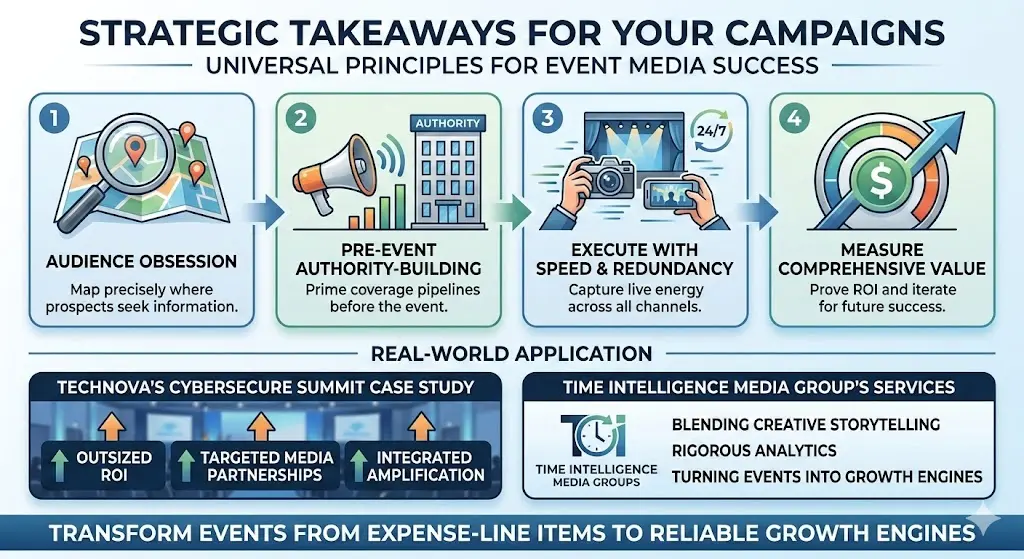
This case study reveals universal principles for event media success. Start with audience obsession: map precisely where prospects seek information. Invest in pre-event authority-building to prime coverage pipelines. Execute with speed and redundancy to capture live energy. Finally, measure comprehensively to prove value and iterate.
Time Intelligence Media Group’s Events Media Coverage Services embody these principles, blending creative storytelling with rigorous analytics. Brands adopting similar approaches see events evolve from expense-line items to reliable growth engines.
This case study of a successful event media campaign illustrates how strategic visibility, precise execution, and rigorous measurement create transformative business results. TechNova’s CyberSecure Summit generated outsized ROI through targeted media partnerships and integrated amplification. Time Intelligence Media Group delivers comparable outcomes via professional Events Media Coverage Services, helping brands turn events into proven revenue drivers with repeatable frameworks.