Measuring ROI of event media coverage has become essential as brands invest more in live experiences, hybrid events, and digital campaigns. Events are no longer just line items in the marketing budget; they are strategic branding assets that must show measurable impact. When companies understand how media exposure from events translates into awareness, leads, and revenue, they can allocate budgets with confidence and scale what works.
Time Intelligence Media Group helps brands turn one-time events into measurable growth engines by combining strategic storytelling with performance analytics. Their Events Media Coverage Services do not stop at securing press; they include frameworks to track results across channels, from PR pickups and social mentions to website conversions and sales impact.
Why Measuring Event Media ROI Matters
Many brands still treat event coverage as a vanity metric: “We got mentioned on TV” or “The event trended on social media.” Without clear ROI measurement, those wins are hard to defend in board meetings or annual reviews. Measuring ROI of event media coverage allows marketing teams to justify spend, compare campaigns, and refine strategies over time.
In practical terms, ROI measurement answers concrete questions: Which events generated the most qualified leads? Which publications drove actual demo requests? Which type of content—video highlights, interviews, or photo galleries—produced the highest engagement? When brands track these outcomes, events shift from cost centers to predictable growth channels.
This becomes especially critical at the mid-funnel (MOFU) stage, where audiences have already discovered the brand—often through topics like The Importance of Event Visibility in Branding—and now need proof of effectiveness. ROI measurement provides that proof, grounding creative ideas in performance data.
Defining ROI for Event Media Coverage
Before measuring ROI, brands must define what “return” means for them. For some, success is pure revenue; for others, it is market share, sentiment lift, or category leadership. Clarity at this stage is vital, because unfocused goals lead to scattered metrics that tell no coherent story.
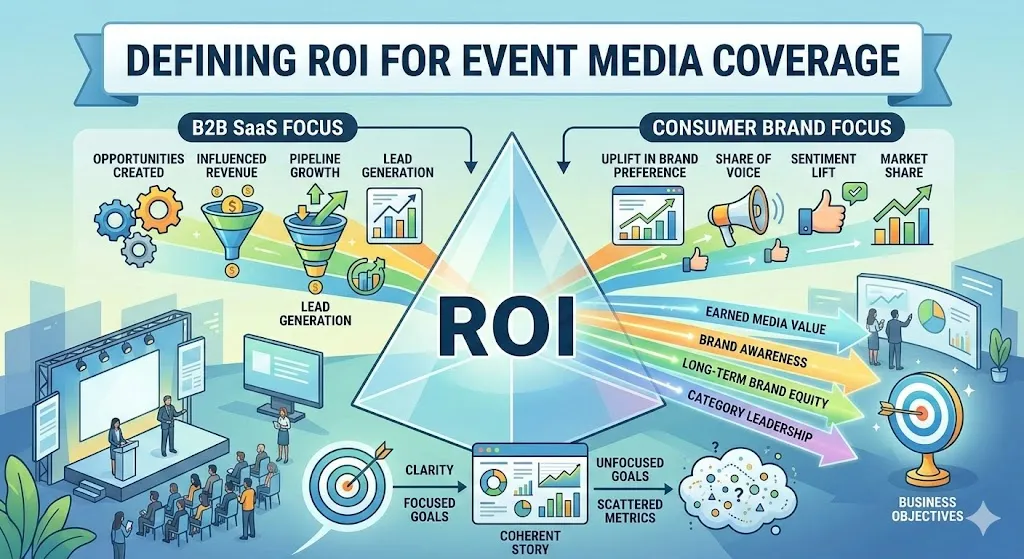
In practice, ROI for event media coverage often combines several elements: earned media value, brand awareness metrics, lead generation, pipeline influence, and long-term brand equity. A B2B SaaS company might focus on opportunities created and influenced revenue, while a consumer brand may track uplift in brand preference and share of voice against competitors. The key is aligning ROI definitions with overall business objectives, not just marketing vanity metrics.
Key Metrics to Track for Event Media ROI
Tracking the right metrics is at the heart of measuring ROI of event media coverage. Focusing on a few core indicators yields clearer insights than chasing dozens of loosely related numbers. At minimum, brands should track media reach, engagement, and conversion outcomes linked to media touchpoints.
On the visibility side, useful metrics include number of media mentions, estimated audience reach, share of voice versus competitors, and sentiment analysis of coverage. On the digital side, website sessions from event-related content, time on page, click-through rates, and social engagement levels help show how deeply audiences interact with the event narrative. These numbers form the bridge between awareness and consideration.
Building an ROI Framework Before the Event
Measuring ROI of event media coverage starts long before cameras roll or press releases go out. The highest-performing brands design their measurement framework at the planning stage, not after the event. This ensures that every activity—from media outreach to content creation—is tied to specific KPIs and tracking mechanisms.
A strong framework usually includes three components: clear objectives, defined metrics, and agreed attribution rules. For example, if the objective is to generate qualified leads, the team must agree on what qualifies as a lead, which forms or actions count, and how to attribute those leads to media coverage versus other channels. Without these agreements, reporting quickly becomes inconsistent and contested.
Time Intelligence Media Group often collaborates with clients’ marketing and sales teams to co-create these frameworks. By aligning event media goals with CRM fields, marketing automation workflows, and sales dashboards, they ensure that every mention, article, or interview can be traced through the funnel. This pre-work dramatically improves the accuracy and credibility of ROI reporting.
Data Sources Used in ROI Measurement
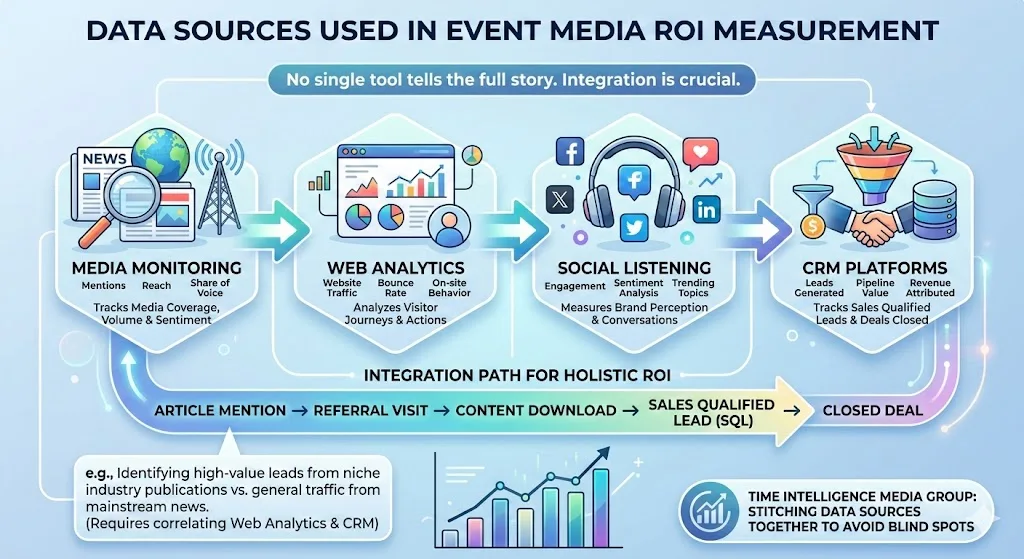
Reliable ROI requires reliable data. Measuring ROI of event media coverage typically draws from several complementary data sources, each covering a piece of the journey. No single tool tells the full story, so integration is crucial.
Common sources include media monitoring platforms for mentions and reach, web analytics tools for traffic and behavior, social listening systems for engagement and sentiment, and CRM platforms for leads and revenue. When these systems are connected, it becomes possible to trace a path such as: article mention → referral visit → content download → sales qualified lead → closed deal.
For example, a brand might discover that articles in one industry publication consistently produce high-value leads, while general news coverage drives traffic but almost no conversions. That insight only emerges when web analytics and CRM data are analyzed side by side. Time Intelligence Media Group’s Events Media Coverage Services place special emphasis on stitching these data sources together to avoid blind spots.
Calculating ROI: From Cost to Value
Once data is collected, brands must translate it into ROI figures that decision-makers understand. The classic ROI calculation compares net gains to total costs, including event production, media outreach, content creation, and analytics tools. While exact formulas vary by organization, the principle is the same: quantify value and compare it against investment.
For instance, imagine an event campaign costing a total of $80,000, including PR and media coverage. Post-event analysis shows that media-driven leads produced $320,000 in closed revenue over six months. Even before accounting for intangible benefits like brand lift, the financial ROI is clear and compelling. Such numbers make it easier to secure budget for future events.
In addition to direct revenue, brands often calculate earned media value (EMV)—an estimate of what equivalent exposure would have cost in paid advertising. While EMV is not a perfect metric, it offers a useful benchmark. When EMV significantly exceeds media spend, it supports the case that event coverage is delivering outsized returns relative to traditional ad buys.
Attribution Models for Event Media Impact
Attribution is one of the most challenging aspects of measuring ROI of event media coverage. Customers rarely follow a single, linear path; they encounter a mix of touchpoints such as articles, social posts, email campaigns, and retargeting ads before making a decision. Choosing the right attribution model helps teams avoid both over- and under-crediting event media.
Simple models like first-touch or last-touch attribution can provide a starting point. First-touch highlights the role of media exposure in creating awareness, while last-touch shows whether event-related content nudged prospects over the line. However, multi-touch models often give a more realistic picture by spreading credit across various interactions along the buyer journey.
Time Intelligence Media Group frequently advises clients to test different models and compare outcomes. For example, a multi-touch model might reveal that event coverage is particularly influential in the middle of the funnel, supporting other content rather than acting as the final conversion trigger. This insight helps reposition events not as isolated campaigns, but as integrated components of the overall marketing ecosystem.
Practical Example: From Visibility to Revenue
To illustrate how all of this works in practice, consider a mid-sized B2B brand hosting a thought-leadership summit. The goal is to connect with decision-makers, secure qualified leads, and position the company as an industry authority. Before the event, the team sets clear KPIs around coverage volume, website engagement, and pipeline generated.
During the campaign, targeted media outreach secures interviews in three industry publications, a podcast appearance, and a video segment on a niche business channel. Each asset links to a dedicated summit landing page with unique tracking parameters. Over the next 90 days, analytics show that these placements generated 1,200 visits, 160 content downloads, 45 sales qualified leads, and 12 closed deals.
Measuring ROI of event media coverage also benefits from a connected content strategy across the funnel. Top-of-funnel pieces like The Importance of Event Visibility in Branding introduce concepts and attract broad audiences. Mid-funnel content (like this article) educates prospects on frameworks, metrics, and decision criteria. Bottom-of-funnel assets, such as a detailed Case Study: Successful Event Media Campaign, provide proof that strategies work in real-world scenarios.