

Local reporting has always been the backbone of informed communities, shaping public opinion, civic engagement, and accountability at the grassroots level. However, as we move toward 2030, the structure, delivery, and sustainability of community newsrooms are undergoing a profound transformation.
The rise of artificial intelligence, data-driven storytelling, audience fragmentation, and platform-based distribution has changed how local journalism is produced and consumed. Traditional newsroom models are evolving into hybrid ecosystems where journalism, analytics, partnerships, and strategic media services intersect.
In this evolving environment, organizations like Time Intelligence Media Group are playing a crucial role in supporting modern newsroom ecosystems through services such as Audience Insights Services, Research & Reports Services, and Media Partnerships Solutions. These services are increasingly shaping how local newsrooms understand their audiences, build sustainable models, and expand their regional influence.
The New Identity of Community Newsrooms in 2030
By 2030, community newsrooms will no longer function as purely editorial institutions. Instead, they will operate as multi-dimensional media intelligence hubs. Their responsibilities will extend beyond reporting to include audience analysis, strategic distribution, and collaborative media ecosystems.
Hyperlocal content will become more personalized, and news delivery will be tailored based on behavioral data, geographic relevance, and engagement patterns. The newsroom will evolve into a data-informed storytelling unit where editorial decisions are guided by audience behavior and predictive analytics.
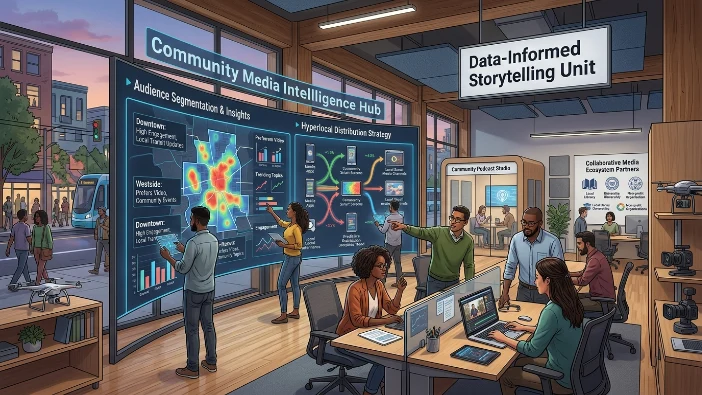
In this new environment, Audience Insights Services become essential. Newsrooms will rely on deep audience segmentation to understand what local readers want, when they consume content, and how they interact with news formats across platforms.
The Rise of Data-Driven Journalism and Audience Intelligence
One of the most significant trends shaping local reporting in 2030 is the dominance of data-driven journalism. Instead of relying solely on intuition or traditional editorial judgment, newsrooms will increasingly depend on structured audience intelligence systems.
With Audience Insights Services, media organizations can analyze behavioral patterns such as reading time, click-through behavior, topic preferences, and content engagement depth. This allows editors to refine their content strategy and prioritize stories that have both informational and engagement value.
Audience intelligence will also enable predictive journalism. Newsrooms will be able to anticipate which community issues are likely to gain traction, allowing proactive reporting instead of reactive coverage.
For example, if data indicates rising public concern around housing affordability in a specific region, editorial teams can allocate resources in advance to investigative reporting on that issue. This shift ensures journalism becomes more relevant, timely, and impactful.
Research-Led Journalism as the Foundation of Trust
In the era of misinformation and content overload, credibility becomes the most valuable currency for news organizations. By 2030, audiences will increasingly demand verified, data-backed, and research-driven reporting.
This is where Research & Reports Services will redefine the backbone of local journalism. Newsrooms will integrate structured research frameworks into their editorial workflows, ensuring that every major story is supported by data, field analysis, and verified sources.
Research-led journalism will also enable deeper storytelling. Instead of surface-level reporting, community newsrooms will produce analytical reports that explain not just what is happening, but why it is happening and what it means for the local population.
For instance, economic reporting will evolve from simple updates to comprehensive regional impact analyses, combining government data, market trends, and community feedback. This approach will strengthen public trust and position local newsrooms as authoritative knowledge centers.
Collaboration Over Competition: The Media Partnership Revolution
Another defining trend for 2030 is the shift from competition-based journalism to collaboration-driven media ecosystems. Local newsrooms will increasingly collaborate with regional publishers, digital platforms, academic institutions, and civic organizations to expand their reach and resources.
Through Media Partnerships Solutions, organizations like Time Intelligence Media Group will enable structured collaboration frameworks that allow newsrooms to share content, data, and distribution channels without compromising editorial independence.
This partnership-driven model will help smaller community newsrooms survive in an increasingly competitive media landscape. Instead of operating in isolation, they will become part of interconnected media networks that strengthen content distribution and audience engagement.
Collaborative journalism will also improve reporting quality. Shared investigative projects, cross-border local reporting, and pooled research resources will allow community newsrooms to cover complex issues more effectively than ever before.
Hyper-Personalization and the Future of News Consumption
By 2030, news consumption will be deeply personalized. Artificial intelligence and machine learning systems will curate content feeds based on individual preferences, location history, reading behavior, and engagement patterns.
However, personalization brings both opportunity and challenge. While audiences will receive more relevant content, there is also a risk of information silos and reduced exposure to diverse perspectives.
This is where Audience Insights Services will play a balancing role. By analyzing audience diversity and engagement patterns, newsrooms can ensure that personalization does not compromise editorial diversity. They will be able to design content strategies that maintain a healthy mix of personalized and universally relevant reporting.
In this environment, local journalism will become more dynamic. Readers will not just consume news; they will experience a curated information ecosystem tailored to their civic and social context.
The Economic Model of Local Newsrooms in 2030
Sustainability remains one of the biggest challenges for community journalism. By 2030, traditional advertising revenue alone will no longer be sufficient to sustain newsroom operations.
Instead, hybrid revenue models will dominate. These will include a combination of subscription systems, branded content partnerships, data services, and institutional collaborations.
Research & Reports Services will also emerge as a major revenue stream. Newsrooms will monetize their analytical capabilities by producing industry reports, regional studies, and policy insights for organizations, governments, and businesses.
At the same time, Media Partnerships Solutions will enable revenue-sharing models where content distribution across multiple platforms generates collective income for participating publishers.
This diversified economic structure will reduce financial pressure on local newsrooms and create more stable operational ecosystems.
The Role of Technology in Redefining Local Journalism
Technology will continue to reshape every aspect of journalism by 2030. Artificial intelligence will assist in content generation, data analysis, transcription, and even preliminary reporting drafts.
However, the human role will remain essential in investigative storytelling, ethical judgment, and contextual interpretation.
Newsrooms will increasingly integrate AI-powered tools with human editorial oversight to ensure accuracy and authenticity. In this hybrid model, technology will enhance efficiency while journalists maintain narrative control.
Services like Audience Insights Services will rely heavily on machine learning systems to interpret large-scale audience data. Similarly, Research & Reports Services will use automated data aggregation tools to compile and structure complex datasets for reporting.
Ethical Journalism and the Trust Deficit Challenge
As digital media expands, trust becomes one of the most critical challenges for community journalism. Audiences are becoming more skeptical of information sources, especially in an era of deepfakes and algorithm-driven content feeds.
By 2030, ethical journalism will not just be a principle but a strategic necessity. Newsrooms will need to implement transparent sourcing, verified data practices, and clear editorial accountability frameworks.
Research & Reports Services will contribute significantly to this transparency by ensuring that all published insights are grounded in verifiable data and structured methodologies.
Additionally, media partnerships will require ethical alignment between collaborating organizations to maintain consistency in reporting standards.
The Evolution of Community Engagement
Community newsrooms will no longer be passive content providers. Instead, they will become active participants in civic engagement. Audience interaction will move beyond comment sections into structured feedback systems, participatory journalism, and community-driven reporting initiatives.
With the support of Audience Insights Services, newsrooms will be able to identify key community concerns and integrate them directly into editorial planning.
This participatory model will strengthen the relationship between journalists and audiences, making newsrooms more responsive and socially embedded.
Future Skills for Journalists in 2030

The role of journalists will evolve significantly by 2030. In addition to traditional reporting skills, journalists will need to develop competencies in data analysis, digital tools, audience psychology, and multimedia storytelling.
Understanding audience behavior through Audience Insights Services will become a core editorial skill. Similarly, working with structured datasets in Research & Reports Services will be essential for investigative reporting.
Collaboration skills will also become increasingly important as journalists engage in cross-platform partnerships through Media Partnerships Solutions.
A New Era for Local Reporting
The future of local reporting in 2030 is not a decline of journalism but a transformation into a more intelligent, interconnected, and audience-driven ecosystem. Community newsrooms will evolve from traditional reporting units into dynamic media intelligence platforms that combine storytelling, analytics, research, and collaboration.
Organizations like Time Intelligence Media Group, through services such as Audience Insights Services, Research & Reports Services, and Media Partnerships Solutions, will play a key role in enabling this transformation.
As journalism continues to adapt to technological, economic, and social changes, one thing remains constant: the need for accurate, trusted, and meaningful local reporting that empowers communities and strengthens democracy.



