

Mobile-first indexing has reshaped how digital content is discovered, ranked, and consumed across search engines, especially in the evolving landscape of local journalism. In 2026, the dominance of mobile devices is no longer a trend but a structural reality. Readers increasingly rely on smartphones for breaking news, community updates, and regional reporting, which means search engines now prioritize mobile-optimized versions of news websites for indexing and ranking.
Local news organizations face both opportunity and pressure in this environment. The opportunity lies in increased visibility among mobile audiences who consume hyperlocal content on the go. The pressure arises from the necessity to optimize speed, usability, and content structure for mobile-first crawling systems.
Within this transformation, modern media service providers such as Time Intelligence Media Group play a critical role in helping publishers adapt through strategic solutions like Audience Insights Services, Research & Reports Services, and Sponsored Content Services, which directly align with mobile-first indexing requirements and local news performance optimization.
Understanding Mobile-First Indexing in the Context of Local News Platforms
Mobile-first indexing means search engines primarily use the mobile version of a website for indexing and ranking. For local news publishers, this has significant implications for visibility, engagement, and monetization.
Local news websites often carry time-sensitive content such as political updates, community events, weather alerts, and local business developments. When these platforms are not optimized for mobile-first indexing, they risk lower search rankings and reduced readership despite producing high-quality journalism.
The shift has forced publishers to rethink everything from content layout to loading speed and multimedia integration. In this environment, insights-driven strategies become essential, particularly those offered through Audience Insights Services, which help publishers understand how mobile readers interact with news content differently compared to desktop users.
The Transformation of Local News Consumption Behavior in the Mobile Era
Mobile consumption has changed not only how users access news but also what they expect from it. Readers demand instant loading, concise storytelling, and visually optimized formats. Long-form articles still perform well, but only when structured for mobile readability and supported with engaging digital elements.
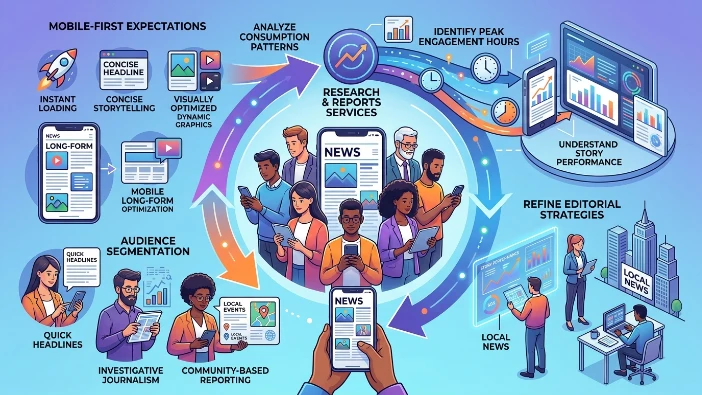
Local news audiences are also increasingly segmented. Some users prefer quick headlines, while others engage deeply with investigative journalism or community-based reporting. This behavioral shift makes data-driven decision-making essential.
Through Research & Reports Services, media organizations can analyze consumption patterns, identify peak engagement hours, and understand which types of local stories perform best in mobile-first indexing environments. These insights help publishers refine editorial strategies to match real-world user behavior.
Mobile-First Indexing and Its Direct Impact on Local News Visibility
Search visibility is the most immediate area affected by mobile-first indexing. Local news websites that fail to optimize mobile experiences often experience reduced indexing efficiency, which leads to lower search rankings.
Google and other search engines prioritize mobile-friendly content that loads quickly, adapts to screen sizes, and maintains consistent content parity between desktop and mobile versions. Any mismatch can result in ranking penalties or reduced crawl efficiency.
In this competitive ecosystem, Sponsored Content Services become increasingly valuable. When properly optimized for mobile-first indexing, sponsored articles can seamlessly integrate into editorial ecosystems, improving visibility without compromising user experience. This also allows local publishers to monetize effectively while maintaining compliance with search engine expectations.
Role of Audience Intelligence in Enhancing Mobile-First Local News Strategy
Understanding audience behavior is central to succeeding in a mobile-first environment. Local news publishers must identify what users read, how long they engage, and what types of content lead to repeat visits.
Audience Insights Services enable publishers to decode these behavioral patterns in detail. For instance, mobile readers often prefer shorter paragraphs, clear headings, and fast-loading multimedia content. By analyzing engagement metrics, publishers can adjust their storytelling formats to better suit mobile consumption habits.
This data-driven approach ensures that local news platforms not only comply with mobile-first indexing but also actively benefit from it by increasing dwell time, reducing bounce rates, and improving overall search rankings.
The Strategic Role of Research and Reporting in Mobile-First Optimization
In-depth analysis is essential for understanding the long-term implications of mobile-first indexing on local journalism. Market trends, algorithm updates, and user behavior shifts all contribute to the evolving digital landscape.
Through Research & Reports Services, media organizations gain access to structured insights that go beyond surface-level analytics. These reports often reveal how different local news categories perform under mobile-first indexing conditions, such as politics, sports, community events, and business updates.
Such intelligence allows editorial teams to prioritize content types that perform best on mobile platforms, ensuring sustainable growth in both traffic and engagement.
Media Partnerships and Content Distribution in a Mobile-First World
Although not directly included as a primary service focus in this analysis, media partnerships often play a supporting role in strengthening distribution channels for mobile-first content. Collaborations between local news publishers, digital platforms, and content aggregators ensure wider reach and improved indexing performance.
When combined with insights from Audience Insights Services and analytical depth from Research & Reports Services, these partnerships become more strategic, ensuring that content is not only distributed widely but also optimized for mobile discovery and engagement.
Sponsored Content and Monetization Under Mobile-First Indexing
Monetization remains a critical challenge for local news organizations. Mobile-first indexing has introduced both challenges and opportunities in this domain. On one hand, ad-heavy layouts can negatively impact page speed and ranking. On the other hand, well-structured sponsored content can significantly enhance revenue streams.
Sponsored Content Services help publishers design content that aligns with mobile-first SEO requirements while maintaining reader trust and engagement. These services ensure that branded content is optimized for readability, speed, and search engine compliance, making it an effective monetization strategy in the mobile era.
When executed correctly, sponsored content does not disrupt user experience but instead integrates seamlessly into editorial ecosystems, enhancing both visibility and revenue potential.
Technical SEO Challenges for Local News in Mobile-First Indexing
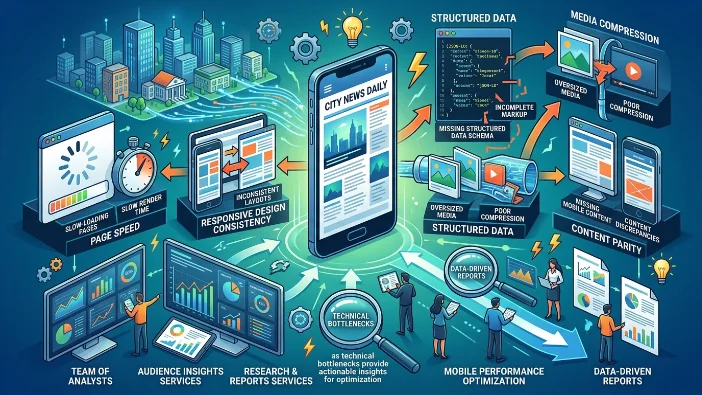
Local news websites face several technical challenges when adapting to mobile-first indexing. These include page speed optimization, responsive design consistency, structured data implementation, and media compression.
Slow-loading pages can significantly reduce indexing efficiency, while inconsistent mobile layouts can lead to ranking drops. Additionally, local news platforms often struggle with maintaining content parity between desktop and mobile versions, which is critical for indexing accuracy.
To address these challenges, data-backed strategies supported by Audience Insights Services and Research & Reports Services are essential. These services help identify technical bottlenecks and provide actionable insights for improving mobile performance.
Case Study Insights: Mobile-First Indexing Outcomes in Local News Ecosystems
In practical applications, local news organizations that have successfully adopted mobile-first indexing strategies demonstrate significant improvements in search visibility and user engagement.
Websites optimized for mobile responsiveness experience higher click-through rates, increased session durations, and improved audience retention. The integration of Sponsored Content Services also allows for monetization without sacrificing user experience.
Meanwhile, platforms leveraging Audience Insights Services report more accurate content targeting, ensuring that articles reach the right demographic segments at the right time. Combined with Research & Reports Services, these insights create a feedback loop that continuously improves editorial performance.
Future Outlook of Mobile-First Indexing for Local News in 2026 and Beyond
As mobile usage continues to dominate digital consumption, mobile-first indexing will become even more sophisticated. Future algorithms are expected to prioritize not just mobile compatibility but also user intent, engagement quality, and content relevance at a hyperlocal level.
Local news organizations that invest in data-driven strategies, audience intelligence, and optimized content distribution will be better positioned for long-term success.
Companies like Time Intelligence Media Group will continue to play a pivotal role in enabling this transformation by offering integrated media solutions that align editorial goals with digital performance metrics.
Mobile-first indexing has fundamentally transformed the landscape of local news publishing. It has shifted the focus from traditional desktop-first content strategies to mobile-optimized, user-centric digital ecosystems.
Through the strategic use of Audience Insights Services, Research & Reports Services, and Sponsored Content Services, local news publishers can not only adapt to these changes but also thrive in an increasingly competitive digital environment.
The future of local journalism depends on its ability to integrate technology, data, and content strategy into a unified mobile-first approach that prioritizes user experience, search visibility, and sustainable monetization.



