
Humanitarian organisations collect large volumes of operational data through aid programmes, field reports, beneficiary assessments, logistics systems, and monitoring activities. This information documents real-world outcomes, emerging crises, funding requirements, and measurable impact. Journalists value verified humanitarian data because it provides evidence, context, and accountability.
Transforming internal humanitarian data into a newsworthy press release requires a structured process. Raw information does not automatically become a media story. Every statistic, case update, and operational milestone needs verification, context, and a clear public interest angle before publication.
What makes internal humanitarian data suitable for a press release?
Internal humanitarian data becomes suitable for a press release when it contains verified facts, measurable outcomes, current relevance, identifiable public interest, and evidence that supports a clear news story. Journalists prioritise information that demonstrates impact, accountability, and timely developments affecting communities.
Humanitarian data refers to operational information collected by charities, non-governmental organisations (NGOs), international agencies, and relief programmes. Examples include beneficiary numbers, emergency response statistics, healthcare delivery records, food distribution totals, and infrastructure recovery figures.
Not every dataset deserves media attention. Journalists evaluate whether information contributes to public understanding of an issue.
Essential characteristics of publishable humanitarian data
A press-ready dataset includes:
- Verified numerical evidence
- Current operational updates
- Geographic relevance
- Human impact supported by facts
- Transparent methodology
- Clear organisational accountability
For example, reporting that 12,450 households received emergency shelter within 21 days after severe flooding across three counties provides measurable impact. Reporting that many families received assistance lacks precision.
Reliable data strengthens credibility because every figure can be verified independently.
How do journalists evaluate humanitarian press releases?
Journalists evaluate humanitarian press releases by assessing accuracy, relevance, public significance, evidence quality, source credibility, and editorial value. Information supported by verified statistics and transparent reporting receives greater consideration than promotional organisational updates or unsupported claims.
Newsrooms receive hundreds of press releases every week.
Editors filter submissions using clear editorial criteria.
News value
Editors look for developments such as:
- New humanitarian emergencies
- Significant funding milestones
- Major programme results
- National policy implications
- Research findings
- Public health concerns
A report showing that emergency food demand increased by 37% over twelve months creates stronger news value than announcing routine operational activity.
Evidence quality
Statistics require context.
Instead of writing:
“Over 8,000 people received assistance.”
Provide:
“During January and February 2026, emergency teams delivered food parcels to 8,247 displaced residents across six local authorities.”
Specific evidence improves editorial confidence.
Independent relevance
Journalists ask one question first:
Why does this matter to the public today?
The answer defines whether a story proceeds.
Readers seeking foundational knowledge about media credibility and public trust can explore:
How high-authority media backlinks validate grassroots credibility for struggling public sector initiatives before developing media-ready communications.
What steps turn operational data into a media-ready story?
Operational data becomes a media-ready story through systematic verification, trend identification, audience relevance, editorial framing, evidence organisation, expert review, and structured press release writing. Every stage converts technical reporting into accessible public information without reducing factual accuracy.
A structured workflow improves consistency and reduces editorial revisions.
Step 1: Collect verified datasets
Gather information from trusted internal systems.
Examples include:
- Monitoring reports
- Programme evaluations
- Financial summaries
- Logistics dashboards
- Medical reporting
- Survey results
Only finalised data enters media preparation.
Step 2: Identify the strongest finding
Every press release focuses on one primary story.
Examples include:
- Emergency response speed improved by 28%.
- Clean water access expanded to 54 communities.
- Vaccination coverage reached 97% across target districts.
Supporting statistics strengthen the main finding rather than compete with it.
Step 3: Add public context
Readers require explanation.
If malnutrition declined by 18%, explain:
- previous conditions
- intervention period
- population affected
- measurable outcome
Context transforms numbers into meaningful information.
Step 4: Verify every statistic
Cross-check:
- dates
- locations
- percentages
- totals
- quotations
- references
Editorial accuracy protects organisational credibility.
Step 5: Build a logical narrative
Effective humanitarian press releases usually follow this sequence:
- Headline
- Lead paragraph
- Key statistic
- Supporting evidence
- Operational explanation
- Leadership quotation
- Background information
- Media contact
This structure matches newsroom expectations.
Which components strengthen a humanitarian press release?
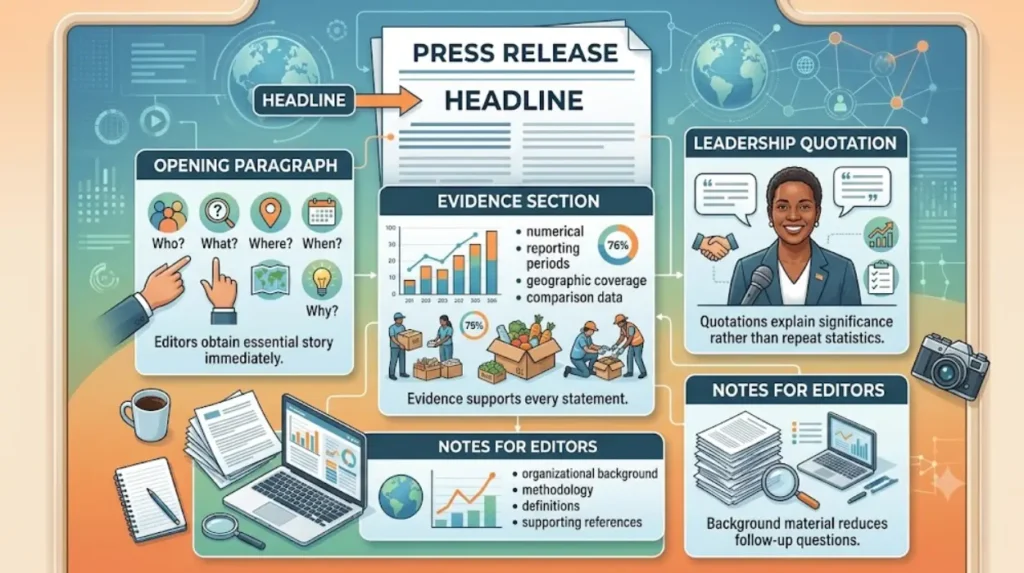
Strong humanitarian press releases combine factual headlines, evidence-led introductions, verified statistics, relevant quotations, operational context, transparent methodology, and accurate contact information. Each component helps journalists understand the significance of the announcement without requesting additional clarification.
Each section performs a specific editorial function.
Headline
The headline presents the primary development.
Example:
“Emergency Health Programme Reaches 50,000 Children Across Northern England.”
It states the achievement without exaggeration.
Opening paragraph
The first paragraph answers:
- Who?
- What?
- Where?
- When?
- Why?
Editors obtain the essential story immediately.
Evidence section
Include:
- numerical outcomes
- reporting periods
- geographic coverage
- comparison data
Evidence supports every statement.
Leadership quotation
Quotations explain significance rather than repeat statistics.
Instead of repeating numbers, leaders describe operational priorities, partnerships, or future programme direction.
Notes for editors
Provide:
- organisational background
- methodology
- definitions
- supporting references
Background material reduces follow-up questions.
How does data presentation improve journalist engagement?
Clear data presentation improves journalist engagement because organised information reduces interpretation time, strengthens factual confidence, supports faster editorial decisions, and simplifies independent verification. Structured evidence increases newsroom efficiency while preserving reporting accuracy and transparency throughout publication workflows.
Presentation influences readability.
Large statistical tables rarely belong inside the main body.
Instead, summarise the most important figures.
Present percentages with totals
Instead of writing:
“Coverage increased by 18%.”
Write:
“Coverage increased from 24,100 beneficiaries in 2025 to 28,438 beneficiaries in 2026, representing an 18% increase.”
Absolute numbers improve understanding.
Use meaningful comparisons
Compare identical reporting periods.
Examples include:
- Year-on-year
- Quarter-on-quarter
- Before and after intervention
- Regional comparisons
Consistent comparisons improve accuracy.
Explain specialist terminology
Humanitarian reporting often includes technical language.
Define terms such as:
- food security
- internally displaced persons
- WASH services
- protection monitoring
Clear definitions improve accessibility.
Organisations reviewing communication strategies often compare structured media development processes through:
ROI Case Study as an internal reference.
What common mistakes reduce media coverage?
Media coverage declines when press releases contain unsupported claims, excessive organisational promotion, inconsistent statistics, weak headlines, missing context, inaccurate quotations, or unclear public relevance. Editorial quality depends on precision, transparency, and evidence rather than promotional language or internal achievements alone.
Avoidable mistakes reduce publication opportunities.
Unsupported impact claims
Statements such as:
“We transformed thousands of lives.”
lack measurable evidence.
Replace them with verified outcomes.
Too many statistics
Ten separate datasets compete for attention.
Select one primary statistic supported by three or four complementary findings.
Promotional language
Journalists report facts.
Expressions including:
- industry-leading
- world-class
- revolutionary
reduce editorial neutrality.
Missing sources
Every statistic requires an identifiable origin.
Examples include:
- programme monitoring system
- annual impact report
- field assessment
- independent evaluation
Source transparency supports credibility.
Why does a structured press release improve long-term communication outcomes?

Structured humanitarian press releases improve long-term communication by increasing consistency, supporting journalist relationships, strengthening organisational credibility, simplifying future reporting, and creating reusable evidence for stakeholders, policymakers, partners, and funding organisations evaluating measurable humanitarian performance over time.
A consistent communication framework creates cumulative value.
Every accurate press release contributes to a documented record of operational performance.
Over time, organisations establish stronger evidence libraries for:
- annual reports
- funding applications
- policy engagement
- stakeholder communications
- media relationships
Structured reporting also improves internal collaboration between programme teams, communications specialists, monitoring officers, and leadership.
Explore More Expert Insights:
The Director’s Guide to Crafting Press Releases that Turn Local Awareness into National Advocacy
Integrating Strategic Press Distribution into Your National Hospitality Rollout Checklist
Internal humanitarian data represents evidence of real-world operations, but evidence alone does not create media coverage. Journalists require verified facts, public relevance, structured storytelling, and transparent reporting before considering publication.
A step-by-step process transforms operational information into an effective press release. Verified datasets, focused narratives, contextual statistics, accurate quotations, and logical structure improve editorial usability. Organisations that standardise this process produce communications that are easier to verify, easier to understand, and more valuable for journalists covering humanitarian issues.