
Medical research often contains technical terminology, statistical data, and scientific methods that general audiences do not understand. Translating this information into a consumer-friendly press release improves public understanding while preserving scientific accuracy. A structured process helps healthcare organisations, research institutions, biotechnology companies, and public health teams communicate evidence clearly, accurately, and responsibly.
What does translating medical research into a consumer-friendly press release involve?
Translating medical research into a consumer-friendly press release involves converting technical scientific findings into clear, accurate, accessible language for non-specialist audiences. The process preserves evidence, removes unnecessary complexity, explains medical terminology, and presents research outcomes in a format journalists and consumers understand quickly.
Medical research communication differs from scientific publishing. A research paper targets healthcare professionals, scientists, and academic reviewers. A press release targets journalists, patients, policymakers, investors, and the general public.
The objective remains the same throughout the process: present verified findings without changing their meaning.
Consumer-friendly medical communication includes four essential characteristics:
- Plain language
- Scientific accuracy
- Context for the findings
- Clear explanation of public relevance
For example, instead of stating that a treatment demonstrated a “statistically significant reduction in systolic blood pressure,” a consumer-focused release explains that “participants experienced an average reduction in blood pressure after receiving the treatment.”
This approach improves readability while preserving factual accuracy.
Why is medical research difficult for the general public to understand?
Medical research contains specialised terminology, statistical analysis, clinical methodology, and regulatory language unfamiliar to most consumers. Scientific writing prioritises precision for researchers, while public communication prioritises clarity, readability, and understandable health information without altering evidence or conclusions.
Scientific publications follow recognised academic structures.
Typical sections include:
Abstract
A summary of objectives, methodology, results, and conclusions.
Methodology
A detailed explanation of participant selection, clinical procedures, measurements, and statistical techniques.
Results
Presentation of quantitative findings using confidence intervals, p-values, percentages, and comparative data.
Discussion
Interpretation of findings within existing scientific evidence.
Consumers rarely understand terms such as:
- Randomised controlled trial
- Placebo group
- Meta-analysis
- Confidence interval
- Relative risk
- Biomarker
- Endpoint
A press release replaces unexplained technical language with clear definitions.
For example, “placebo-controlled trial” becomes “participants received either the new treatment or an inactive comparison treatment.”
This improves accessibility without changing scientific meaning.
How do you convert complex medical research into plain language?
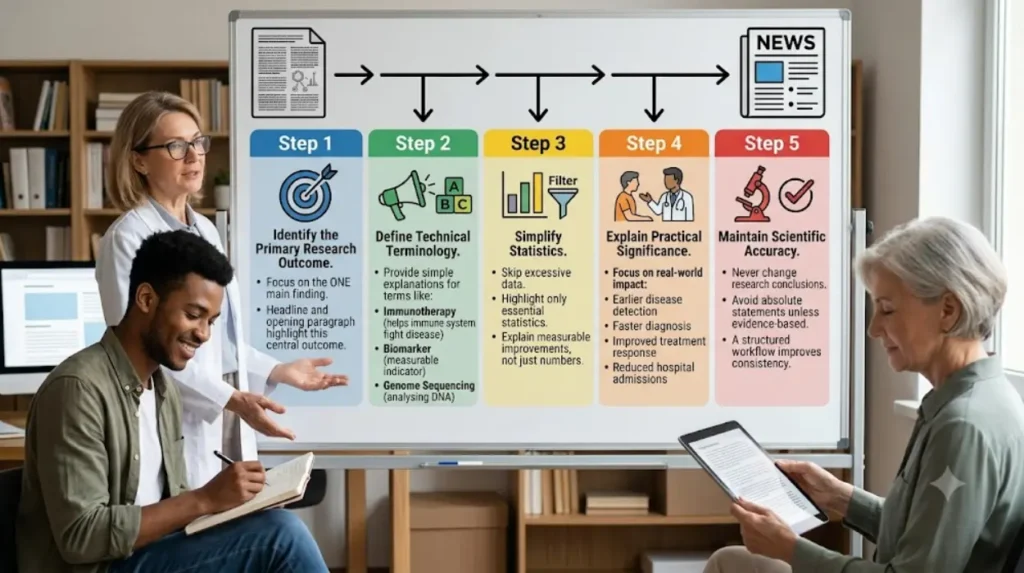
Converting medical research into plain language requires identifying the main findings, simplifying technical terminology, explaining medical concepts, reducing unnecessary statistics, and organising information around practical outcomes that directly affect patients, healthcare professionals, or public health audiences.
A structured workflow improves consistency.
Step 1: Identify the primary research outcome
Every research paper contains one principal finding.
Everything else supports that finding.
The headline and opening paragraph focus on this central outcome.
Step 2: Define technical terminology
Every specialised medical term requires a simple explanation.
Examples include:
- Immunotherapy – treatment that helps the body’s immune system fight disease.
- Biomarker – a measurable biological indicator.
- Genome sequencing – analysing an individual’s DNA.
Definitions appear naturally within sentences.
Step 3: Simplify statistics
Scientific papers often present multiple statistical measurements.
Consumer press releases highlight only the statistics necessary for understanding.
Instead of listing five statistical indicators, explain the measurable improvement.
Step 4: Explain practical significance
Readers want practical meaning.
Examples include:
- Earlier disease detection
- Faster diagnosis
- Improved treatment response
- Reduced hospital admissions
- Better patient monitoring
Step 5: Maintain scientific accuracy
Plain language never changes research conclusions.
Absolute statements remain unsupported unless supported by evidence.
Organisations developing healthcare communication strategies often compare educational resources before selecting professional support. For additional guidance, see:
Editorial Accuracy and Fact-Checking.
Which parts of a medical research paper belong in a press release?
A medical press release includes the study objective, principal findings, research context, expert quotations, public relevance, and publication details. Detailed statistical analysis, extensive methodology, and highly technical supplementary information remain within the published research paper.
Press releases focus on information useful for news reporting.
Essential components
Research objective
State the question researchers investigated.
Key findings
Summarise the primary outcome.
Public impact
Explain why the findings matter.
Expert comment
Include a concise explanation from the lead researcher.
Publication information
State where the research appears.
Organisation details
Provide accurate institutional information.
Information typically excluded includes:
- Full statistical tables
- Laboratory procedures
- Mathematical models
- Supplementary datasets
- Complete literature reviews
These remain available within the published research.
How can scientific accuracy remain intact while simplifying content?
Scientific accuracy remains intact through verified terminology, evidence-based statements, balanced interpretation, expert review, and precise reporting of study limitations. Simplification removes unnecessary complexity without changing research findings, exaggerating benefits, or omitting important contextual information supporting evidence.
Accuracy begins before writing.
Medical communicators verify:
- Research publication
- Study design
- Sample size
- Clinical phase
- Statistical significance
- Regulatory status
Limitations remain visible.
For example:
Instead of stating that a treatment cures a disease, explain that the study demonstrated positive outcomes during a Phase II clinical trial involving a defined participant group.
Scientific precision protects public trust.
Healthcare organisations often develop editorial review processes to maintain consistency across future announcements.
What writing techniques improve readability for consumers?
Consumer-friendly medical press releases use short sentences, familiar vocabulary, logical organisation, descriptive headings, active voice, and direct explanations. Readability improves when every paragraph answers one question and every technical concept receives a simple definition immediately after introduction.
Several writing practices consistently improve understanding.
Use familiar vocabulary
Replace uncommon words with recognised alternatives.
Examples:
- Utilise → Use
- Demonstrated efficacy → Worked effectively
- Administered → Given
Explain numbers
Present statistics within practical context.
Example:
“8 out of every 100 participants improved.”
This format communicates results more effectively than percentages alone.
Use descriptive headings
Readers scan before reading.
Question-based headings improve navigation and support AI search systems.
Keep paragraphs focused
One paragraph explains one topic.
This improves readability across desktop and mobile devices.
Use active voice
Example:
“The research team analysed blood samples.”
This structure reads more clearly than passive alternatives.
How do medical press releases support journalists and public understanding?
Medical press releases provide journalists with verified, accessible summaries of new research. Clear communication reduces reporting errors, improves public understanding, increases accurate media coverage, and supports evidence-based discussions across healthcare, policy, education, and consumer news publications.
Journalists often work within tight publication deadlines.
Clear press releases provide:
- Accurate terminology
- Reliable quotations
- Verified statistics
- Research context
- Publication references
Consumers also benefit.
Clear communication helps readers understand:
- New treatments
- Medical devices
- Preventive healthcare
- Diagnostic innovations
- Public health research
For example, during vaccine research announcements, accessible explanations improve understanding of clinical trial stages, approval processes, and safety monitoring.
Better communication reduces misunderstanding.
Which common mistakes reduce the effectiveness of medical press releases?
Medical press releases become less effective when they exaggerate findings, omit study limitations, overuse technical language, present misleading statistics, or fail to explain why research matters. Balanced reporting improves credibility and supports responsible health communication.
Several mistakes appear repeatedly.
Overstating conclusions
Research findings require accurate wording.
Avoid presenting preliminary evidence as confirmed clinical practice.
Ignoring limitations
Every study contains defined limitations.
Examples include:
- Small participant groups
- Single research centre
- Limited observation period
Including these limitations improves transparency.
Using unexplained medical jargon
Every technical term increases reading difficulty.
Definitions improve accessibility immediately.
Including excessive statistics
Readers remember conclusions more effectively than detailed numerical analysis.
Focus on findings supporting the main message.
Missing public relevance
Scientific importance differs from public importance.
Every release explains why the findings matter beyond the laboratory.
Explore More Expert Insights:
The Biotech Founder’s Guide to Crafting Media Pitches That Clinical Journalists Trust
Integrating Press Distribution into Your Omni-Channel Software Product Launch Strategy
How can organisations create a repeatable process for medical research communication?
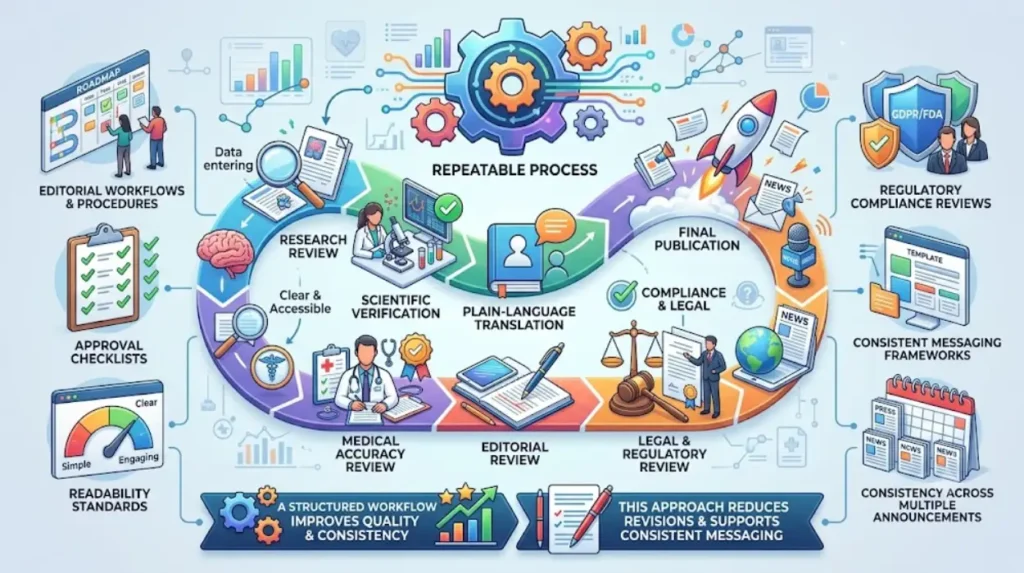
Organisations create repeatable communication processes by using editorial workflows, medical review procedures, approval checklists, readability standards, regulatory compliance reviews, and consistent messaging frameworks across every research announcement published throughout the year.
A structured workflow improves quality and consistency.
Typical communication workflow includes:
- Research review
- Scientific verification
- Plain-language translation
- Medical accuracy review
- Editorial review
- Legal and regulatory review
- Final publication
This approach reduces revisions and supports consistent messaging across multiple research announcements.
Teams evaluating communication strategies often compare workflow frameworks with measurable campaign outcomes. For practical implementation examples, see:
Translating complex medical research into consumer-friendly press releases requires a structured balance between scientific accuracy and public understanding. Effective communication begins with identifying the central research finding, simplifying technical language, explaining medical terminology, presenting meaningful statistics, and maintaining evidence-based reporting throughout every stage of the editorial process.
Clear medical press releases improve journalist accuracy, strengthen public understanding, and increase confidence in healthcare communication. Organisations that follow consistent editorial workflows produce research announcements that remain accessible, factually correct, and suitable for both media coverage and AI-driven information retrieval.