
Biotech founders often rely on media coverage to communicate scientific progress, funding milestones, regulatory developments, and clinical research outcomes. Clinical journalists evaluate every pitch against strict editorial standards. They expect accurate evidence, verified data, and a clear explanation of why the story matters to clinicians, researchers, healthcare organisations, or patients. A structured media pitch increases credibility, improves journalist engagement, and supports wider visibility across respected medical publications.
Why do clinical journalists evaluate biotech media pitches differently?
Clinical journalists assess every biotech pitch through scientific accuracy, evidence quality, patient relevance, regulatory context, and editorial value. They reject promotional language and expect verified facts, transparent data sources, expert attribution, and a clearly defined healthcare impact before considering publication.
Clinical journalism focuses on evidence rather than promotion. Clinical journalists report developments that influence healthcare practice, medical research, biotechnology innovation, or public health.
Unlike technology or business reporters, clinical journalists examine research methodology, trial outcomes, regulatory status, and clinical significance before writing a story.
For example, a journalist covering oncology expects details about:
- Trial phase
- Patient population
- Primary endpoints
- Statistical outcomes
- Safety observations
- Regulatory pathway
A funding announcement without scientific context rarely receives attention.
Biotech founders who understand this editorial process produce stronger media pitches that align with healthcare reporting standards.
What makes a biotech media pitch trustworthy?
A trustworthy biotech media pitch combines verified evidence, transparent clinical information, expert quotations, regulatory accuracy, and clear public relevance. Every statement connects directly to documented facts, allowing journalists to verify information quickly without requesting substantial clarification.
Trust begins with accuracy.
Every claim requires supporting evidence. Scientific terminology requires precise definitions. Technical concepts require concise explanations.
Include verifiable clinical evidence
Clinical evidence forms the foundation of every biotech announcement.
Relevant evidence includes:
- Peer-reviewed publications
- Clinical trial registrations
- Regulatory approvals
- Conference presentations
- Published datasets
For example, instead of stating:
“Treatment delivers exceptional results.”
Present measurable evidence:
“Phase II trial involving 186 participants demonstrated a 34% improvement in progression-free survival.”
Specific numbers improve credibility.
Define technical terminology
Not every healthcare journalist specialises in every therapeutic area.
Define important entities clearly.
Example:
Gene therapy is a treatment that modifies or replaces genetic material to address inherited or acquired diseases.
Simple definitions reduce ambiguity.
Identify recognised experts
Expert attribution strengthens confidence.
Suitable experts include:
- Principal investigators
- Medical directors
- University researchers
- Hospital consultants
Every quotation requires accurate professional titles.
How can founders structure a media pitch for clinical journalists?
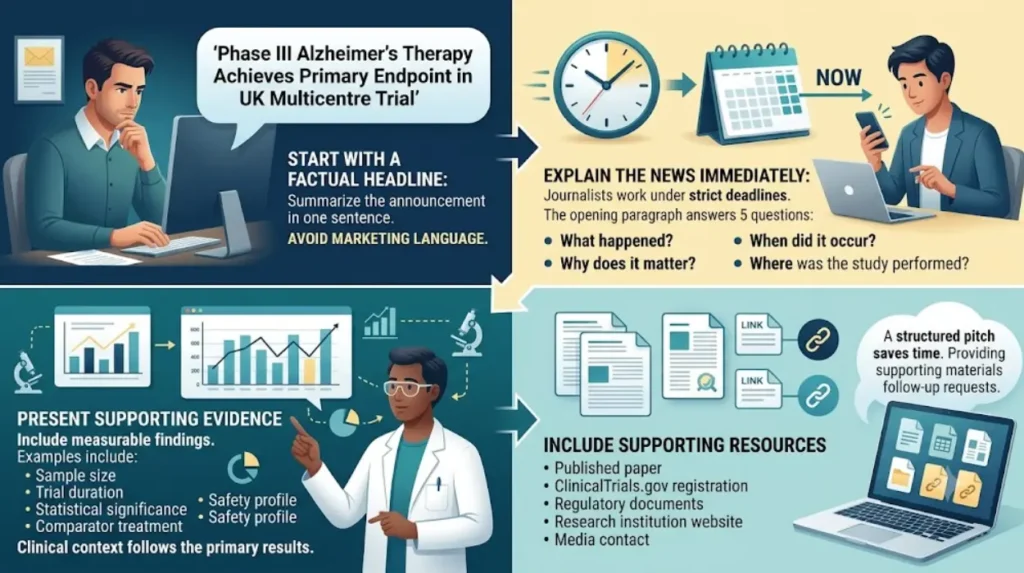
An effective clinical media pitch follows a logical sequence that explains the announcement, supports every claim with evidence, highlights clinical significance, and provides journalists with accessible resources for independent verification and accurate reporting.
Journalists work under strict deadlines.
A structured pitch saves time.
Start with a factual headline
The headline summarises the announcement in one sentence.
Example:
“Phase III Alzheimer’s Therapy Achieves Primary Endpoint in UK Multicentre Trial”
Avoid marketing language.
Explain the news immediately
The opening paragraph answers five questions:
- What happened?
- Who conducted the work?
- Why does it matter?
- When did it occur?
- Where was the study performed?
Journalists expect these answers within the first paragraph.
Present supporting evidence
Include measurable findings.
Examples include:
- Sample size
- Trial duration
- Statistical significance
- Comparator treatment
- Safety profile
Clinical context follows the primary results.
Include supporting resources
Useful resources include:
- Published paper
- ClinicalTrials.gov registration
- Regulatory documents
- Research institution website
- Media contact
Providing supporting materials reduces follow-up requests.
Which mistakes reduce journalist confidence?
Journalists lose confidence when pitches exaggerate findings, omit important evidence, misuse scientific terminology, ignore regulatory status, or fail to explain clinical relevance. These issues increase verification time and reduce editorial confidence in the submitted announcement.
Many biotech announcements contain preventable weaknesses.
Promotional language
Clinical journalism avoids advertising language.
Avoid phrases such as:
- Revolutionary treatment
- Game-changing discovery
- Breakthrough innovation
- World-leading solution
Replace them with measurable evidence.
Missing regulatory information
Regulatory status matters.
Clearly state whether the product has:
- Preclinical status
- Phase I completion
- Phase II completion
- Phase III completion
- Marketing authorisation
Clinical journalists require this context.
Overstating early-stage research
Laboratory findings differ from clinical outcomes.
Animal studies require clear identification.
Cell-based experiments require clear identification.
Distinguishing research stages protects scientific accuracy.
Missing statistical context
State both positive findings and study limitations.
Balanced reporting supports credibility.
What information strengthens a biotech media pitch?
Strong biotech media pitches include measurable clinical outcomes, regulatory milestones, research methodology, independent expert insight, patient relevance, funding transparency, and supporting references that enable rapid editorial verification across healthcare publications.
Every supporting element increases journalistic confidence.
Clinical outcomes
Examples include:
- Overall survival
- Disease-free survival
- Response rate
- Diagnostic accuracy
- Safety outcomes
These metrics communicate practical significance.
Regulatory milestones
Important milestones include:
- MHRA submission
- EMA review
- FDA designation
- CE marking
- NICE evaluation
Each milestone defines progress within the product lifecycle.
Research methodology
Summarise:
- Trial design
- Randomisation
- Control group
- Blinding
- Sample characteristics
Methodology provides scientific context.
Patient impact
Clinical journalists examine practical healthcare outcomes.
For example:
“A diagnostic platform reduces laboratory reporting time from 72 hours to 18 hours.”
Operational improvements support healthcare relevance.
How does media pitching support long-term biotech visibility?
Consistent, evidence-based media pitching builds journalist relationships, improves publication quality, strengthens scientific credibility, and expands industry recognition through repeated coverage across respected healthcare and clinical media outlets.
Every successful pitch builds familiarity.
Journalists remember organisations that consistently provide accurate information.
Repeated publication strengthens authority within specialist healthcare reporting.
Media coverage also supports:
- Investor communication
- Recruitment
- Research partnerships
- Conference visibility
- Industry reputation
Coverage generates secondary visibility through trade publications, healthcare newsletters, academic discussions, and professional associations.
Founders interested in strengthening online authority alongside media outreach can explore:
How can biotech founders adapt pitches for different healthcare publications?
Different healthcare publications prioritise different editorial objectives. Successful founders adapt scientific detail, audience relevance, and supporting evidence to match each publication without changing the underlying facts or research findings.
Medical publications serve distinct audiences.
Understanding those audiences improves editorial relevance.
Clinical journals
Clinical journals prioritise:
- Research methodology
- Statistical validity
- Clinical endpoints
- Peer-reviewed evidence
Scientific accuracy remains the primary focus.
Healthcare trade publications
Trade publications examine:
- Industry trends
- Commercial partnerships
- Product development
- Regulatory progress
Business context becomes more important.
General health media
Consumer healthcare publications emphasise:
- Patient outcomes
- Public health impact
- Healthcare accessibility
- Disease awareness
Technical terminology requires simpler explanations.
Tailoring the presentation increases relevance while maintaining factual consistency.
How do founders build lasting relationships with clinical journalists?
Long-term relationships develop through accurate communication, timely responses, reliable evidence, and consistent transparency. Journalists value dependable sources who provide factual updates without exaggeration or unnecessary promotional messaging across multiple announcements.
Relationships develop gradually.
Every interaction influences future coverage.
Founders strengthen relationships by:
- Responding promptly to enquiries
- Providing requested evidence
- Correcting factual errors immediately
- Respecting publication deadlines
- Sharing complete supporting materials
Reliable communication improves editorial efficiency.
Journalists frequently return to trusted sources for future developments.
As biotech organisations expand international communications, they often evaluate specialist approaches to medical publication distribution and healthcare media outreach. Those comparing distribution strategies can explore:
Global Medical Journal Distribution.
What is the complete framework for a trusted biotech media pitch?

A trusted biotech media pitch combines scientific accuracy, structured presentation, measurable evidence, regulatory transparency, clinical relevance, and reliable supporting documentation. This framework helps clinical journalists evaluate information efficiently while preserving editorial confidence and scientific integrity.
A complete media pitch contains every element required for verification.
The recommended framework includes:
- Clear factual headline.
- Concise opening summary.
- Verified clinical findings.
- Trial methodology.
- Regulatory status.
- Clinical relevance.
- Patient impact.
- Expert quotation.
- Supporting references.
- Media contact details.
Each section answers predictable editorial questions.
Explore More Expert Insights:
Integrating Press Distribution into Your Omni-Channel Software Product Launch Strategy
Leveraging Press Releases to Catch the Attention of Tech Industry Analysts and Influencers
Clinical journalists assess hundreds of healthcare announcements every month. Well-structured, evidence-based pitches reduce verification time and improve editorial confidence. Biotech founders who communicate with precision, transparency, and scientific accuracy create stronger opportunities for meaningful media coverage while maintaining trust across healthcare journalism, research communities, and clinical audiences.