
Launching a software product requires consistent communication across every customer touchpoint. An omni-channel product launch combines marketing, public relations, social media, email, paid advertising, content marketing, events, and partner communications into one coordinated strategy. Press distribution strengthens this approach by delivering verified announcements to journalists, industry publications, search engines, and business audiences at the same time. When every communication channel supports the same launch message, software companies achieve broader visibility, stronger brand consistency, and improved media coverage.
Why does press distribution matter in an omni-channel software product launch?
Press distribution gives every marketing channel a verified source of information that strengthens consistency, expands audience reach, supports media coverage, improves search visibility, reinforces campaign messaging, and creates an authoritative announcement that other channels reference throughout the product launch lifecycle successfully.
Press distribution is the structured process of sending an official announcement to media outlets, journalists, news platforms, trade publications, and digital publishing networks.
An omni-channel strategy is a coordinated marketing approach that delivers consistent messaging across every communication platform.
When combined, these two activities create a unified product launch.
For example, a software company launching an AI-powered accounting platform publishes one official press release. The same announcement supports:
- LinkedIn campaign posts
- Email newsletters
- Product landing pages
- Sales outreach
- Industry webinars
- Customer onboarding content
- Investor communications
Every audience receives identical product information.
This consistency improves trust and reduces conflicting messages.
How does press distribution fit into an omni-channel launch strategy?
Press distribution acts as the central communication asset that supports marketing campaigns before, during, and after launch. Every marketing channel references the same verified information, ensuring message consistency, accurate reporting, coordinated timing, and stronger cross-channel performance throughout the campaign.
A software launch usually includes several communication stages.
Pre-launch preparation
Before launch, companies prepare:
- Product messaging
- Feature descriptions
- Executive quotes
- Screenshots
- Media assets
- Customer success stories
The press release combines these elements into one structured announcement.
Marketing teams then adapt this content for different platforms.
Launch day distribution
On launch day, multiple activities happen simultaneously.
The press release reaches journalists.
The website publishes the announcement.
Social channels promote launch updates.
Email campaigns notify subscribers.
Sales teams begin outreach.
Paid advertising directs users toward product pages.
This coordinated timing creates a larger market impact.
Post-launch amplification
After launch, the same announcement continues supporting:
- Blog articles
- Product demonstrations
- Webinar invitations
- Customer case studies
- Industry conference presentations
The launch message remains consistent across every activity.
Which marketing channels benefit from press distribution?
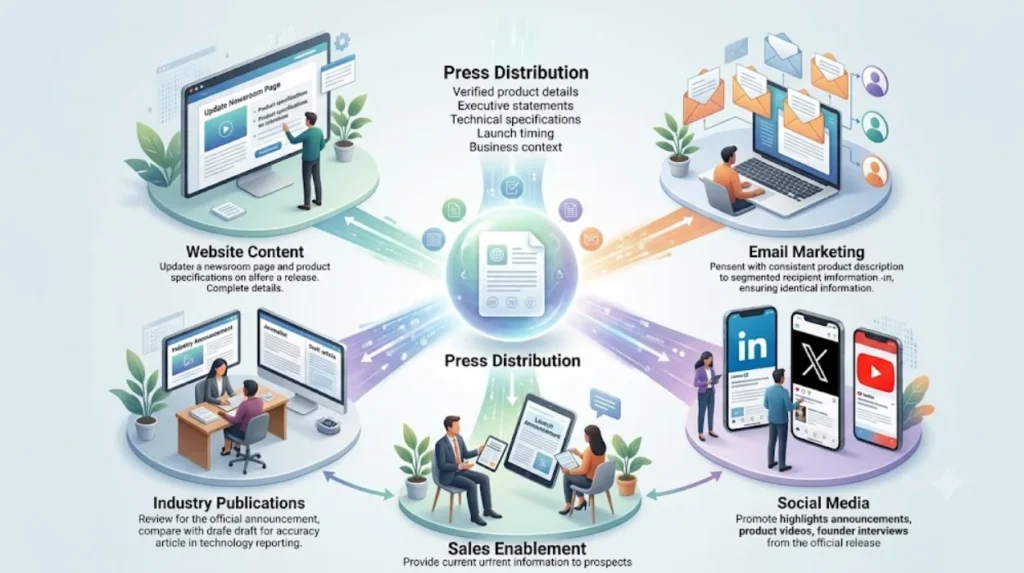
Press distribution strengthens multiple marketing channels because it provides verified product information, executive statements, technical specifications, launch timing, and business context that teams reuse across digital marketing, sales, public relations, customer communications, and partner engagement activities consistently.
Several marketing channels depend on accurate launch information.
Website content
The newsroom and product pages reference the official announcement.
Visitors receive complete launch details directly from the company.
Email marketing
Launch emails use consistent product descriptions.
Subscribers receive identical information regardless of campaign segment.
Social media
LinkedIn, X, YouTube, and community platforms promote highlights from the official release.
Example:
- Feature announcements
- Product videos
- Founder interviews
Sales enablement
Sales representatives use launch announcements during customer conversations.
This ensures every prospect receives current information.
Industry publications
Technology publications often review official announcements before preparing news coverage.
This improves reporting accuracy.
Readers exploring early media visibility strategies can also review:
How Medical Startups Earn Placements for additional context on securing publication opportunities.
What information belongs inside a software product launch press release?
A software launch press release contains verified business information, product functionality, customer value, executive commentary, launch availability, technical specifications, supporting statistics, and contact information presented in a structured format that journalists and industry publications understand immediately.
A software launch announcement contains several essential components.
Company introduction
Explain:
- Company name
- Industry
- Core products
- Business focus
Example:
A cybersecurity software company introducing a cloud security platform.
Product overview
Describe:
- Main functionality
- Target audience
- Primary business problem
- Deployment model
Example:
A SaaS workforce management platform for manufacturing companies.
Launch details
Include:
- Launch date
- Availability
- Geographic markets
- Pricing structure if public
Executive quote
Leadership explains:
- Business purpose
- Customer benefits
- Product vision
Supporting evidence
Add measurable facts.
Examples include:
- 2,500 beta users
- 99.95% platform uptime
- ISO 27001 certification
- Integration with Microsoft Teams and Slack
Specific figures improve credibility.
How can software companies coordinate press distribution with other launch activities?
Successful coordination follows a structured timeline where marketing, public relations, customer success, product teams, sales, and executives publish aligned communications according to predefined launch milestones, approval workflows, publication schedules, and audience-specific delivery plans without conflicting information.
Coordination begins several weeks before launch.
Four weeks before launch
Teams finalize:
- Messaging
- Product assets
- Media lists
- Launch calendar
Two weeks before launch
Marketing prepares:
- Landing pages
- Email campaigns
- Social media assets
- Demonstration videos
Launch week
Activities occur according to schedule.
The press release publishes first.
Marketing channels activate immediately afterward.
Customer support updates documentation.
Sales teams begin outreach.
Partners receive launch materials.
Every department follows one communication timeline.
What business benefits result from integrating press distribution?
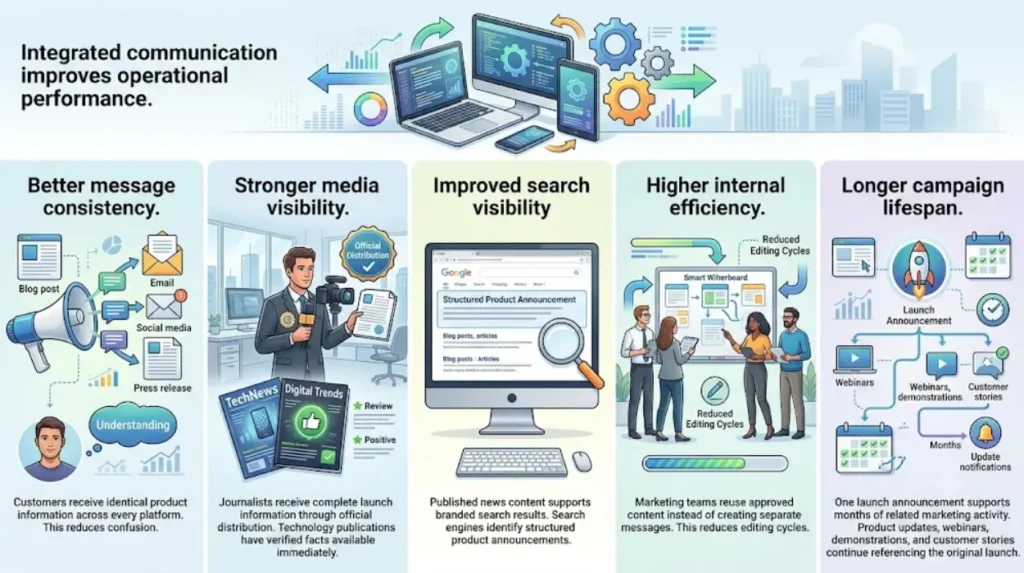
Integrated press distribution improves communication efficiency, media visibility, customer confidence, campaign consistency, search discoverability, stakeholder alignment, and long-term content reuse while reducing duplicated messaging across departments responsible for software product launch communications and external engagement.
Integrated communication improves operational performance.
Better message consistency
Customers receive identical product information across every platform.
This reduces confusion.
Stronger media visibility
Journalists receive complete launch information through official distribution.
Technology publications have verified facts available immediately.
Improved search visibility
Published news content supports branded search results.
Search engines identify structured product announcements.
Higher internal efficiency
Marketing teams reuse approved content instead of creating separate messages.
This reduces editing cycles.
Longer campaign lifespan
One launch announcement supports months of related marketing activity.
Product updates, webinars, demonstrations, and customer stories continue referencing the original launch.
What common mistakes reduce the impact of press distribution?
Several planning errors reduce launch performance, including inconsistent messaging, poor publication timing, missing technical information, weak supporting evidence, delayed coordination, and disconnected marketing activities that prevent audiences from receiving one clear product announcement across multiple communication channels.
Several avoidable problems appear during software launches.
Publishing before supporting content exists
Some companies distribute announcements before updating:
- Product pages
- Pricing information
- Documentation
Users encounter incomplete information.
Different messaging across channels
Marketing and PR teams sometimes publish different product descriptions.
This creates confusion.
One approved messaging framework eliminates inconsistencies.
Explore More Expert Insights:
Leveraging Press Releases to Catch the Attention of Tech Industry Analysts and Influencers
Crisis Communication Frameworks for SaaS: How to Formulate and Issue an Official Statement Fast
Limited supporting evidence
Claims without measurable data reduce credibility.
Instead include:
- Customer numbers
- Performance benchmarks
- Security certifications
- Integration examples
Delayed campaign coordination
Press distribution works best when every communication channel activates within the planned launch schedule.
Delays reduce momentum.
How do companies evaluate whether integrated press distribution is successful?
Performance evaluation combines media coverage, audience engagement, website traffic, branded search growth, referral sources, campaign attribution, lead generation, and communication consistency to measure how effectively press distribution supported the complete software product launch strategy across all marketing channels.
Several measurable indicators demonstrate launch performance.
Important metrics include:
- Number of media placements
- Referral traffic from news websites
- Branded search growth
- Product page visits
- Email engagement
- Social media engagement
- Webinar registrations
- Demo requests
Companies also compare launch performance against previous releases.
Consistent measurement improves future launch planning.
Businesses comparing communication approaches after planning an integrated strategy can explore:
Premium Tech Wire Distribution for evaluation factors relevant to distribution options and launch investment decisions.
Press distribution forms a core component of an omni-channel software product launch strategy because it provides one verified source of information for every marketing and communication activity. A structured press release aligns websites, email campaigns, social media, sales outreach, customer communications, and media relations around consistent messaging. This coordination improves operational efficiency, strengthens media coverage, supports search visibility, and creates a reliable foundation for long-term product marketing. Integrating press distribution into launch planning enables software companies to deliver accurate information across every customer touchpoint while maintaining consistency throughout the entire product launch lifecycle.