Press release SEO follows the same technical principles worldwide, but the United Kingdom and the United States operate under different media ecosystems, search behaviours, publication standards, and audience expectations. These differences influence keyword targeting, regional language, news distribution, local authority signals, and search visibility. Understanding these distinctions helps organisations produce content that aligns with each market’s editorial and search environment.
How does press release SEO differ between the UK and the US?
Press release SEO differs between the UK and the US through regional language, search intent, media structures, keyword targeting, publication networks, and local search signals. These factors influence how releases are written, distributed, indexed, and discovered by audiences using search engines and AI-powered search platforms.
Although Google dominates search in both countries, user behaviour differs significantly. British audiences search using UK spelling, local terminology, and region-specific expressions. American audiences use US spelling and different vocabulary for the same concepts.
For example:
- United Kingdom: “organisation”, “authorised”, “petrol station”, “holiday”
- United States: “organization”, “authorized”, “gas station”, “vacation”
Search engines recognise these differences when matching queries with content. A press release written for a UK audience performs better when it uses British English consistently.
Why does language localisation matter?
Search engines analyse page content alongside user search queries. Exact language alignment improves topical relevance.
For example:
- “Defence technology” aligns with UK searches.
- “Defense technology” aligns with US searches.
- “Public transport” performs differently from “public transportation.”
- “City centre” differs from “downtown.”
These language variations affect keyword matching and search visibility.
Why do keyword strategies change between the UK and the US?
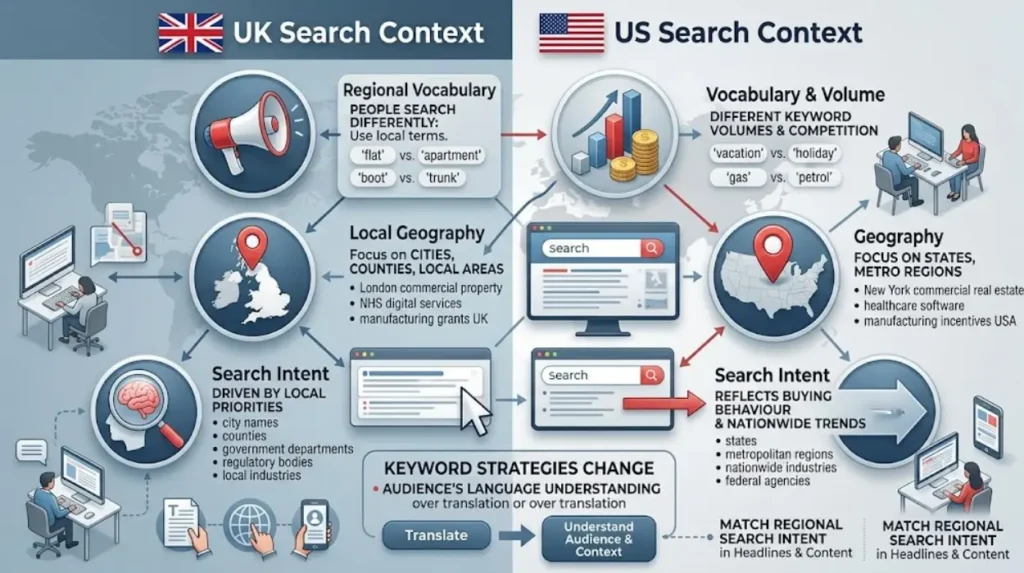
Keyword strategies change because people search differently in each country. Regional vocabulary, local geography, buying behaviour, and search intent produce different keyword volumes and competition levels, even when discussing the same product, service, or industry.
Keyword research begins with understanding the audience’s language rather than translating existing content.
For example, UK searches include:
- London commercial property
- NHS digital services
- manufacturing grants UK
Comparable US searches include:
- New York commercial real estate
- healthcare software
- manufacturing incentives USA
Each keyword reflects different terminology and local priorities.
How does search intent vary?
Search intent represents the reason behind a user’s query.
UK searches often include:
- city names
- counties
- government departments
- regulatory bodies
- local industries
US searches frequently include:
- states
- metropolitan regions
- nationwide industries
- federal agencies
Press releases perform better when headlines and body content match regional search intent instead of using generic international wording.
How do UK and US media landscapes affect press release SEO?
Media structures influence press release SEO because search engines evaluate publication authority, topical relevance, geographic relevance, and editorial quality. The UK and US contain different publisher ecosystems that shape online visibility after distribution.
The United Kingdom has a relatively concentrated national media environment supported by regional newspapers, trade publications, professional journals, and specialist industry websites.
The United States has thousands of regional publications, local television websites, city newspapers, state publications, and industry-focused digital media.
These structural differences influence how news spreads across online publications.
What role do trade publications play?
Trade publications serve specialised professional audiences.
Examples include industries such as:
- construction
- healthcare
- logistics
- manufacturing
- finance
- education
Industry publications often generate highly relevant backlinks because their content focuses on a single subject area. Search engines associate those publications with strong topical authority.
Why does local SEO matter more for UK press releases?
Local SEO strengthens UK press release visibility because many organisations target cities, counties, regional economies, and local media outlets. Geographic relevance helps search engines connect news stories with location-specific searches and regional audiences.
Location signals appear throughout an optimised press release.
Examples include:
- city names
- county names
- business locations
- regional projects
- local partnerships
- event locations
A release discussing a project in Manchester benefits from mentioning Manchester naturally throughout the content instead of using only national terminology.
Which local entities improve relevance?
Relevant local entities include:
- cities
- counties
- universities
- transport networks
- public organisations
- industry clusters
Search engines use these entities to understand geographic context.
What role do headlines play in UK press release SEO?
Headlines define topical relevance for readers, search engines, news aggregators, and AI search systems. UK-focused headlines prioritise clarity, factual language, regional keywords, and concise wording without excessive promotional language.
An effective headline contains:
- the primary topic
- the geographic context
- the main entity
- one clear message
For example:
“Manchester Manufacturing Sector Reports Export Growth”
The headline immediately communicates location, industry, and subject.
Why are concise headlines effective?
News platforms often truncate long headlines.
Short headlines improve:
- readability
- indexing
- search visibility
- AI summarisation
- news feed display
Clear headlines also increase consistency across syndicated publications.
How do backlinks work differently in UK press release SEO?
Backlinks support search visibility when they originate from relevant, trustworthy publications. Their value depends on editorial context, topical relevance, publication authority, and natural placement rather than simply the number of links generated through distribution.
Search engines evaluate several factors.
These include:
- publication relevance
- editorial quality
- topic alignment
- link placement
- surrounding content
One relevant editorial link often carries greater contextual value than multiple unrelated directory links.
Which backlinks add the most relevance?
Examples include links from:
- industry journals
- professional associations
- recognised news publishers
- academic publications
- government information resources
These sources strengthen topical relationships between organisations and their industries.
How do AI search systems interpret UK press releases?
AI search systems analyse structured content, factual statements, entities, relationships, and clear language instead of relying only on keyword frequency. Well-organised press releases provide information that AI systems summarise, cite, and connect with related knowledge sources.
Modern AI-powered search focuses on understanding information.
Important content elements include:
- people
- organisations
- locations
- dates
- statistics
- products
- events
Each entity contributes additional context.
Why does structured writing improve AI understanding?
AI systems identify relationships more accurately when information follows a logical sequence.
For example:
- organisation
- announcement
- location
- date
- supporting facts
This structure improves information extraction without relying on repetitive keywords.
Readers looking for practical optimisation methods can continue with:
How Time Intelligence Media Group Optimises UK Releases for AI Search.
Which technical SEO elements matter in both countries?
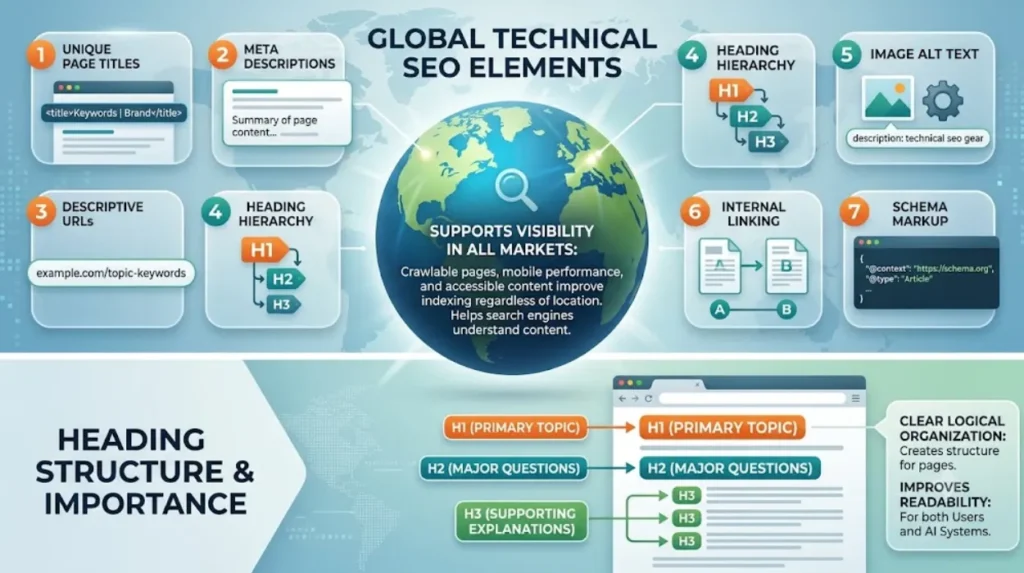
Technical SEO supports visibility in both markets through crawlable pages, structured headings, descriptive metadata, mobile performance, and accessible content. These technical foundations improve indexing regardless of geographic location.
Important technical elements include:
- unique page titles
- meta descriptions
- descriptive URLs
- heading hierarchy
- image alt text
- internal linking
- schema markup
Each element helps search engines understand page content.
Why is heading structure important?
A clear heading hierarchy creates logical organisation.
Typical structure:
- H1 for the primary topic
- H2 for major questions
- H3 for supporting explanations
This format improves readability for both users and AI systems.
What common mistakes reduce press release SEO performance?
Several recurring mistakes reduce search visibility by weakening relevance, readability, indexing, and user experience. Accurate regional language, factual structure, and audience-focused optimisation improve long-term search performance across digital news platforms.
Common mistakes include:
- mixing UK and US spelling
- keyword repetition
- vague headlines
- missing location references
- weak metadata
- duplicated content
- broken internal links
- unclear entity definitions
Each issue reduces content quality signals.
Why does duplicate content matter?
Publishing identical releases across multiple pages creates indexing challenges.
Search engines prefer identifying one authoritative version while recognising syndicated copies appropriately.
Unique supporting content surrounding a press release strengthens its overall search performance.
Readers exploring implementation choices after understanding these principles can continue with:
Which PR Distribution Add-Ons Are Worth Paying For in the UK.
How can organisations create region-specific press release SEO?
Region-specific press release SEO combines local language, regional keyword research, geographic entities, factual structure, trusted publication selection, and technical optimisation. These components produce content that matches search behaviour within the intended country while improving discoverability across search engines and AI search systems.
Effective region-specific optimisation follows a consistent process.
Step 1: Research regional keywords
Use keywords that reflect local spelling, terminology, and search behaviour.
Step 2: Write in regional English
Maintain either British English or American English throughout the entire release.
Step 3: Include relevant locations
Reference cities, counties, organisations, and industry sectors naturally.
Step 4: Structure information clearly
Present facts using logical headings, concise paragraphs, and defined entities.
Step 5: Optimise technical elements
Ensure metadata, headings, URLs, and internal links accurately describe the content.
Step 6: Publish within relevant media ecosystems
Select publications that match the industry’s audience and geographic focus.
Explore More Expert Insights:
What UK B2B Buyers Actually Read in Trade Publications
Why UK Charities Struggle to Get Media Coverage for Campaigns
Press release SEO works differently in the UK and the US because each market has distinct language conventions, search behaviour, media ecosystems, and geographic signals. Effective optimisation starts with regional keyword research, consistent local terminology, structured writing, and clear entity definitions. It also depends on technically sound publishing practices, relevant media placement, and content organised for both traditional search engines and AI-powered search systems. Understanding these differences enables organisations to create press releases that align with regional search expectations while improving visibility, discoverability, and informational accuracy.