

Travel sponsored stories connect travel brands with UK audiences through paid editorial-style content distributed across relevant media channels. The format combines destination information, travel trends, brand messaging, and audience targeting to create content that fits the context of trusted publications.
Travel brands use sponsored stories to reach defined audience groups, including holiday planners, business travellers, families, luxury travellers, and adventure seekers.
Why Travel Brands Use Sponsored Stories in 2026 explains the wider role of this format within modern travel marketing. The next step is understanding how distribution turns sponsored content into measurable audience reach.
What Are Travel Sponsored Stories?
Travel sponsored stories are paid media articles created for a brand and published through media channels to reach selected audiences with useful travel information, brand messaging, destination content, or product details in an editorial-style format.
Sponsored stories sit between traditional advertising and editorial content. The advertiser pays for placement, while the content follows the publication’s format, audience expectations, and disclosure requirements.
A travel sponsored story focuses on a defined subject. Examples include a guide to weekend breaks in Scotland, a review-style feature about luxury accommodation, or an article explaining family travel options for the summer.
The commercial relationship remains clear. Sponsored content carries appropriate labelling so audiences understand that the article represents paid content.
How Does Sponsored Content Differ From Display Advertising?
Display advertising normally uses banners, videos, native placements, or other visual formats. Sponsored stories use longer-form written content as the primary communication format.
This difference affects how audiences consume the message. A sponsored story provides space for destination information, practical advice, product details, brand positioning, and supporting context.
For example, a hotel brand can promote a destination through an article covering five reasons to visit the area. The article provides useful information while also introducing the hotel’s location and offering.
How Does Travel Sponsored Content Reach UK Audiences?
Travel sponsored content reaches UK audiences through publication selection, audience targeting, content distribution, search visibility, social amplification, and relevant media placement, allowing travel brands to place specific messages in front of people interested in destinations, accommodation, experiences, and travel services.
Distribution starts with audience definition. A campaign identifies the people the content needs to reach and the media environments that attract those people.
A UK travel campaign can focus on national audiences or specific groups within England, Scotland, Wales, and Northern Ireland. Audience selection also includes interests and travel intent.
Publication selection then connects the content with suitable media environments. Travel content fits publications covering lifestyle, business, consumer interests, regional destinations, tourism, transport, and leisure.
Why Does Publication Selection Matter?
Publication relevance affects audience alignment. A sponsored story about business travel has a different audience requirement from an article about family holidays.
For example, a corporate travel story fits a business publication more closely than a family lifestyle website. A regional tourism feature fits a publication serving the destination’s local area.
Media selection also affects the context surrounding the story. Readers encounter the sponsored content alongside other articles that match their interests.
What Role Does Content Distribution Play?
Content distribution determines where the sponsored story appears and how audiences discover it. A distribution strategy can involve multiple relevant publications rather than a single website.
Multi-publication distribution increases the number of media environments carrying the campaign. It also creates multiple opportunities for readers to encounter the same travel message.
Distribution requires consistency. The headline, core facts, brand references, destination information, and calls to action need to remain accurate across placements.
Which Content Elements Help Sponsored Stories Reach Travel Audiences?
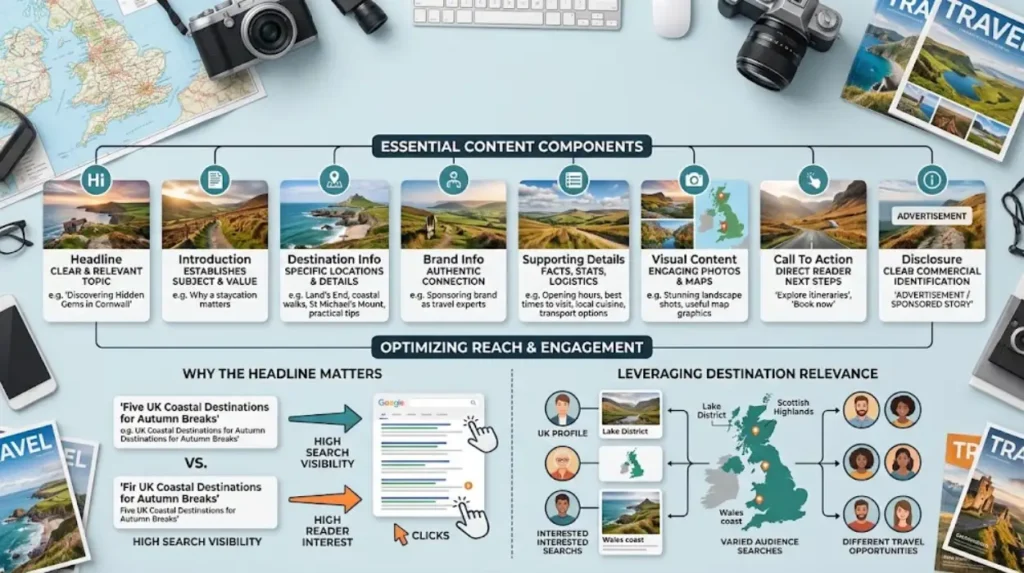
Effective travel sponsored stories combine a relevant headline, useful information, clear brand positioning, destination context, audience-focused language, credible facts, visual assets, and a logical structure that supports both reader engagement and discoverability across UK media channels.
Content quality affects how audiences interact with sponsored stories. The article needs a clear subject from the headline onwards.
Important components include:
- Headline: States the travel topic clearly.
- Introduction: Establishes the subject and reader relevance.
- Destination information: Provides specific locations, attractions, routes, or travel considerations.
- Brand information: Connects the topic with the sponsoring company.
- Supporting details: Adds facts, statistics, features, prices, dates, or practical information where appropriate.
- Visual content: Uses relevant photography, maps, graphics, or other approved assets.
- Call to action: Directs interested readers towards the relevant next step.
- Disclosure: Identifies the commercial nature of the content.
Why Does the Headline Matter?
The headline determines the initial relevance of the article. Travel audiences respond to clear subjects such as destination guides, travel trends, seasonal planning, accommodation choices, and transport information.
A specific headline also supports search visibility. For example, “Five UK Coastal Destinations for Autumn Breaks” communicates the topic more clearly than a generic promotional headline.
The headline needs to match the article. Search relevance, reader expectations, and publication standards all depend on topical consistency.
How Does Destination Relevance Improve Audience Alignment?
Destination relevance connects the story with a defined geographical interest. UK audiences search for domestic destinations and international travel options throughout the year.
A story about Cornwall addresses a different search and audience context from a story about Dubai. Specific destination terminology helps establish the subject for readers and search systems.
Travel brands also use regional references to connect campaigns with specific markets. Examples include London city breaks, Lake District holidays, Scottish Highlands tours, and Welsh coastal trips.
How Does Search Visibility Support Travel Sponsored Stories?
Search visibility helps travel sponsored stories remain discoverable beyond their initial publication by using relevant search terms, descriptive headings, topical entities, useful information, and technically accessible content that aligns with how UK audiences search for travel destinations and services.
Search visibility gives sponsored stories another discovery pathway. Readers do not need to encounter an article directly through a publication homepage or referral placement.
Relevant terminology helps search engines understand the article. Terms such as “UK holiday destinations”, “family holidays”, “London hotels”, and “European city breaks” establish topical relationships.
The content also needs semantic depth. A destination article about Edinburgh, for example, can naturally discuss accommodation, attractions, transport, seasonal travel, and local experiences.
What Is the Role of Keywords?
Keywords identify the language audiences use when searching for information. Primary keywords provide the central topic, while related terms expand contextual relevance.
A travel article targeting “UK weekend breaks” can include related concepts such as short holidays, countryside escapes, coastal destinations, city breaks, accommodation, and travel planning.
Keyword use remains natural. Repetition reduces readability and weakens the quality of the article.
How Do Entities Support Travel Search Visibility?
Entities are identifiable subjects such as destinations, hotels, airlines, attractions, travel companies, cities, and tourism organisations.
Clear entity references help establish relationships between the brand, destination, product, and subject. For example, an article about London tourism can identify London, Heathrow Airport, major attractions, and relevant accommodation categories.
Entity clarity also supports AI search systems because structured and specific information is easier to interpret than vague promotional language.
How Do UK Media Publications Influence Audience Reach?
UK media publications influence sponsored-story reach through their existing readership, topical authority, geographic focus, content formats, and distribution channels, connecting travel campaigns with audiences already interested in consumer, business, lifestyle, regional, tourism, or destination-related subjects.
Every publication has a defined editorial environment. Its audience composition, geographic relevance, content categories, and publishing standards influence campaign suitability.
National publications provide broad UK exposure. Regional publications provide stronger geographical relevance. Trade publications reach specialist audiences such as tourism professionals, hospitality businesses, and travel operators.
This creates different distribution strategies for different objectives.
When Is National Distribution Relevant?
National distribution suits campaigns that require broad UK awareness. Examples include airline announcements, major travel trends, nationwide hotel campaigns, and large-scale tourism initiatives.
The campaign needs a broad subject with national relevance. A story about changes to UK travel behaviour fits this structure more closely than a highly local accommodation announcement.
When Is Regional Distribution Relevant?
Regional distribution focuses on audiences connected to specific locations. A tourism organisation promoting North Wales needs media relevance within Wales and nearby UK markets.
Regional stories can address local attractions, events, transport developments, hospitality openings, or destination campaigns.
The geographical connection gives the sponsored story a defined audience context.
How Can Travel Brands Measure Sponsored Story Performance?
Travel brands measure sponsored story performance through publication reach, referral traffic, engagement, search visibility, clicks, conversions, and campaign reporting, connecting distribution activity with defined marketing objectives and providing evidence of how audiences interact with sponsored travel content.
Measurement starts with campaign objectives. Awareness campaigns prioritise reach and visibility. Traffic campaigns focus on clicks and referral sessions. Conversion campaigns track actions such as bookings, enquiries, or registrations.
Useful performance indicators include:
- Number of publication placements
- Estimated audience reach
- Referral traffic
- Page views
- Engagement metrics
- Link clicks
- Search impressions
- Branded search activity
- Conversion actions
- Cost per acquisition
Tracking links also help separate sponsored-content traffic from other marketing channels.
Why Does Reporting Matter?
Reporting provides a record of where the content appeared and how audiences interacted with it. A campaign report can identify publication placements, links, traffic sources, and available engagement data.
This information supports future campaign planning. Strong-performing topics and publication categories provide evidence for subsequent distribution decisions.
Reporting also helps compare campaigns across destinations, audience segments, and content formats.
Which Travel Brands Use Sponsored Stories?
Travel brands use sponsored stories across tourism, hospitality, airlines, travel technology, transport, attractions, destination marketing, and travel services, with each category using the format to communicate different information to audiences planning holidays, business trips, experiences, accommodation, and journeys.
Sponsored stories support multiple travel business models. The content structure changes according to the product and audience.
How Do Hotels Use Sponsored Stories?
Hotels use sponsored stories to promote destinations, accommodation experiences, seasonal offers, facilities, and local attractions.
For example, a London hotel can sponsor an article about planning a three-day city break. The story establishes the destination topic before introducing accommodation information.
How Do Tourism Organisations Use Sponsored Stories?
Tourism organisations use sponsored stories to increase destination awareness. Content can focus on attractions, seasonal events, local experiences, transport access, and itinerary planning.
A Scottish tourism campaign can focus on a specific region and explain attractions, travel routes, accommodation categories, and seasonal activities.
How Do Travel Technology Companies Use Sponsored Stories?
Travel technology companies use sponsored stories to explain booking tools, travel applications, comparison services, or digital travel solutions.
The article provides educational context before explaining the relevant technology. This format supports audiences researching travel options rather than audiences responding to a short advertisement.
How Can Brands Evaluate Travel Sponsored Content Options?
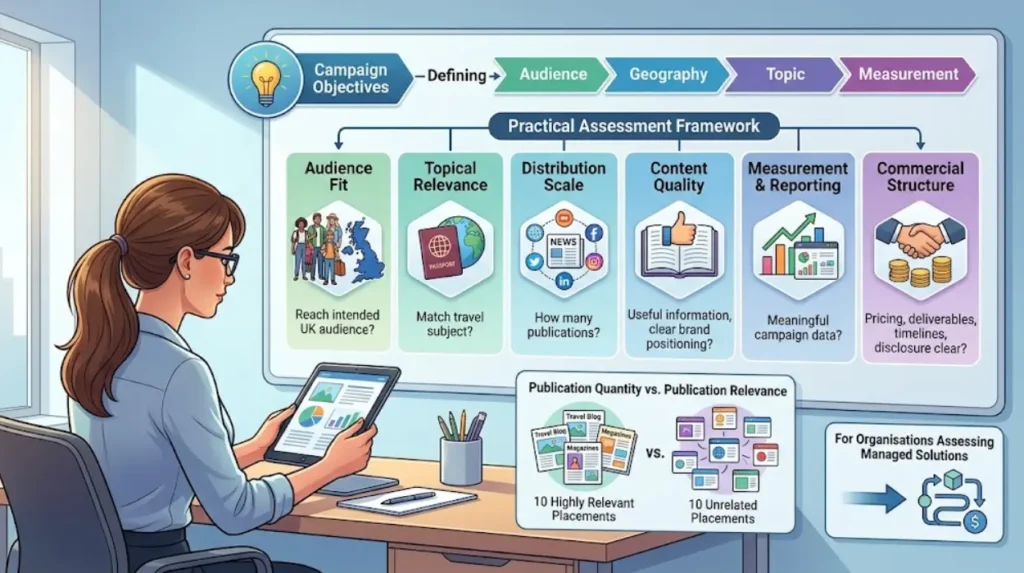
Brands evaluate travel sponsored content options by comparing audience fit, publication relevance, distribution scale, content quality, search visibility, reporting, pricing, disclosure standards, and campaign objectives before selecting a sponsored-content approach for the UK market.
The evaluation process starts with the campaign objective. Brands then define the required audience, geographical scope, content topic, publication types, distribution scale, and measurement requirements.
A practical assessment covers six areas:
- Audience fit: Does the publication reach the intended UK audience?
- Topical relevance: Does its content environment match the travel subject?
- Distribution: How many relevant publications receive the content?
- Content quality: Does the article provide useful information and clear brand positioning?
- Measurement: Does reporting provide meaningful campaign data?
- Commercial structure: Are pricing, deliverables, timelines, and disclosure requirements clear?
Brands also need to distinguish between publication quantity and publication relevance. Ten highly relevant placements provide a different audience context from ten unrelated placements.
For organisations assessing a managed solution,
Travel Sponsored Content provides a natural next step for reviewing service-focused options.
What Is the Overall Process for Reaching UK Travel Audiences?
The process combines audience research, campaign objectives, topic selection, content creation, publication selection, distribution, search optimisation, performance tracking, and reporting, creating a structured route from travel-brand message development to measurable exposure across relevant UK media environments.
The process follows a clear sequence:
- Define the campaign objective.
- Identify the UK audience.
- Select the travel topic.
- Develop the sponsored story.
- Optimise the content for search and reader relevance.
- Select appropriate media publications.
- Distribute the story.
- Monitor publication and traffic data.
- Measure campaign performance.
- Review results for future activity.
This structure connects content with distribution. It also prevents publication selection from becoming an isolated activity.
Explore More Expert Insights:
How Ecommerce Sponsored Content Reaches UK Shoppers
How Thought Leadership Content Gets Published on 15 Sites
Travel sponsored stories work best when content, audience, publication relevance, search visibility, and measurement operate as one campaign system. This approach gives UK travel brands a defined method for reaching audiences through relevant media environments while maintaining clear commercial disclosure and measurable campaign objectives.



