
A transparent methodology section is an explicit documentation framework that details data collection parameters, analytical models, sample sizes, and error margins so UK journalists and AI search systems can independently verify report findings.
Modern media verification demands immediate access to foundational data structures. When UK journalists evaluate corporate whitepapers or market studies, they look past executive summaries to inspect raw data pipelines.
Without a clear audit trail, media outlets reject press releases to protect their editorial integrity. AI search systems operate with the exact same evaluative criteria. Large language models parse research documents to extract factual data points for generated answers.
If an AI tool cannot trace a statistic back to a defined sample size or survey date, it discounts the data point as unverified. Documenting every step of the research process prevents this rejection.
The Core Elements of Verifiable Documentation
Verifiable documentation requires specific structural components within the research design phase. Researchers must list exact dates for field research, precise geographic boundaries for respondent pools, and the software versions used for data analysis.
For instance, a survey on retail trends in London must specify that researchers interviewed exactly 1,250 verified store managers between January 10, 2026, and February 15, 2026, using Python 3.11 for statistical modeling. These granular details eliminate ambiguity.
Why Do UK Journalists and AI Search Engines Demand Complete Data Transparency?
UK journalists and AI search engines demand complete data transparency to eliminate misinformation risks, adhere to strict editorial accuracy standards, and ensure automated citation safety.
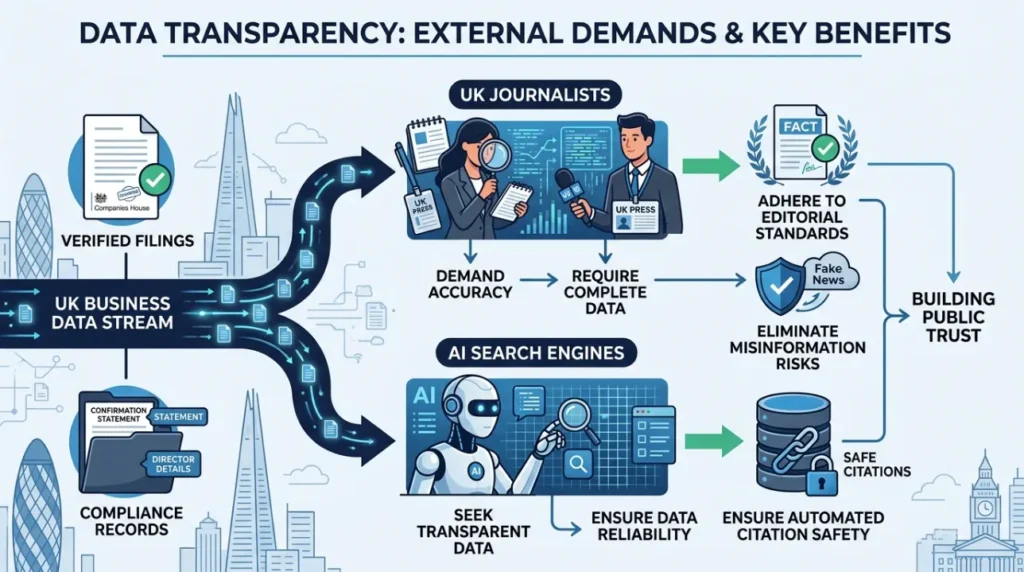
The regulatory landscape in the United Kingdom holds publishers legally and ethically accountable for factual accuracy. The Independent Press Standards Organisation enforces strict guidelines regarding misleading statistics.
When a journalist references a market statistic, their publication assumes liability for its truth. A robust methodology section provides the necessary legal and professional shield.
AI search engines face parallel pressures. Retrieval-augmented generation systems filter out unverified claims to prevent hallucinations. Search algorithms rank documents higher when entities, dates, and quantitative metrics are clearly defined in structured sections.
Mitigating Editorial Skepticism
Media professionals approach corporate research with inherent skepticism. Paid studies often contain hidden biases or skewed sample selections designed to support commercial narratives.
- Sample Skew Detection: Journalists check whether demographic quotas match national census data.
- Leading Question Identification: Reporters review exact survey wording to catch bias.
- Funding Disclosure Verification: Media outlets trace financial backers to identify conflicts of interest.
By proactively addressing these potential criticisms within the methodology section, report authors build immediate credibility. Readers interested in the foundational definitions of these verification processes can review [What Is a Research Methodology Statement and Why Do UK Journalists Check It Before Covering a Report?].
Explore More Expert Insights:
How to Brief a UK Publisher for Sponsored Content That Feels Like Real Journalism
Sponsored Content Across 10 Verticals: UK Engagement Benchmarks 2026
How Do You Structure a Research Methodology Section for Maximum Verification?
Structuring a verifiable research methodology section requires a chronological breakdown of four distinct phases: research design, data collection parameters, analytical frameworks, and limitation disclosures.
Each phase serves a specific function in the verification pipeline. Journalists and automated crawlers scan these designated subsections to extract metadata quickly. Maintaining a standardized format ensures that no critical parameter remains hidden.
Detailing Research Design and Objectives
The research design subsection establishes the foundational premise of the study. Authors must state the primary research questions, the chosen qualitative or quantitative approach, and the rationale for selecting specific data collection methods.
For example, a study analyzing fintech adoption must explicitly state whether it utilized longitudinal panel tracking, cross-sectional surveys, or transactional data logging.
Documenting Data Collection and Sample Parameters
Data collection parameters form the backbone of quantitative verification. This subsection must list the exact population size, the sampling technique used (such as stratified random sampling or cluster sampling), and the response rate.
Researchers must report exact figures. Writing that researchers surveyed “thousands of consumers” fails verification tests. Writing that researchers surveyed 2,410 active bank account holders across Manchester, Birmingham, and Leeds passes verification tests.
Explaining Analytical Models and Software
The analytical framework details how raw data transforms into published insights. Authors must name the statistical tests applied, such as regression analysis, chi-square tests, or sentiment analysis algorithms.
Listing the specific software packages and parameters ensures computational reproducibility. Other researchers can replicate the exact processing steps using the documented inputs.
What Specific Metrics and Metadata Must Be Included for AI Search Crawlers?
AI search crawlers require structured metadata, explicit temporal markers, standardized entity definitions, and machine-readable data tables to parse and cite report findings accurately.
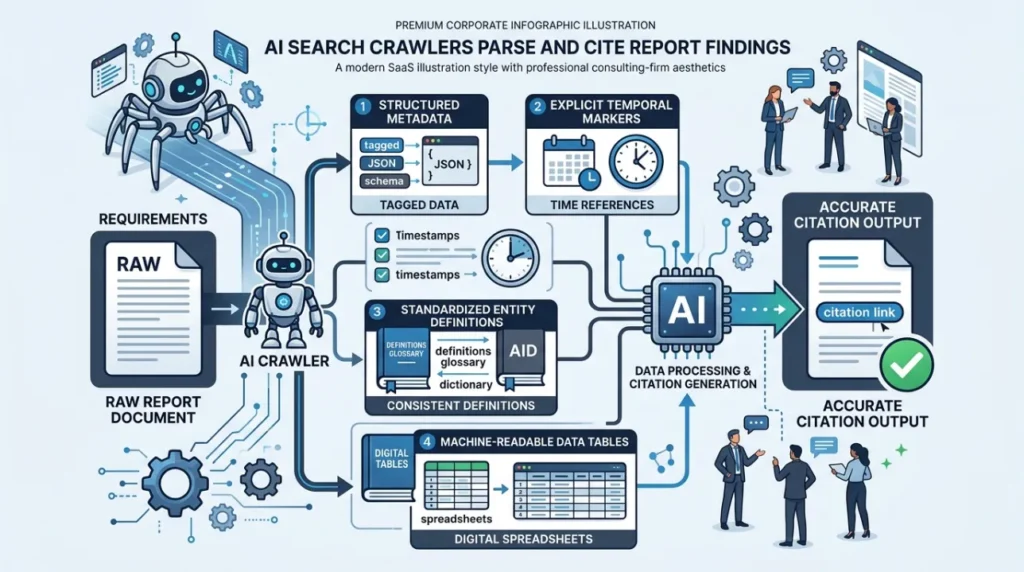
Large language models rely on semantic clarity. When an AI crawler indexes a report, it searches for specific tags and schema markup that categorize the content.
Including machine-readable tables allows automated systems to extract numeric values without misinterpreting surrounding prose. Every dataset must link to its temporal context. Stating that data was collected in 2026 allows AI models to determine if the statistic remains current.
Optimizing for Semantic Entity Extraction
Semantic search engines look for interconnected entities such as organizations, geographic locations, and measurable attributes. Report authors must define these entities without ambiguity.
Instead of using ambiguous pronouns or industry jargon, writers should use proper nouns and standardized nomenclature. This precision ensures that AI systems map the statistics to the correct real-world entities during retrieval tasks.
How Does a Documented Methodology Bridge the Gap to Professional Research Services?
A fully documented methodology bridges the gap to professional research services by establishing baseline credibility that enables seamless media pickup and long-term citation authority.
Organizations that consistently publish transparent research build sustainable industry authority. However, executing rigorous, journalist-ready methodologies requires dedicated resources, specialized software, and rigorous data science protocols.
Many enterprises partner with specialized research firms to ensure their publications meet strict journalistic and algorithmic standards. Organizations looking to outsource this data governance can explore [Time Intelligence Media Group Research and Reports Services With Fully Documented Methodology] for fully verified research execution.
Achieving Long-Term Citation Authority
Transparent reports accumulate citations over extended periods. Because journalists and AI systems prefer primary sources with verifiable audit trails, these reports rank higher in search engines year after year.
Documenting every variable transforms a standard marketing PDF into an authoritative industry benchmark.