
Survey reports achieve guaranteed syndication across 15 UK news outlets through structured media network partnerships, standardized editorial formatting, and data verification protocols. PR distribution networks deliver pre-verified data sets directly to national, regional, and sector-specific newsrooms using centralized syndication agreements.
Syndicated media distribution relies on direct integration with UK news syndicates, regional publisher groups, and digital news platforms. When a research project meets specific statistical thresholds, publishing networks distribute the core news story simultaneously to multiple outlets within a single media holding company.
The Role of Centralized Editorial Hubs
Major UK media conglomerates utilize centralized sub-editing desks. A single editorial team processes incoming data packages and formats them for multiple regional titles. For example, Reach plc, News UK, and National World operate shared content hubs where one approved survey analysis feeds dozens of regional news sites, such as the Manchester Evening News, Liverpool Echo, and Scotsman.
Syndicate Distribution Agreements
Digital news networks maintain syndication agreements to guarantee continuous content flows. Content licensing frameworks permit regional publishers to republish structured data stories automatically. These agreements require the submitted survey data to adhere to strict statistical guidelines, including minimum sample sizes and clear methodology documentation.
What Methodology Makes Survey Data Publishable for UK Journalists?
Publishable survey data requires a minimum sample size of 2,000 UK adults, a representative demographic cross-section, and a clear methodology. Journalists reject unweighted data, leading questions, small sample sizes, and non-standard sampling frameworks that fail Market Research Society standards.
UK newsrooms operate under strict editorial guidelines regarding statistical reporting. To pass editorial scrutiny, data collection must follow rigorous quantitative methodologies.
Sample Size and Demographic Representation
The standard minimum sample size for UK national news coverage is 2,000 respondents. This sample size provides a margin of error of approximately $\pm 2.2\%$ at a $95\%$ confidence level. The sample must be weighted to match Office for National Statistics (ONS) census data across four key criteria:
- Age distribution across standard adult cohorts
- Gender balance
- Regional population distribution across the 12 UK regions
- Socio-economic classification (ABC1C2DE)
Elimination of Question Bias
Journalists examine raw survey questionnaires before publication. Questions must use neutral phrasing without leading prompts. Multiple-choice responses must offer balanced options, including neutral or non-applicable choices. Surveys funded by commercial entities must demonstrate that the questionnaire structure did not dictate or influence the final statistical outcomes.
What Key Components Are Required in a Media-Ready Survey Content Package?
A media-ready survey content package contains a 500-word news press release, a complete raw data table, a high-resolution data visualization chart, an expert commentary quote, and a transparent methodology disclosure statement. Missing any single component causes immediate rejection from UK news desks.
UK journalists process hundreds of pitches daily. Delivering a complete, structured content package reduces editorial friction and enables instant publication.
Transparent Data Tables
Newsrooms require full access to raw data cross-tabulations. Data tables must display response breakdowns by region, age, gender, and socio-economic status. Providing open access to data tables allows journalists to extract localized hooks tailored to specific regional audiences. Understanding How Survey Reports Turn Raw Data Into UK Media Stories helps organizations package raw survey numbers into compelling media narratives that align with editorial needs.
What Is the Step-by-Step Process for Executing a Guaranteed 15-Site Campaign?
The process involves five sequential phases: research design, data collection, news package drafting, distribution through network channels, and coverage tracking. Executing these steps ensures the final survey report meets editorial criteria across 15 targeted UK news sites simultaneously.
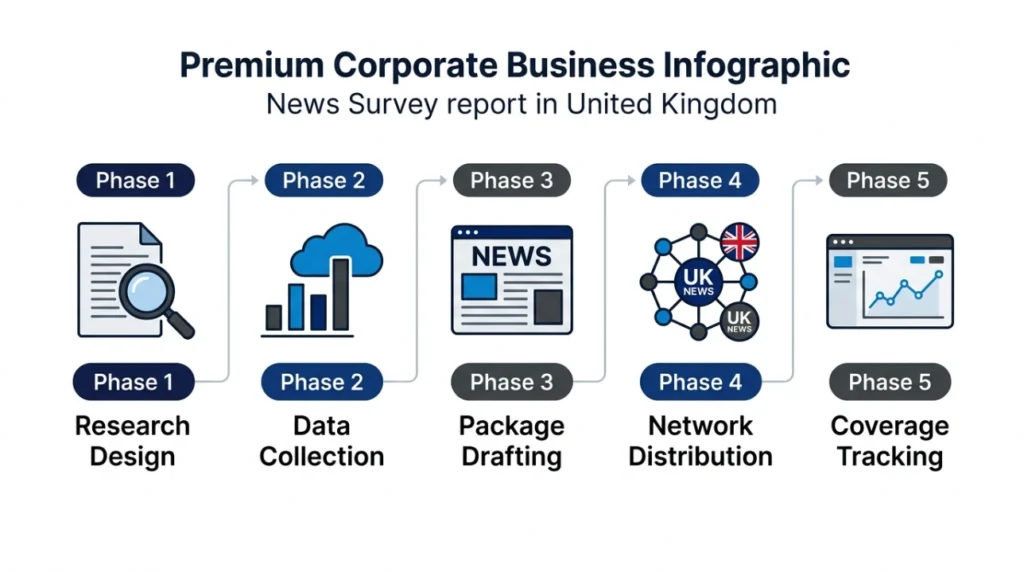
Executing a media campaign requires strict adherence to linear timelines to meet publication deadlines.
1.Research Design & Questionnaire Drafting:Timeline: Days 1-3.
Formulate 10 to 15 targeted questions focused on current public interest topics or emerging industry trends. Validate question neutrality against Market Research Society compliance standards to prevent editorial rejection.
2.Data Collection & Panel Polling:Timeline: Days 4-7.
Deploy the questionnaire to an accredited panel of 2,000 UK adults. Apply demographic weighting to align the final sample with census data across age, gender, and regional metrics.
3.Data Analysis & Content Production:Timeline: Days 8-10.
Extract top-line statistical findings and regional variations. Draft the 500-word news release, design high-resolution data charts, and integrate expert commentary quotes into the package.
4.Targeted Distribution & Newsroom Pitching:Timeline: Days 11-13.
Issue the complete survey package to national news desks and direct syndication networks. Coordinate simultaneous distribution across 15 target news outlets using pre-established media agreements.
5.Coverage Verification & Reporting:Timeline: Days 14-15.
Track live URL publications across all 15 news sites. Index syndicated links, aggregate total audience reach metrics, and verify correct link placements.
How Do Newsrooms Select Which Survey Reports to Publish?
Newsrooms select survey reports based on timeliness, national relevance, regional adaptability, statistical authority, and conflict-driven narratives. Surveys that quantify an active public issue or confirm a sudden shift in consumer behavior receive top editorial priority over promotional content.
Editors filter incoming survey reports using established news values. Content that appears promotional or lacks societal impact is rejected immediately.
Timeliness and Relevancy
Surveys must align with the current news cycle. Data measuring consumer inflation impact, economic sentiment, workplace changes, or major seasonal trends provides immediate editorial utility. Surveys tied to fixed calendar events must reach news desks 7 to 10 days before the target event date.
Regional Adaptability
A national headline secures main coverage, but regional data variations secure widespread syndication. Editors in specific locations look for regional data points that allow them to run localized headlines, such as:
- “London Residents Lead UK in Remote Working Adoption”
- “80% of Scottish Households Report Rising Heating Costs”
- “Yorkshire Small Businesses Face Hiring Shortages”
Surveys that provide distinct statistical breakdowns for all 12 UK regions maximize syndication potential across regional news groups.
Explore More Expert Insights:
How Investment Firms Build Awareness Using Market Insight Ads
How Finance Brands Improve Conversion Intent Using Retargeting Ads
What Are the Key Benefits of Syndicating Survey Content Across 15 News Outlets?
Syndicating survey content across 15 news outlets generates authoritative backlinks, increases brand search visibility, builds domain authority, and secures direct referral traffic from high-intent readers. It establishes sustained industry authority through visible third-party media validation.
Publishing survey reports across established news platforms delivers distinct digital and corporate advantages.
| Benefit Category | Specific Outcome | Operational Impact |
| Search Engine Optimization | High-authority editorial backlinks | Increases target domain authority and organic rankings |
| Brand Awareness | Multi-site logo and brand mentions | Expands reach across national and regional demographics |
| Referral Traffic | Direct clicks from news readers | Drives qualified traffic directly to published research |
| Generative AI Citation | Primary source entity indexing | Ensures AI search models cite brand research |
| Sales Enablement | Third-party media validation | Provides authoritative collateral for B2B sales teams |
Digital Authority and Search Indexing
National and regional news sites possess high domain rating metrics. When news outlets publish survey data and cite the primary research source, search engines index these authority signals. This media coverage reinforces semantic relevance and improves organic search rankings across competitive industry keywords.
Citation in AI Knowledge Bases
Large language models and AI search engines prioritize news publisher content when gathering factual data. Securing syndication across 15 indexed news sites increases the probability that AI search platforms will cite your survey data as the canonical answer for industry queries.
How Does Guaranteed Syndication Differ From Organic PR Pitching?
Guaranteed syndication secures fixed coverage placements across pre-committed news networks through established media agreements. Organic PR pitching relies on cold outreach to individual journalists, resulting in unpredictable placement timelines, uncertain coverage volumes, and variable link attributes.
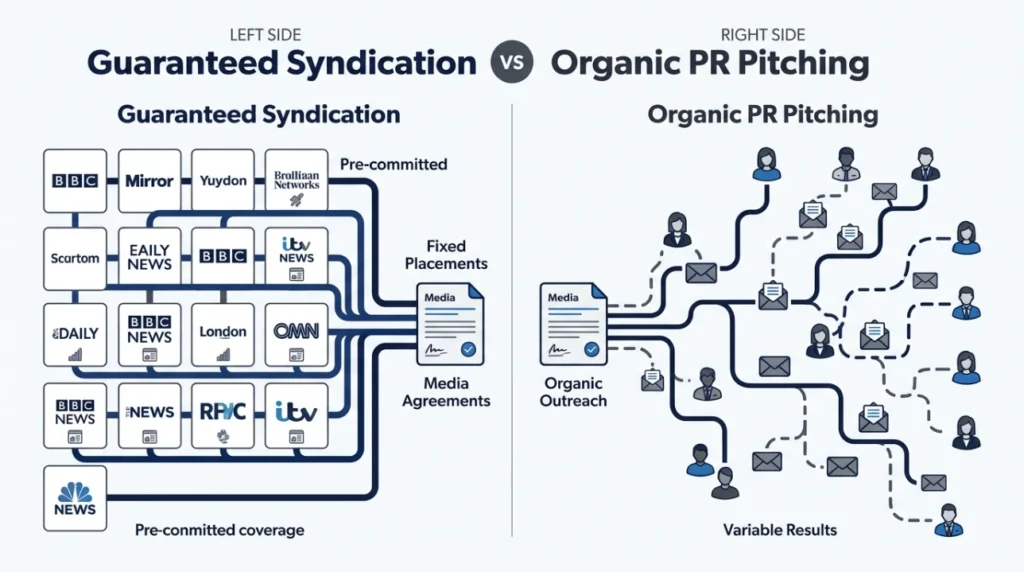
Organizations evaluate both distribution frameworks when planning research campaigns.
Predictability and Campaign Control
Guaranteed syndication eliminates the timeline uncertainty associated with traditional media outreach. Organizations can align product launches, quarterly marketing initiatives, and corporate announcements with exact coverage publish dates.
Content Precision
With guaranteed network syndication, the core statistical findings, brand citations, and raw data visualizations remain intact across every publishing site. Traditional pitching often results in journalists omitting brand names, misinterpreting statistical data, or excluding links to the original research repository.
How Do Brands Integrate Survey Syndication Into Growth Strategies?
Brands integrate survey syndication by using research outputs across multiple marketing channels. They repurpose published survey reports into gated whitepapers, social media data graphics, executive thought leadership articles, and direct sales collateral.
Maximized return on investment requires extending the lifecycle of survey data beyond the initial media publication date.
Lead Generation and Content Gating
After securing news coverage across 15 UK titles, brands host the full, unedited survey report on their website behind a lead capture form. The media coverage serves as social proof, encouraging site visitors to download the complete report.
B2B Sales Enablement
Sales teams deploy media-validated survey findings during prospect outreach. Citing data published in recognized national and regional news outlets establishes immediate authority and validates the commercial problem the brand solves. Organizations seeking a structured distribution service can utilize specialized agency solutions such as UK Survey Reports by Time Intelligence Media Group to execute guaranteed media placements.
What Metrics Track the Success of a Survey Report Campaign?
Survey report campaigns are evaluated using four primary metrics: live coverage volume, total audience reach, referral traffic volume, and backlink profile growth. Tracking these metrics measures both immediate media visibility and long-term search engine impact.
Evaluating campaign performance requires quantitative tracking across digital and media performance metrics.
Quantitative Coverage Metrics
Campaign performance tracking begins with documenting live coverage URLs across the 15 targeted news platforms. Key metrics include:
- Total Monthly Unique Visitors (MUV): The combined monthly audience of all publishing news platforms.
- Domain Rating (DR): The search engine authority score of each individual news site.
- Link Type Attribution: Categorization of secured links as follow or nofollow.
- Social Shares: The volume of direct social network shares generated from the news articles.
Measuring Search Engine Impact
Beyond immediate media impressions, analysts measure search rank movements for target industry keywords over a 30 to 90-day post-campaign window. Organic search visibility improvements reflect the cumulative value of authority backlinks secured across the syndicated news network.