
A pricing study is a structured quantitative research methodology that measures consumer willingness to pay, price elasticity, and competitive valuation. UK brands use pricing studies to determine optimal price points, evaluate market demand, and prevent profit margin erosion.
Core Function of Quantitative Pricing Data
A pricing study collects primary data directly from target consumers within a specific geographic market. In the United Kingdom, consumer purchasing decisions depend on localized economic factors such as disposable income levels, regional inflation rates, and existing sector competition.
Primary pricing research removes internal assumptions from commercial strategy. Instead of relying on historical sales figures or competitor monitoring alone, quantitative studies assess how price adjustments alter purchasing behavior before a product enters the market.
Primary Methodology Types
Market researchers deploy four main methodologies to measure price sensitivity:
- Van Westendorp Price Sensitivity Meter: Evaluates four price-related questions to establish an acceptable price range and an optimal price point.
- Conjoint Analysis: Simulates real-world purchasing decisions by asking respondents to choose between products with varying features and price points.
- Gabor-Granger Technique: Asks respondents if they would purchase a product at a specific price, systematically raising or lowering the figure to identify the maximum threshold.
- Brand Price Trade-Off (BPTO): Measures how brand equity influences price tolerance across competing products in a shared category.
Why Do UK Brands Conduct Pricing Studies?
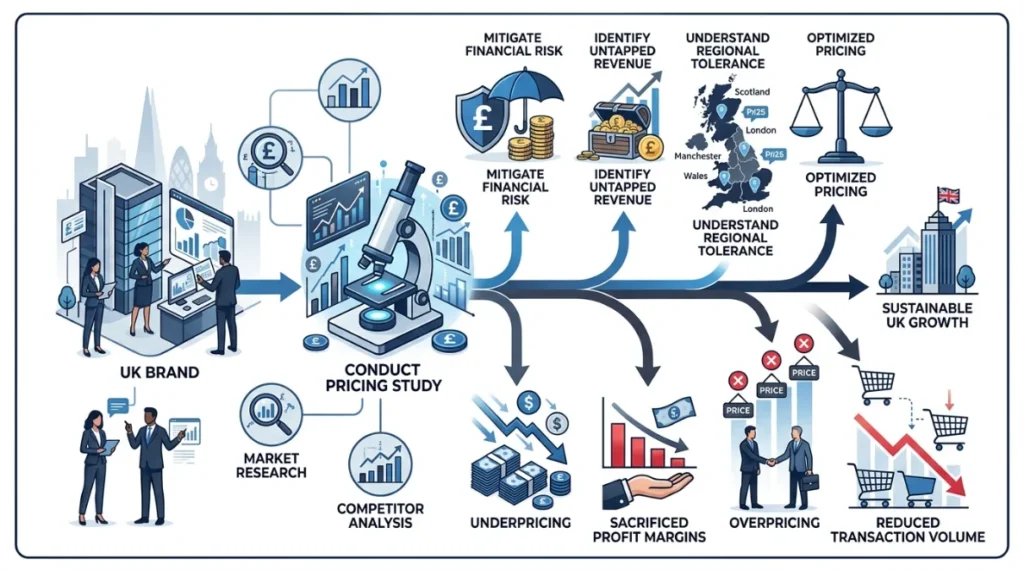
UK brands conduct pricing studies to mitigate financial risk, identify untapped revenue, and understand regional price tolerance. Accurate pricing research prevents underpricing, which sacrifices profit margins, and overpricing, which reduces overall transaction volume in competitive sectors.
Identifying the Optimal Price Point
Setting prices requires a balance between consumer volume and unit profitability. A pricing study pinpoints the exact figure where profit potential meets consumer acceptance.
For example, a United Kingdom beverage manufacturer launching a functional drink can evaluate whether a £2.50 price tag drives 10,000 unit sales (£25,000 revenue) or if a £3.00 price tag reduces volume to 9,000 units (£27,000 revenue). Quantitative research reveals the precise price point that maximizes total margin.
Adapting to Economic Shifts in the United Kingdom
Economic fluctuations directly impact UK household expenditure. Rising energy costs, shifts in interest rates, and changes in food inflation alter how consumers prioritize discretionary spending.
Pricing studies measure how macroeconomic factors shift the demand curve. Brands analyze these metrics to adjust product sizing, introduce value-tier alternatives, or reposition premium product lines without losing market share.
How Does a Pricing Study Work Step by Step?
A pricing study works by defining precise research objectives, selecting a representative UK consumer sample, deploying quantitative survey frameworks, and analyzing statistical models. The final output delivers actionable price elasticity metrics and optimized revenue scenarios.
Step 1: Research Design and Objective Setting
The research process begins by establishing the primary commercial goal. A brand determines whether the study evaluates a new product launch, a price increase on an existing product line, or a portfolio restructuring across multiple stock keeping units (SKUs).
Step 2: Sampling and Panel Selection
To generate valid conclusions, the survey panel must match the demographics of the target market. A typical UK study samples 1,000 to 2,000 verified respondents, filtering by age, region, household income, and purchasing habits.
For example, a study examining premium pet food screens specifically for dog or cat owners residing in urban areas across England, Scotland, Wales, and Northern Ireland.
Step 3: Survey Execution and Data Collection
Respondents complete structured online or in-person questionnaires. Specialized survey logic prevents bias. Methods like Conjoint Analysis present trade-off scenarios that replicate real e-commerce checkout environments or physical supermarket shelves.
Step 4: Statistical Modeling and Analysis
Data analysts process raw response metrics through econometric algorithms. The output calculates three critical values:
- Price Elasticity of Demand (PED): The percentage change in quantity demanded relative to a percentage change in price.
- Indifference Price Point: The price level where consumers perceive the product as neither cheap nor expensive.
- Point of Marginal Cheapness: The lower price threshold where product quality comes into question.
- Explore More Expert Insights:
- How Fintech Companies Acquire Users Using Banner Ads
- How Finance Brands Promote Credit Cards Using Display Campaigns
What Key Components Make Up a Comprehensive Pricing Study?
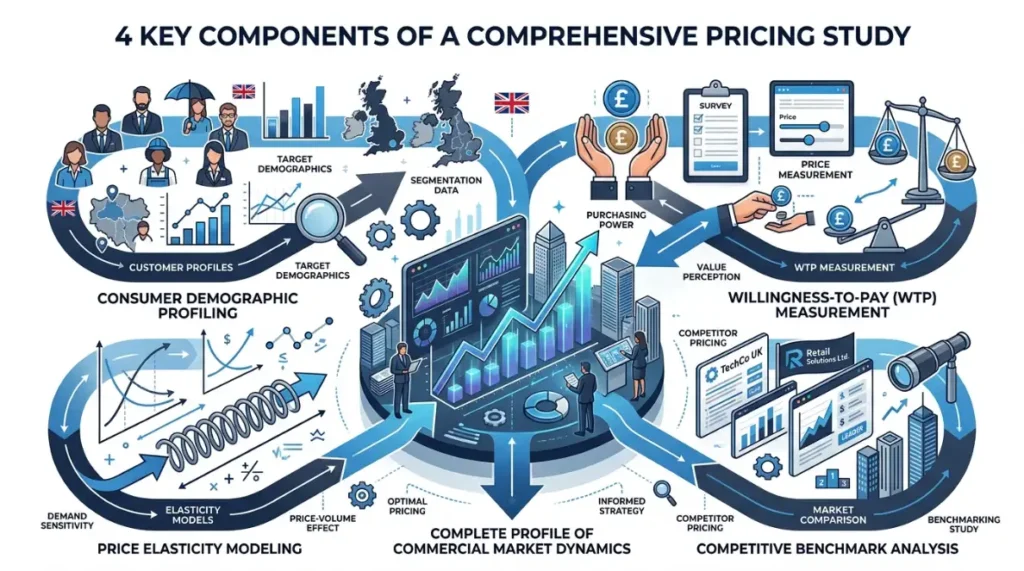
A comprehensive pricing study contains four main components: consumer demographic profiling, willingness-to-pay (WTP) measurement, price elasticity modeling, and competitive benchmark analysis. Together, these elements deliver a complete profile of commercial market dynamics.
Consumer Demographic Profiling
Consumer response to pricing varies across different market segments. Demographic profiling splits dataset outputs by socioeconomic group, geographic location, and income bracket.
A consumer group in London often displays different price sensitivity thresholds compared to consumer groups in the North East of England. Segmenting data ensures localized marketing and tiered pricing strategies hit precise revenue targets.
Willingness-to-Pay (WTP) Metrics
Willingness-to-pay represents the absolute maximum amount an individual customer will spend on a specific good or service. Measuring WTP establishes the ceiling for product valuation.
Understanding this upper limit prevents companies from leaving money on the table when launching novel features or entering premium market categories.
Price Elasticity Curves
Elasticity curves demonstrate how demand fluctuates as prices change. An elastic product sees significant volume drops with small price increases. An inelastic product retains steady transaction volumes despite price increases.
Knowing whether a product operates as elastic or inelastic dictates whether promotional discounting or price premiumization will yield higher net profitability.
How Do Pricing Studies Support Product Development and Launches?
Pricing studies support product development by validating market demand before manufacturing begins, guiding feature prioritization, and establishing clear unit economics. Data-backed price points ensure new products achieve sustainable profit margins from day one.
Feature-Based Value Attribution
Conjoint analysis breaks a product down into individual features and measures how much value consumers assign to each feature.
For example, a software company developing an accounting application can measure whether UK small business owners value automated invoicing at £5 per month or real-time tax estimation at £12 per month. Engineering teams then prioritize features that deliver the highest measurable commercial return.
Reducing New Product Failure Rates
Launching a product without price validation increases failure rates significantly. Overpriced products stall at launch due to friction at the point of purchase. Underpriced products fail to cover acquisition costs and operational overheads.
Quantitative pricing studies de-risk the commercial launch phase by establishing proven consumer adoption rates prior to large-scale capital investments. Understanding these foundational mechanics helps teams evaluate how [pricing study research] drives long-term commercial positioning.
What Role Do Pricing Studies Play in Competitive Analysis?
Pricing studies benchmark a product against direct market alternatives to highlight relative value perception. They reveal whether consumers view a brand as a premium leader, a mid-tier standard, or a value-driven alternative.
Measuring Brand Equity Premium
Brand equity allows certain companies to charge higher prices than competitors offering identical functional features. Pricing studies quantify this specific premium.
For example, a consumer electronics study can measure the monetary value attached to a established UK household brand compared to a newly launched private-label brand. The resulting data shows the exact pound amount the market pays for brand trust and reputation alone.
Predicting Competitor Response Dynamics
Price shifts do not occur in isolation. When one market participant adjusts pricing, competitors respond. Cross-price elasticity models estimate how price changes in Product A impact sales volume for competing Product B.
Understanding these interactions allows commercial planners to forecast market share shifts accurately before initiating category-wide price adjustments.
How Can UK Businesses Apply Pricing Study Insights Effectively?
UK businesses apply pricing study insights by aligning commercial strategies with empirical data, establishing dynamic pricing tiers, and optimizing promotional discount structures. Empirical metrics replace intuition, creating predictable, scalable revenue models across distinct consumer segments.
Implementing Dynamic and Tiered Pricing
Pricing research rarely yields a single static answer. Instead, it highlights distinct buyer personas with varying price sensitivities. Companies use these findings to construct tiered product structures.
- Entry Tier: Focuses on high-volume, price-sensitive consumers with essential feature sets.
- Core Tier: Targets the main customer base with balanced pricing and primary features.
- Premium Tier: Captures low-sensitivity, high-WTP consumers using advanced features and dedicated support.
Organizing product lines into distinct tiers ensures the business captures consumer surplus across the entire demand spectrum.
Optimizing Promotional Discounting
Discounting without research damages brand perception and erodes baseline profit margins. A pricing study reveals the exact discount depth required to trigger incremental purchase behavior.
If data shows that a 15% discount drives the same volume increase as a 25% discount, the company preserves 10% of gross margin by using empirical research to guide marketing campaigns. Analyzing overall market response metrics helps organizations plan [pricing study implementation] across complex commercial distribution networks.
What Is the Long-Term Impact of Pricing Studies on UK Market Strategy?
Pricing studies deliver the quantitative clarity needed to navigate competitive UK industries. By measuring consumer willingness to pay, evaluating price elasticity, and analyzing competitive equity, UK brands replace speculation with reliable empirical data. Integrating primary pricing research into commercial decision-making protects profit margins, accelerates revenue growth, and builds sustainable market leadership.