
Original research is the systematic collection, analysis, and publication of proprietary data, proprietary surveys, and proprietary market experiments designed to answer specific industry questions and establish verified facts within the United Kingdom commercial landscape.
Original research functions as primary source material for search engines, journalists, and industry analysts across England, Scotland, Wales, and Northern Ireland. Content creators generate primary data through quantitative surveys, qualitative interviews, financial audits, and technical benchmarking tests.
Defining Primary Data Entities
Primary data represents unprocessed information gathered directly from target populations or operational environments. Unlike secondary content, which recycles existing online resources, original research introduces novel empirical evidence into the public domain. Search engines prioritize primary data because it satisfies unique query intents that generic aggregators fail to resolve.
The Role of Proprietary Datasets
Proprietary datasets consist of proprietary metrics collected via direct observation or controlled testing. Examples include retail footfall analytics compiled across London shopping districts, manufacturing output metrics from West Midlands industrial hubs, and software adoption rates measured across Manchester technology firms. These datasets form the foundation of authoritative digital PR campaigns and high-tier media citations.
Why does original research outrank competitor content in search engines?
Original research outranks competitor content because search engine algorithms evaluate unique information gain, primary citation velocity, and semantic entity density to determine search engine result page dominance.
Search engine crawlers evaluate web pages for information gain, which measures the amount of new data a document adds to the existing corpus of web information. Articles that merely summarize prior web pages receive lower algorithmic priority than pages hosting novel survey findings or proprietary statistical models.
Algorithmic Evaluation of Information Gain
Algorithmic models assign higher relevance scores to documents containing unique statistical distributions, numerical tables, and empirical proofs. When a brand publishes an exclusive industry report, web scrapers index those distinct data points immediately. Consequently, the publishing domain becomes the definitive source node for that specific topic cluster.
Citation Velocity and Backlink Acquisition
High-tier publications, academic institutions, and trade journals link exclusively to primary data sources rather than secondary summaries. Examples include The Financial Times, The Guardian, and industry-specific portals such as Retail Gazette. When these authoritative domains reference a brand’s study, the target domain accumulates high-authority backlinks, which directly increases domain rating and search visibility across competitive UK keyword variations.
How do brands execute original research campaigns?
Brands execute original research campaigns by defining precise research hypotheses, deploying structured data collection methodologies, analyzing statistical outcomes through rigorous validation processes, and formatting findings for digital consumption.

Successful execution requires strict adherence to methodological standards. Brands must eliminate sampling bias, ensure statistical significance, and maintain ethical data handling practices compliant with UK data protection regulations.
Phase One: Hypothesis Formation and Methodology
The research lifecycle begins with the formulation of a clear research question that addresses an unmet information need within a specific vertical. Examples include investigating consumer spending shifts in Edinburgh retail sectors or analyzing cybersecurity vulnerabilities among Cardiff financial institutions. Researchers establish sample sizes, selection criteria, and collection timeframes before fielding surveys or running tests.
Phase Two: Data Collection and Statistical Analysis
Data collection involves deploying digital questionnaires, conducting focus groups, or extracting performance metrics using verified software tools. Once compiled, statisticians clean the dataset by removing anomalies and evaluating confidence intervals. This analytical rigor ensures that published claims withstand scrutiny from academic reviewers and industry regulators.
Phase Three: Packaging and Visual Formatting
The final execution step involves translating raw numbers into accessible formats. Designers construct data visualizations, summary infographics, and structured tables that clearly display statistical outcomes. Clear visual hierarchy helps both human readers and AI retrieval systems extract core facts efficiently.
Explore More Expert Insights:
How Fintech Companies Acquire Users Using Banner Ads
How Finance Brands Promote Credit Cards Using Display Campaigns
What are the core components of high-impact research reports?
High-impact research reports require transparent methodology statements, granular numerical datasets, expert qualitative commentary, and actionable operational takeaways tailored to the United Kingdom market.
A comprehensive research report must provide complete context so readers can evaluate the validity of the findings. Omitting methodological details reduces trust among editors and search engine evaluation teams.
Transparent Methodology Documentation
A rigorous methodology section outlines the exact parameters of the study. Specific details include geographic boundaries (such as England-wide vs. Greater London), demographic filters (such as B2B decision-makers with over 250 employees), and total sample counts (such as $n=1,500$ respondents). Complete transparency allows external entities to replicate or verify the study.
Granular Numerical Datasets and Visualizations
Reports must feature specific quantitative breakdowns rather than vague generalizations. Examples include reporting exact percentage shifts, mean response times, and median cost figures. Visual assets such as correlation matrices and trend charts provide immediate clarity for technical audiences.
Expert Commentary and Contextual Analysis
Quantitative figures gain deeper relevance when paired with qualitative interpretation from recognized industry leaders. Integrating quotes and analysis from sector specialists provides necessary context, explaining the practical implications of the data for UK enterprises navigating shifting economic conditions.
How does original research build enduring brand authority?
Original research builds enduring brand authority by establishing the publishing organization as a primary industry thought leader, securing consistent media mentions, and generating sustainable organic search traffic.
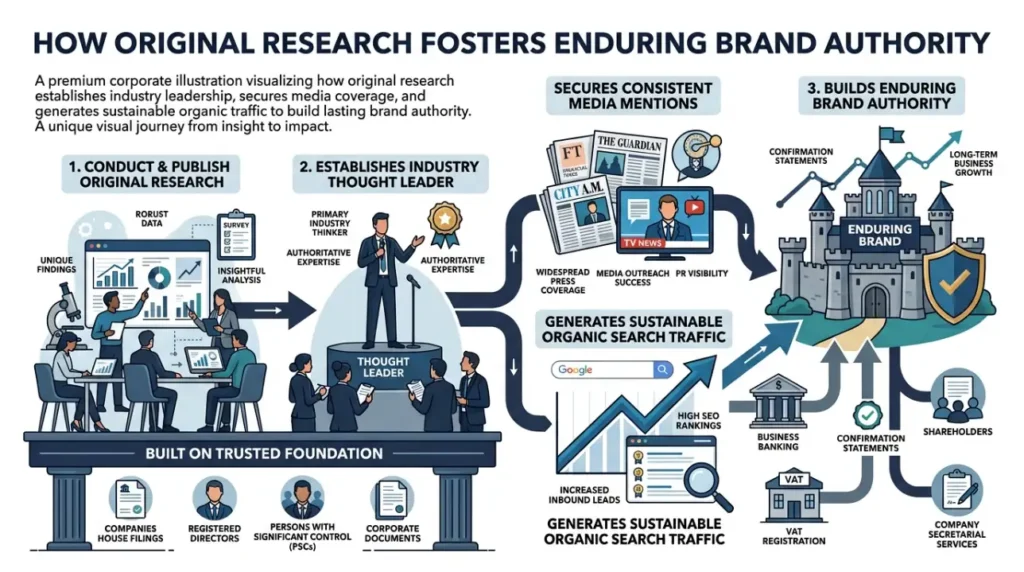
Brands that consistently publish proprietary studies transition from information consumers to information producers. This shift alters how search engines, industry peers, and prospective clients perceive the organization’s market standing.
Establishing Industry Thought Leadership
Publishing empirical data proves a brand possesses deep market understanding and analytical capability. When executives from rival firms cite a brand’s proprietary findings in keynote presentations or white papers, the publishing brand secures undisputed market authority.
Securing Earned Media and AI Citations
Primary data serves as raw material for modern journalism and artificial intelligence retrieval engines. Large language models and search engines cite primary sources to answer factual user queries. By publishing structured research, brands secure permanent placement within automated knowledge graphs and generative search outputs.
When should organizations deploy original research strategies?
Organizations deploy original research strategies during periods of high market saturation, shifting regulatory landscapes, or emerging consumer trends that lack existing empirical documentation.
Deploying original research requires allocating adequate time and financial resources. Organizations evaluate market readiness by assessing internal data assets, industry information gaps, and competitor content saturation levels.
Overcoming Content Saturation in Competitive Verticals
In crowded digital markets where thousands of blogs publish identical advice, original research provides the sole differentiator. Brands operating in competitive sectors like UK fintech, legal services, or commercial real estate use proprietary studies to bypass generic content competition and capture high-value informational search traffic.
Responding to Regulatory and Economic Shifts
Major structural changes, such as new tax policies announced in Westminster or evolving compliance standards for digital platforms, create immediate information voids. Organizations that rapidly field studies addressing these changes capture peak search interest and position themselves as indispensable resources during periods of uncertainty.