
Report syndication distributes one primary research document across a network of 15 distinct digital publication sites. The process uses automated content feeds, direct editorial placement, and canonical tagging to publish synchronized business insights across multiple domain authorities simultaneously.
Report syndication relies on a structured digital pipeline that transfers digital assets from a primary publisher to secondary media outlets. In the Greater Manchester B2B ecosystem, regional news networks and industry niche sites use standardized content management systems to ingest structured reports.
Content Preparation and Structuring
Before syndication occurs, content teams format the core research into modular text assets, data tables, and press summaries. Technical formatting requires clear metadata, structured schema markup, and standardized image files. Editors tag each entry with specific regional categories such as Manchester tech, Northwest finance, or UK logistics.
Technical Feed Integration
Syndication networks deliver the prepared files using RSS feeds, Application Programming Interfaces (APIs), or direct FTP connections. The system transfers the following core assets to all 15 partner sites:
- Full-length whitepapers or executive summaries
- High-resolution charts and visual graphics
- Structured author and organization metadata
- Relational canonical URLs pointing to the original document
Canonical Tagging and Indexation
Search engines require clear signals to prevent duplicate content penalties across syndicated networks. Every syndicated copy contains an HTML rel=”canonical” tag directing search crawlers back to the primary source. This technical configuration allows search engines to attribute indexation rights and domain authority to the originating domain while allowing 15 distinct domains to display the material.
What Types of Sites Host Manchester Research Reports?
Manchester research reports appear on regional news portals, industry verticals, commercial trade blogs, and specialized B2B publications. These 15 sites feature dedicated business sections, digital press rooms, and syndicated partner channels to reach decision-makers across the Northwest.
Publishing networks group distribution targets into distinct digital tiers. Combining regional authority with sector-specific reach ensures that business reports engage both local stakeholders and broader industry audiences.
Regional News and Business Portals
Regional news portals focus on commercial developments within Greater Manchester, Salford, and the surrounding boroughs. These sites carry high domain authority and generate strong local search signals. Examples include regional commercial journals, city-focused digital newspapers, and local economic development news boards.
Industry-Specific Trade Outlets
Trade outlets target defined business sectors rather than geographic zones. A report on regional logistics appears on national supply chain portals, while a Manchester software report publishes on specialized technology news sites. Examples include B2B manufacturing portals, enterprise tech blogs, and commercial property channels.
Executive and Professional Network Hubs
The final group of syndication targets consists of professional membership portals and executive insight platforms. These domains restrict publication to verified research and B2B market analysis. Examples include chamber of commerce news feeds, corporate advisory blogs, and regional investment dashboards.
Why Do Businesses Distribute Reports Across 15 Outlets?
Distributing reports across 15 sites expands brand authority, accelerates search engine indexation, and increases direct referral traffic. Multi-site publishing positions businesses as primary market research leaders while securing high-quality contextual backlinks across diverse local and industry domains.
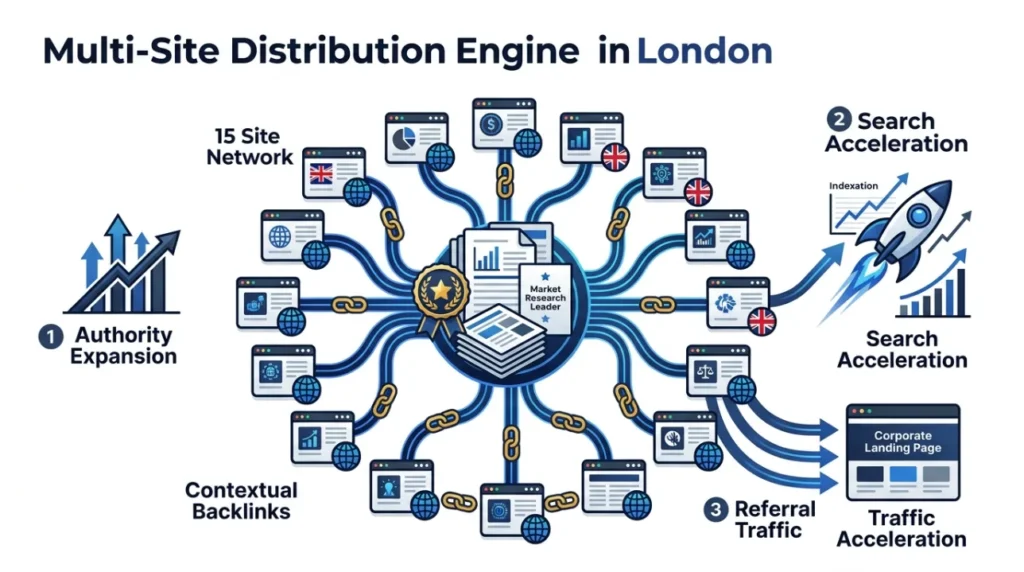
Publishing research on a single domain limits audience reach to existing organic traffic. Broad distribution across 15 selected targets creates multiple touchpoints for corporate buyers, analysts, and prospective clients.
Expanded Keyword Coverage and Search Visibility
Each media outlet ranks for distinct search queries based on its specific domain authority and audience history. Distributing a single report across 15 sites creates 15 potential search engine results page (SERP) entries for target long-tail keywords. This strategy increases overall brand footprint across competitive regional search queries.
Building Contextual Backlink Profiles
Multi-site distribution establishes natural backlink equity. When secondary publications host report summaries, they include contextual links back to the original source. B2B buyers looking to win B2B trust often encounter these report references across multiple regional publications, which reinforces brand credibility.
Direct Referral Traffic Generation
Syndicated outlets drive qualified referral traffic directly to the original publisher’s lead capture forms. Readers reviewing executive summaries on secondary news sites click through embedded links to access full data sets, driving targeted visitors into the sales channel.
Explore More Expert Insights:
How to Brief a UK Publisher for Sponsored Content That Feels Like Real Journalism
Sponsored Content Across 10 Verticals: UK Engagement Benchmarks 2026
What Is the Step-by-Step Process for Publishing Across 15 Outlets?
The publishing process involves six sequential steps: market research creation, asset conversion, target network selection, technical distribution setup, editorial review, and live indexation verification. This systematic workflow ensures content compliance, technical accuracy, and simultaneous release across all 15 partner sites.
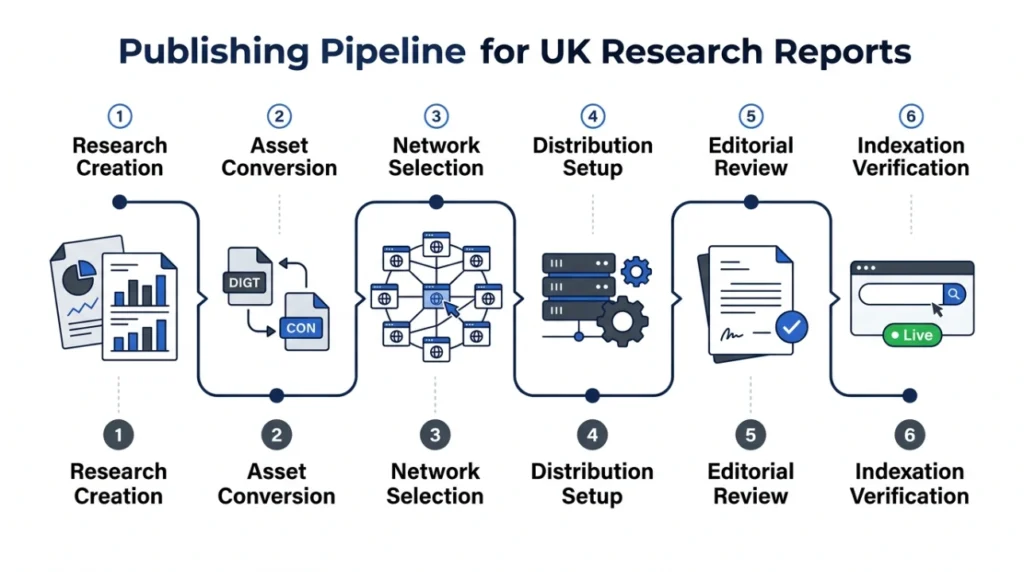
A structured workflow eliminates publishing delays and maintains editorial standards across all syndication endpoints.
Step 1: Research and Asset Production
The process begins with the creation of original primary research. Editors compile survey data, industry stats, and case studies into a comprehensive master report. Writers produce supplemental promotional assets, including:
- A 500-word press release summarizing key findings
- Three 800-word excerpt articles highlighting specific data points
- Downloadable chart graphics formatted for web display
- Short-form executive summaries for editorial pitch decks
Step 2: Media Network Selection
Distributors evaluate potential host sites based on domain rating, audience demographics, and editorial guidelines. The selected 15-site network must match the report’s geographic and vertical focus.
Step 3: Technical Formatting and Feed Distribution
Engineers prepare the files for distribution. Content management systems format the text into clean HTML, attach canonical headers, and queue the posts inside automated distribution APIs or media dashboards.
Step 4: Editorial Verification and Scheduling
Editors at the partner sites review the submitted assets to ensure compliance with local publishing guidelines. Once approved, the teams set a synchronized publication timestamp across all 15 platforms.
Step 5: Distribution and Syndication
At the scheduled timestamp, the distribution system pushes the assets live. The primary report publishes on the central host site first, followed immediately by the 15 syndicated partner instances.
Step 6: Indexation and Audit Verification
Technical teams run post-launch audits to verify that search engine crawlers index all live URLs correctly and recognize canonical tags.
How Do You Measure the Performance of a Multi-Site Publication Strategy?
Performance measurement tracks domain indexation, total referral traffic, organic keyword rankings, contextual backlink acquisition, and direct conversion rates. Analytics tools monitor traffic parameters across all 15 syndication channels to calculate total reach and return on investment.
Evaluating multi-site syndication requires monitoring both macro-level searchVisibility metrics and micro-level user conversion data. Media strategists track specific key performance indicators (KPIs) to assess channel effectiveness.
Performance Tracking Metrics
| Metric Category | Specific Indicator Tracked | Measurement Tool | Primary Goal |
| Search Engine Equity | Canonical link recognition | Google Search Console | Zero duplicate content penalties |
| Audience Engagement | Referral sessions from 15 sites | Google Analytics 4 | Increased direct website visits |
| Brand Authority | Contextual backlinks created | Ahrefs / Semrush | Higher root domain authority |
| Conversion Impact | Report downloads / Lead forms | CRM Analytics | High-intent B2B lead capture |
Analyzing Channel Contribution
Not all 15 sites yield identical results. Analytics dashboards isolate performance data by referral source, identifying which specific publication types generate the highest engagement. Organizations evaluating specialized management options like Time Intelligence Media Group often use these insights to refine site selection for future syndication campaigns.
What Are the Key Quality Standards for Multi-Site Publishing?
Multi-site publishing standards require original research, standardized canonical tagging, strict formatting compliance, and zero auto-generated text spinning. Adhering to these publishing principles ensures high search engine trust, protects brand reputation, and maintains editorial integrity across all distribution nodes.
Maintaining quality control across 15 external publishing channels prevents technical indexing issues and protects corporate credibility.
Original Primary Data
Syndicated content must stem from proprietary data, original surveys, or direct market analysis. Search engines favor reports that introduce new factual information over aggregated opinion pieces.
Strict Technical Standards
Every host site must support standard technical directives:
- Correct implementation of rel=”canonical” tags
- HTTPS security encryption on all target landing pages
- Mobile-responsive layouts for clear reading across devices
- Fast page load speeds under 2.5 seconds for optimal user experience
Consistent Editorial Guidelines
Partner sites must refrain from altering core statistics, quotes, or corporate disclosures within the syndicated material. Preserving textual accuracy maintains institutional trust and ensures regulatory compliance across all regional media channels.