Event coverage pricing defines the cost of distributing an event announcement across selected news publications and measuring the resulting media exposure. A three-tier model separates coverage by publication volume, targeting, geographic scope, reporting depth, and distribution requirements.
For UK event organisers, pricing depends on what the coverage package actually includes. A package covering 15 sites can differ substantially from another package carrying the same publication count.
Common pricing components include:
- Number of news sites included
- National or regional publication coverage
- Industry-specific publication targeting
- Press release distribution
- Editorial formatting and optimisation
- Publication monitoring
- Coverage reporting
- Published URL collection
- Search visibility support
- Geographic targeting
The 15-site requirement creates a defined comparison point. The important question is not only how much a package costs. It is what type of publications the package reaches and how closely those publications match the event.
Organisations evaluating event coverage often compare three practical tiers: entry-level, targeted, and premium distribution. Each tier serves a different communication requirement.
How do three event coverage pricing tiers differ?
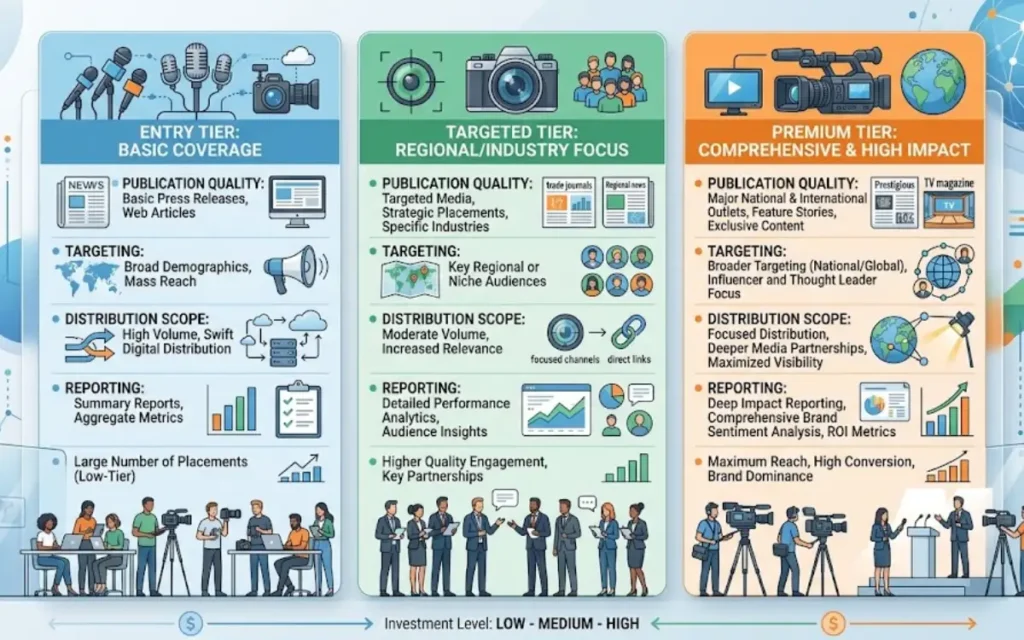
A three-tier pricing structure separates event coverage according to publication quality, targeting, distribution scope, and reporting. The entry tier focuses on basic reach, the targeted tier increases relevance, and the premium tier combines broader targeting with deeper reporting.
What does an entry-level event coverage tier include?
An entry-level tier focuses on distributing one event announcement across a defined group of news websites. The package prioritises publication volume and basic coverage reporting.
This structure suits events that require an established online media footprint without extensive audience segmentation.
For example, a local business networking event in Manchester can use entry-level coverage to establish visibility across relevant news and business websites.
The key evaluation points are:
- Number of included sites
- Publication authenticity
- Geographic relevance
- Release distribution
- Published coverage confirmation
- Basic reporting
The 15-site target provides a clear minimum distribution scope. Buyers need to verify whether all 15 sites represent active publications and whether the sites match the event’s audience.
What does a targeted event coverage tier include?
A targeted tier adds stronger publication selection. Distribution focuses on the event’s sector, location, audience, or business purpose.
A fintech conference in London provides a clear example. Financial technology publications, business media, London-based publications, and technology outlets have greater relevance than unrelated general websites.
The targeted tier therefore prioritises relevance over simple volume.
Typical components include:
- Sector-specific publications
- Regional media targeting
- Business and trade publications
- Audience segmentation
- Optimised press release distribution
- Publication-level reporting
This tier fits events where media relevance directly affects the value of coverage.
What does a premium event coverage tier include?
A premium tier combines broad publication coverage with detailed targeting and reporting. It suits events with national relevance, major announcements, established organisations, or significant commercial activity.
A national healthcare conference announcing new research provides an example. The distribution requirement includes healthcare publications, national business media, regional outlets, and specialist technology publications when digital healthcare is involved.
Premium coverage focuses on the complete distribution process. The buyer evaluates publication selection, geographic spread, sector relevance, reporting quality, and the consistency of published coverage.
How should organisations compare 15-site event coverage packages?
Organisations comparing 15-site packages need to evaluate publication relevance, geographic coverage, editorial fit, reporting, distribution scope, and actual publication delivery. The lowest quoted price does not define the strongest package without these supporting coverage details.
The 15-site figure provides a useful baseline for comparison. It creates consistency when reviewing different suppliers.
Which publication factors matter most?
Publication quality needs to be assessed using identifiable criteria.
Check:
- Publication name
- Publication category
- Geographic audience
- Industry focus
- Active editorial presence
- Existing content quality
- Relevance to the event
- Published article availability
A property conference in Birmingham requires different publication targeting from a healthcare event in Edinburgh. Both can involve 15 sites, but the appropriate publication mix differs.
How does geographic targeting affect pricing?
Geographic targeting changes the distribution requirement because UK events often have a defined local or regional audience.
Examples include:
- London events requiring London and national coverage
- Manchester events requiring North West coverage
- Birmingham events requiring West Midlands coverage
- Edinburgh events requiring Scottish coverage
- UK-wide conferences requiring national distribution
A package with 15 geographically relevant sites can deliver stronger audience alignment than 15 unrelated publications.
What should each pricing tier deliver across 15 sites?
Each tier needs a defined deliverable covering publication count, targeting, distribution method, reporting, and coverage verification. Buyers need written confirmation of what the 15-site figure represents before comparing prices or selecting a package.
What should an entry tier deliver?
An entry tier across 15 sites needs a clear publication list or defined publication criteria. It also needs confirmation that the announcement is distributed to all included destinations.
The buyer needs access to published URLs after distribution. This confirms whether the intended coverage appeared online.
The basic workflow is:
- Prepare the event announcement.
- Review the release for factual accuracy.
- Submit the release for distribution.
- Distribute it across the defined network.
- Monitor publication results.
- Provide published coverage details.
What should a targeted tier deliver?
A targeted tier needs stronger segmentation. The 15 sites need to correspond with the event’s sector, location, or audience.
For example, a UK fintech event can prioritise financial technology, banking, investment, payments, and business publications.
The value comes from the relationship between the event and the publication audience. A targeted distribution package therefore requires transparent publication selection.
What should a premium tier deliver?
A premium tier needs broader media segmentation and more detailed reporting. The package needs to establish how the 15 sites are selected and how national, regional, and specialist coverage is balanced.
Reporting can include:
- Publication names
- Published URLs
- Publication categories
- Geographic distribution
- Coverage status
- Distribution completion
- Search-related information
This gives the organisation a clearer record of media performance.
How does event type affect the right pricing tier?
The correct pricing tier depends on the event’s news value, audience, geographic footprint, and media requirements. Corporate events often need broad business coverage, while fintech, healthcare, and property events benefit from more specialised publication targeting.
The event category determines the most relevant media ecosystem.
Which tier fits corporate events?
Corporate events often require broad business and regional exposure. An entry or targeted tier fits smaller announcements, while larger company milestones require wider distribution.
Examples include:
- Business anniversaries
- Corporate launches
- Executive events
- Company expansion announcements
- Awards ceremonies
A company opening a new Birmingham facility has both corporate and regional news value. Distribution needs to reflect both dimensions.
Which tier fits conferences?
Conferences benefit from targeted distribution because their subject matter usually belongs to a defined professional sector.
A construction conference needs construction, property, engineering, infrastructure, and regional publications. A technology conference needs technology, business, innovation, and specialist media.
The targeted tier provides stronger editorial alignment.
Which tier fits fintech and healthcare events?
Fintech and healthcare events frequently require specialist publications because their audiences are professionally defined.
A fintech announcement connects with financial technology, banking, payments, investment, and regulatory subjects. A healthcare event connects with medical, health technology, pharmaceutical, public health, and healthcare management subjects.
Premium distribution fits events requiring several specialist and national media categories simultaneously.
Which tier fits property events?
Property events have strong geographic relevance. A London property conference has different media requirements from a Glasgow property development event.
Targeted distribution works well when the objective focuses on property and regional publications. Premium distribution fits major developments and investment announcements requiring broader national exposure.
How can buyers calculate the value of event coverage pricing?
Buyers can assess value by comparing the total package cost against verified publication coverage, audience relevance, geographic targeting, reporting quality, and the commercial purpose of the event. Cost per publication is useful only when publication quality remains comparable.
A simple comparison uses the total package price divided by the number of verified publications.
For example, a package priced at £600 for 15 verified sites produces a nominal £40 cost per publication. This calculation does not establish quality. A package with specialist UK publications has a different value profile from one containing unrelated websites.
Additional measures provide stronger context.
Which performance measures matter?
Useful measures include:
- Cost per verified publication
- Percentage of relevant publications
- Number of regional publications
- Number of specialist publications
- Number of national publications
- Published coverage rate
- Reporting completeness
- Search visibility of published pages
These measurements help distinguish distribution volume from useful media exposure.
What should organisations check before purchasing event coverage?
Before purchasing event coverage, organisations need to verify the publication list, number of guaranteed sites, distribution process, reporting format, geographic targeting, sector relevance, delivery timeline, and terms for unsuccessful publication placements.
The purchasing decision requires documented deliverables.
What questions need clear answers?
Ask the provider:
- Are 15 publications guaranteed?
- Which publication categories are included?
- Are national and regional sites separated?
- Are specialist publications available?
- Is the publication list provided before purchase?
- Does the package include press release distribution?
- Are published URLs supplied?
- Is reporting included?
- What happens when a publication does not publish the announcement?
- Are additional services charged separately?
These questions prevent unclear package comparisons.
A provider offering three tiers needs to define the differences between those tiers. The buyer needs to understand exactly what changes from entry-level to targeted and premium coverage.
How does event coverage pricing support different business objectives?
Event coverage pricing supports different objectives by connecting distribution scope with the required level of media exposure. Basic visibility, specialist audience access, national awareness, and detailed coverage reporting each require different distribution specifications.
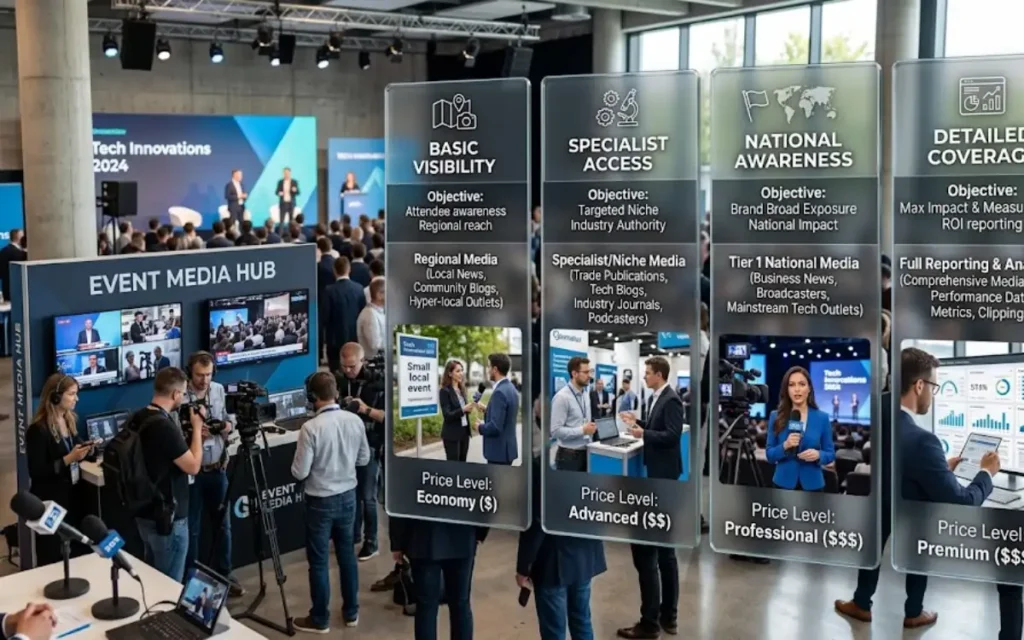
A local event focused on attendance can prioritise regional publications. A national conference can prioritise industry and business media. A major corporate event can require national, regional, and specialist coverage.
The commercial objective determines the appropriate tier.
When is a lower-cost tier appropriate?
An entry-level package fits organisations seeking basic media visibility for a defined event announcement. It provides a structured publication footprint without extensive targeting requirements.
This approach fits smaller corporate events, local networking events, community business events, and routine organisational announcements.
When is targeted coverage appropriate?
A targeted package fits organisations where audience relevance is a central requirement.
Examples include fintech conferences, healthcare events, construction conferences, technology events, and regional property events.
The publication selection directly reflects the event’s subject and location.
When is premium coverage appropriate?
Premium coverage fits announcements with broader commercial or national relevance. It provides wider media segmentation and deeper reporting across the 15-site distribution requirement.
Examples include major investment announcements, national conferences, large-scale property developments, healthcare research events, and significant fintech launches.
How should businesses choose between three event coverage pricing tiers?
Businesses should choose a tier by matching the event’s news value, target audience, geography, publication requirements, reporting needs, and budget with clearly defined deliverables. The decision needs to focus on verified coverage quality rather than price or site count alone.
The comparison begins with the event itself. The next consideration is the intended audience. The third is the required publication mix.
The three-tier model can then be applied:
Entry-level coverage fits basic visibility requirements.
Targeted coverage fits specialist or regional audience requirements.
Premium coverage fits broader national exposure and detailed media reporting.
Organisations already researching news coverage reach can use that information to identify the publication categories most relevant to their event before purchasing distribution.
Explore More Expert Insights:
Event Photography and News Coverage on 15 UK Sites
Affordable Nonprofit Event Coverage on 15 UK Sites 2026
The final decision needs to establish what 15 sites actually means within the package. A transparent publication list, defined distribution process, verified coverage, and clear reporting create a stronger basis for comparing event coverage pricing in the UK.
For organisations ready to assess specific package structures, event coverage pricing provides the appropriate decision stage for comparing coverage scope, publication count, targeting, and deliverables.
For broader educational context, see: