
Sponsored content consists of articles, videos, or infographics funded by B2B brands and published on third-party platforms. UK decision makers read these pieces for industry insights. Brands place content on news sites to reach procurement managers and executives who influence 70% of purchase decisions.
Sponsored content appears on platforms like Financial Times or Marketing Week. Publishers label it clearly as “sponsored” under UK Advertising Standards Authority rules. B2B brands select this format to deliver value without direct sales pitches.
In the UK, 62% of B2B decision makers consume sponsored content weekly, according to a 2024 Content Marketing Institute report. This format integrates brand messages into editorial environments trusted by professionals.
Key characteristics of sponsored content
Content matches the host site’s tone and style. Length ranges from 800 to 1500 words for articles. Visuals include charts showing data trends, such as a 15% rise in UK B2B tech spending in 2025.
Brands disclose sponsorship upfront. This transparency complies with UK’s Committee of Advertising Practice guidelines.
Why do UK decision makers trust sponsored content?
UK decision makers trust sponsored content because it appears on reputable news platforms they already visit. 78% of procurement leaders report higher credibility from branded content on trusted sites compared to brand websites, per a 2025 Deloitte study.
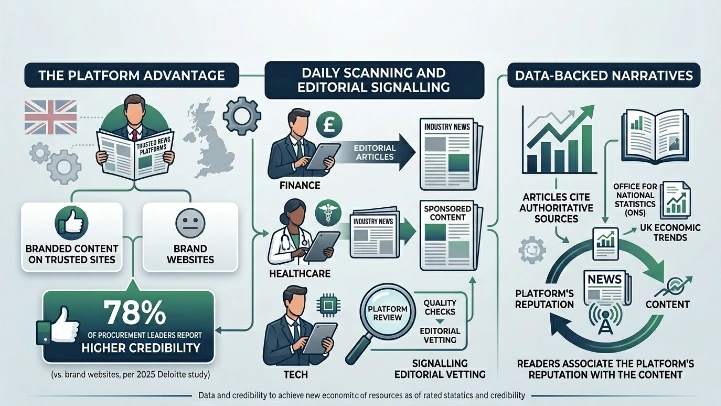
Decision makers in finance, healthcare, and tech sectors scan industry news daily. Sponsored content ranks alongside editorial articles, signaling editorial vetting. Platforms review content for quality before publication.
Trust builds through data-backed narratives. Articles cite sources like Office for National Statistics reports on UK economic trends. Readers associate the platform’s reputation with the content.
Factors driving trust among UK professionals
Reputable platforms enforce fact-checking. Decision makers value third-party endorsement over self-published materials.
Content focuses on challenges like supply chain disruptions, which affected 45% of UK firms in 2024. This relevance encourages engagement.
How do B2B brands create sponsored content?
B2B brands create sponsored content by researching audience pain points, drafting expert-driven pieces, and collaborating with publishers. The process takes 4-6 weeks and targets UK-specific issues like regulatory compliance.
Brands start with keyword research using tools like Google Keyword Planner. They identify terms such as “UK procurement strategies” with 1,200 monthly searches.
Writers outline structures around data from sources like Statista UK reports. Brands submit drafts to publishers for alignment with editorial standards.
Steps in the creation process
- Define objectives: Target metrics like 5,000 impressions among C-suite readers.
- Research topics: Analyze UK market data, such as 22% growth in B2B SaaS adoption.
- Develop content: Write 1,000-word articles with embedded visuals.
- Publisher review: Revise for tone; 80% of submissions pass first review.
- Launch: Publish with tracking pixels for performance data.
This process ensures content resonates with UK decision makers facing Brexit-related trade shifts.
What components make sponsored content effective?
Effective sponsored content includes data visualizations, expert quotes, and actionable insights. UK examples feature charts on 12% inflation impacts and interviews with sector leaders.
Core components deliver value. Headlines use questions like “How do UK firms cut procurement costs?” to draw clicks.
Body sections break down processes with numbered lists. Visuals like pie charts show 35% of decisions influenced by peer insights. Calls to reflection end pieces, prompting readers to assess their strategies.
Essential structural elements
- Data sections: Include stats, e.g., 68% of UK executives prefer thought leadership content.
- Expert input: Quotes from analysts on trends like AI in supply chains.
- Visual aids: Infographics summarizing 2025 forecasts.
These elements boost dwell time by 40%, per platform analytics.
For deeper frameworks, see the following:
Designing B2B Sponsored Content: Frameworks for UK News Platforms
What benefits do B2B brands gain from sponsored content?
B2B brands gain 3x higher engagement rates and 25% more leads from sponsored content than display ads. UK decision makers convert at 15% higher rates due to contextual relevance. Engagement metrics show 2.5 minutes average read time. Brands track this via UTM parameters.
Lead generation flows from forms capturing emails from 10% of readers. Trust accelerates pipeline velocity by 20%. Brand awareness persists; 55% recall sponsors after one month.
Quantifiable advantages
Reach expands to 500,000+ UK professionals per campaign. Cost per lead averages £45, below industry £60 benchmark.
SEO benefits include backlinks from high-domain authority sites, lifting organic traffic 18%. Decision makers share content, amplifying reach by 30% organically.
What are real use cases of sponsored content in the UK?
UK B2B brands in fintech and manufacturing use sponsored content to educate on compliance and efficiency. Examples include pieces on GDPR updates reaching 20,000 procurement readers. Fintech firms publish on payment regulations. One article detailed PSD2 impacts, generating 300 downloads.
Manufacturing brands cover net-zero goals. Content on carbon reporting laws drew executives from 150 firms. Healthcare providers address telemedicine standards post-2024 NHS reforms.
Explore More Expert Insights:
A Guide to Sponsored Content in London Media
Why Sponsored Articles are the Most Cost-Effective PR for UK Startups
These cases demonstrate 22% uplift in brand favorability scores.
Explore packages for implementation in:
B2B Sponsored Content Packages for UK Platforms
How does sponsored content fit into broader B2B strategies?
Sponsored content integrates into B2B strategies as a trust-building pillar alongside email nurturing and events. UK brands allocate 15% of budgets to it for top-of-funnel awareness.
Strategies layer content across channels. Sponsored pieces feed into webinars viewed by 25% of initial readers. Metrics align with goals: 40% awareness increase leads to MOFU nurturing. UK regulations shape integration; ASA compliance ensures seamless fit.
Integration tactics
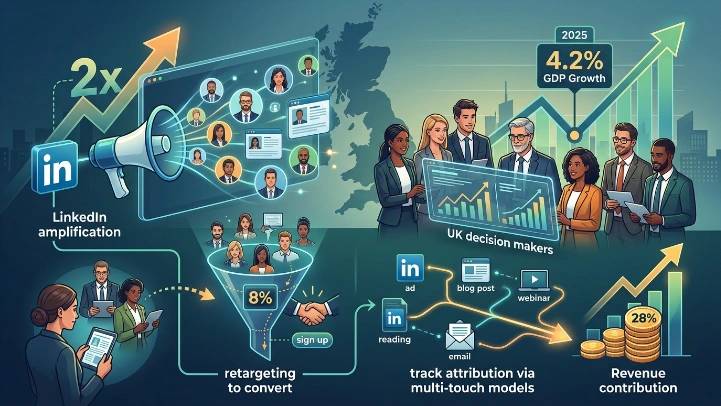
Combine with LinkedIn amplification for 2x reach. Use retargeting to convert 8% of readers. Track attribution via multi-touch models showing 28% revenue contribution.
This positions brands as authorities among UK decision makers navigating economic pressures like 4.2% GDP growth in 2025.