

Sponsored articles are paid editorial-style publications created to communicate a company’s message through a media publication while remaining clearly identified as sponsored content. They combine structured brand information, audience relevance, search visibility, and publication distribution within a controlled content format.
A sponsored article is a form of paid media content. A business funds the publication of an article that presents information about its company, product, service, research, leadership, or market activity.
The format differs from traditional advertising. Display advertising focuses on promotional messages, while sponsored articles use a longer written format. The article can explain a business development, industry trend, product category, research finding, or company perspective.
For UK startups, sponsored articles sit within a broader digital communications strategy. They provide a defined publishing route for organisations that need to communicate with specific audiences.
What makes sponsored articles different from ordinary editorial coverage?
Traditional editorial coverage is independently selected and produced by journalists or editors. Sponsored content is paid for by an organisation and published under the publication’s commercial content framework.
The distinction is important. Sponsored content requires appropriate disclosure so audiences understand its commercial nature. UK advertising and media communications also operate within established standards covering transparency and misleading claims.
A sponsored article therefore combines commercial communication with a publication format while maintaining clear identification of its sponsored status.
Why do UK startups invest in sponsored articles?
UK startups invest in sponsored articles because the format provides controlled communication, targeted audience access, searchable content, credibility through established publications, and a repeatable way to explain business developments without relying entirely on earned media coverage.
Startups operate in competitive markets where established companies already have strong visibility. A new company needs consistent communication across relevant digital channels.
Sponsored articles provide greater control over the message than earned media. The business can define the core topic, supporting evidence, positioning, and key information before publication.
Five factors explain the investment:
- Controlled brand communication
- Access to relevant audiences
- Searchable digital visibility
- Detailed explanation of complex offers
- Repeatable publication opportunities
These factors connect sponsored content with startup marketing, public relations, content marketing, and digital visibility.
How do sponsored articles give startups greater control over their message?

Sponsored articles give startups control over the central topic, factual information, supporting evidence, terminology, and communication structure, allowing businesses to present a consistent explanation of their activities across selected publications and defined audience segments.
Startups often communicate information that requires context. A short advertisement has limited space. A social media post has limited attention. A sponsored article provides room for structured explanation.
What information can a startup control?
A sponsored article can explain:
- The company’s business model
- A newly launched product
- A technology development
- Research findings
- Industry expertise
- Founder or executive insights
- A market expansion
- A new partnership
- A customer problem and its solution
For example, a UK fintech startup launching an automated accounting platform can use an article to explain the platform’s functions, target customers, regulatory considerations, and business purpose.
This structure gives the company a defined communication framework.
Control does not mean editorial independence. Sponsored content remains subject to the publication’s requirements, commercial disclosure rules, factual standards, and applicable advertising regulations.
How do sponsored articles help startups reach relevant UK audiences?
Sponsored articles help startups reach relevant UK audiences by placing business information within publications that attract readers interested in specific industries, professional sectors, geographic markets, or business topics relevant to the startup’s products and objectives.
Audience relevance is a central component of effective sponsored content. A startup selling enterprise software requires a different audience from a consumer health brand.
What determines audience relevance?
Audience relevance depends on several factors:
- Industry focus
- Publication readership
- Geographic coverage
- Business audience
- Consumer interests
- Content category
- Publication authority
- Topic alignment
For example, a Manchester-based property technology startup has stronger topical alignment with property, construction, technology, and regional business audiences than with unrelated entertainment publications.
This does not mean every reader becomes a customer. The purpose is to place relevant information where an identifiable audience already consumes industry or business content.
Audience selection also supports message consistency. A startup can create different articles for different market segments while maintaining the same core business information.
For readers researching the next stage of publication strategy,
Startup sponsored articles across 15 sites provides a natural progression from basic awareness to distribution considerations.
How do sponsored articles support search visibility?
Sponsored articles support search visibility by creating indexable web content containing relevant topics, entities, terminology, and brand information that search engines can process when evaluating online information about a startup and its activities.
Search visibility depends on many technical and content factors. A single sponsored article does not automatically create search rankings.
The value comes from creating useful, relevant, clearly structured content that adds information to the startup’s digital footprint.
Which SEO elements matter in sponsored articles?
Important elements include:
- Relevant page titles
- Clear headings
- Accurate entity names
- Natural keyword usage
- Descriptive content
- Topic relevance
- Internal website connections where permitted
- Mobile-friendly publication pages
- Search-accessible content
For example, a UK cybersecurity startup can publish an article explaining ransomware prevention for small businesses. The article establishes associations between the company, cybersecurity, ransomware prevention, and UK business requirements.
Search engines process these relationships through the content and surrounding page information.
Sponsored articles also create additional branded search results. A startup with several legitimate publications discussing its activities develops a broader online information footprint than a startup relying on one website alone.
However, sponsored publication is not equivalent to guaranteed ranking improvement. Search engines evaluate content quality, relevance, authority, technical accessibility, and other signals.
How do sponsored articles explain complex startup products?
Sponsored articles give startups enough space to explain complex products, technologies, business models, and services through structured information that covers the problem, solution, functionality, market relevance, evidence, and practical application in greater detail.
Complex products often require education before purchase consideration. This is particularly relevant in sectors such as fintech, health technology, cybersecurity, artificial intelligence, climate technology, and business software.
What can a detailed article explain?
A structured article can cover:
- The market problem
- The startup’s approach
- Product functionality
- Target users
- Practical applications
- Supporting evidence
- Industry context
- Business implications
For example, an AI software startup can explain how its system processes business data, which workflows it supports, what users need to provide, and how the technology fits within existing operations.
This level of explanation gives audiences information that short-form advertising frequently cannot provide.
It also supports informed evaluation. Readers can understand the product category before deciding whether the company is relevant to their needs.
How do sponsored articles build a broader digital presence?
Sponsored articles build a broader digital presence by placing consistent, searchable information about a startup across relevant online publications, expanding the number of digital environments where audiences can encounter the company and its core business information.
A startup’s digital presence includes more than its website. It includes search results, publication pages, industry discussions, social profiles, directories, interviews, and other legitimate online references.
Sponsored content contributes another controlled source of information.
Why does publication diversity matter?
Publication diversity creates multiple points of discovery. A reader researching a startup can encounter information through different publications rather than through the company website alone.
For example, a UK climate technology startup can have separate articles discussing:
- Renewable energy technology
- Business sustainability
- Industry innovation
- UK market developments
Each article addresses a different information context while maintaining accurate company information.
This approach also supports topical relevance. Search engines and users receive additional context about the organisation and its area of activity.
The objective is not to produce duplicate articles across websites. Each publication requires relevant, useful content that fits its audience and editorial environment.
What types of UK startups use sponsored articles?
UK startups across technology, finance, healthcare, property, retail, professional services, and sustainability use sponsored articles when they need structured communication for products, market developments, expertise, research, launches, or business milestones.
Sponsored content applies across multiple startup categories because the format supports both simple and complex business information.
Which sectors commonly use this format?
Examples include:
- Fintech: payment platforms, accounting software, financial technology
- Health technology: digital health platforms and healthcare software
- Cybersecurity: security tools and data protection solutions
- Property technology: property management and real estate platforms
- Retail technology: ecommerce systems and customer technology
- Climate technology: energy efficiency and sustainability solutions
- Professional services: specialist business platforms and advisory firms
A fintech startup can focus on payment innovation. A property technology company can explain digital property management. A cybersecurity business can educate readers about emerging security risks.
The topic changes according to the startup’s market, audience, and communication objective.
How should startups evaluate sponsored articles?
Startups should evaluate sponsored articles according to audience relevance, publication quality, content standards, transparency, topical alignment, search accessibility, measurable objectives, and consistency with the company’s wider communications and marketing strategy.
Cost alone does not define the value of sponsored content.
A lower-cost publication with an irrelevant audience provides limited strategic value. A publication with strong topical relevance and an appropriate readership provides a more useful communication environment.
Which factors deserve attention?
Startups can assess:
- Publication audience
- Geographic relevance
- Industry relevance
- Content quality
- Sponsorship disclosure
- Publication standards
- Page accessibility
- Search visibility
- Content lifespan
- Reporting availability
- Alignment with business objectives
Measurement also matters. Relevant metrics include publication reach, referral traffic, branded search activity, engagement, conversions, and assisted conversions.
The correct metric depends on the purpose of the campaign.
A startup focused on awareness tracks visibility and engagement. A startup focused on lead generation tracks qualified traffic and conversions. A startup focused on thought leadership evaluates audience relevance and content engagement.
Explore More Expert Insights:
Why Financial Services Firms Choose Sponsored Content
How Retail Brands Use Sponsored Stories to Drive Sales
What is the main role of sponsored articles in startup marketing?
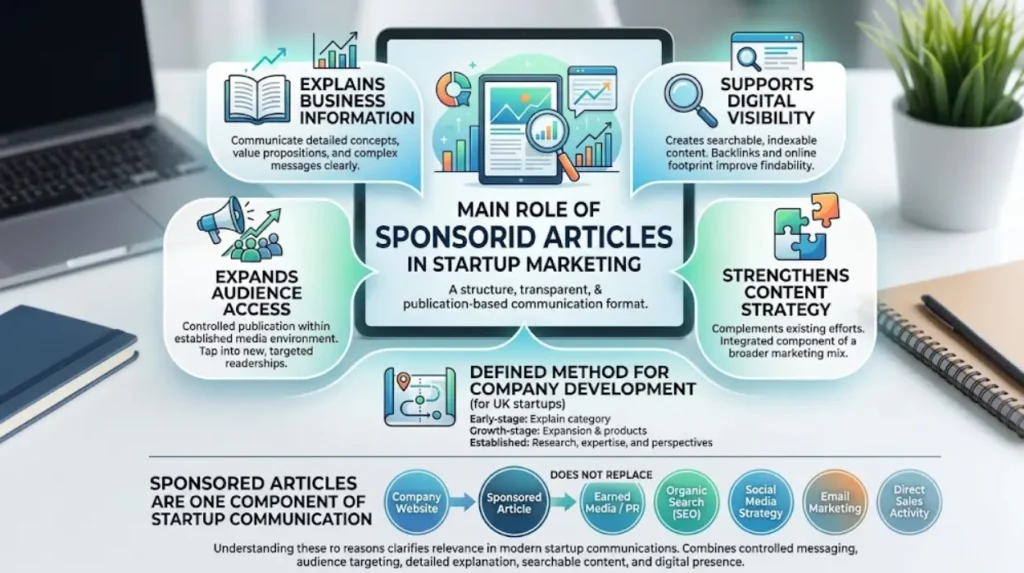
The main role of sponsored articles is to provide startups with a structured, transparent, and publication-based communication format that expands audience access, explains business information, supports digital visibility, and strengthens a broader content strategy.
Sponsored articles are one component of startup communication. They do not replace a company website, earned media, organic search strategy, social media, email marketing, or direct sales activity.
Their value comes from their specific function: controlled publication within an established media environment.
For UK startups, this format provides a defined method for communicating business information at different stages of company development. Early-stage companies can explain their market category. Growth-stage companies can communicate expansion and product developments. Established startups can publish research, expertise, and industry perspectives.
Understanding these five reasons clarifies why sponsored articles remain relevant within modern startup communications. The format combines controlled messaging, audience targeting, detailed explanation, searchable content, and broader digital presence within one structured publication approach.
For startups ready to evaluate a specific publishing solution,
Startup sponsored content provides a next-step resource focused on practical options.



