

Sponsored articles are paid editorial-style publications that communicate a startup’s product, expertise, milestone, or market position through publisher websites. They combine structured brand messaging with publication formats designed for relevant UK audiences.
A sponsored article is commercial content created for publication on an established media website. The startup pays for placement, while the article follows the publisher’s required format, disclosure standards, editorial specifications, and submission process.
For startups, sponsored articles provide a controlled method for distributing a message across multiple media environments. The content can explain a product launch, introduce company leadership, present research findings, announce funding, or establish expertise within a specific sector.
The format differs from a traditional press release. A press release communicates news for journalists and media outlets. A sponsored article provides paid publishing space for a defined brand message.
Startups also use sponsored content to support broader visibility strategies. The approach becomes more effective when publication choices match the startup’s sector, audience, geographic market, and campaign objective.
For businesses researching the topic,
Sponsored articles provides useful context on why UK startups invest in this form of media exposure.
How do startups publish sponsored articles across 15 sites?
Startups publish sponsored articles across 15 sites by defining campaign goals, preparing one core article, adapting it for publisher requirements, selecting relevant websites, coordinating submissions, reviewing publication details, and monitoring every live placement.
A 15-site campaign requires structured coordination. Each publication has its own content requirements, audience profile, formatting rules, and commercial publishing conditions.
The process normally begins with campaign planning.
Step 1: Define the campaign objective
The startup identifies one primary objective. Examples include:
- Increasing awareness of a new product
- Communicating a funding announcement
- Building founder visibility
- Supporting a new market entry
- Explaining a technical solution
- Establishing sector expertise
A defined objective determines the article angle and publisher selection.
Step 2: Create the core article
The startup develops a central article around a specific topic. The content contains factual information, relevant terminology, supporting evidence, and a clear connection to the company.
For example, a UK fintech startup launching an automated accounting platform can publish an article about digital accounting processes for small businesses. The company becomes relevant through the subject rather than relying entirely on promotional claims.
Step 3: Select 15 relevant websites
The publisher list determines the campaign’s audience and contextual relevance. A technology startup requires technology publications and business media. A property startup requires property, business, construction, or regional publications.
The selection process considers:
- Industry relevance
- UK audience reach
- Publication authority
- Geographic relevance
- Content format
- Audience demographics
- Commercial publishing terms
The objective is not simply to reach 15 websites. It is to reach 15 relevant publishing environments.
Step 4: Adapt content for each publisher
A single article does not automatically fit every publication. Headlines, introductions, formatting, word counts, images, author information, and disclosure labels follow publisher specifications.
The central facts remain consistent. The presentation follows each site’s requirements.
Step 5: Submit and coordinate publication
The campaign then moves through submission and publishing. A structured campaign tracker records publication status, URLs, publication dates, headlines, and publisher names.
This process reduces errors across 15 placements.
What does a 15-site sponsored article campaign include?
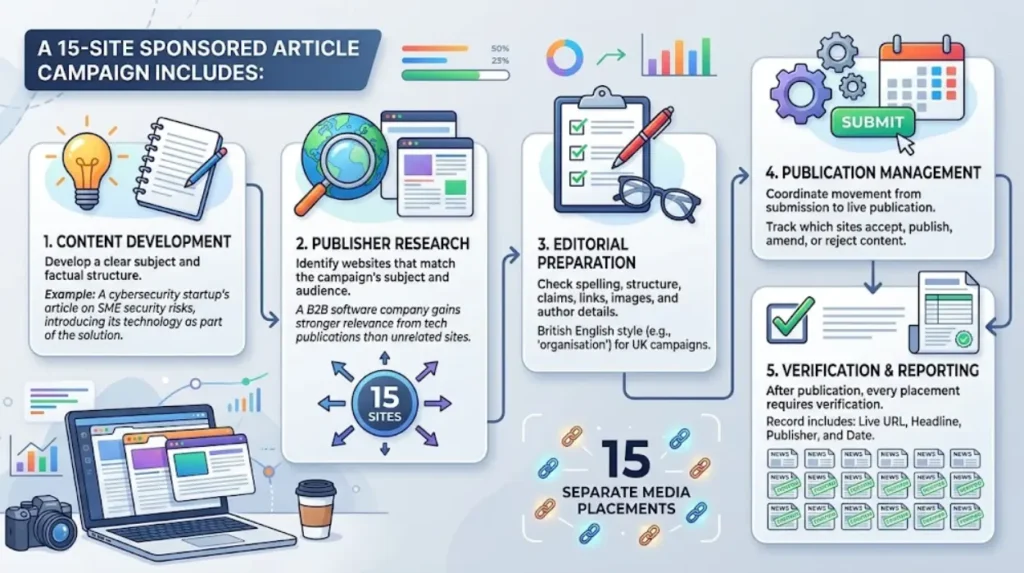
A 15-site sponsored article campaign includes content development, publisher selection, editorial preparation, submission management, publication coordination, live URL verification, and campaign reporting across 15 separate media placements.
Each component supports a different part of the publishing process.
Content development
The article requires a clear subject and factual structure. Strong content answers a defined audience question before presenting the startup’s relevance.
For example, a cybersecurity startup can publish an article explaining common security risks for UK SMEs. Its technology becomes part of a wider industry discussion.
Publisher research
Publisher research identifies websites that match the campaign’s subject and audience.
A B2B software company, for example, gains stronger contextual relevance from business and technology publications than from unrelated lifestyle websites.
Editorial preparation
Editorial preparation checks spelling, structure, claims, links, images, author details, and disclosure requirements.
British English also matters for UK-focused campaigns. Terms such as “organisation”, “optimisation”, and “programme” align the content with the target market.
Publication management
Publication management coordinates the movement from submission to live publication. The process tracks which sites have accepted, published, amended, or rejected content.
Verification and reporting
After publication, every placement requires verification. The campaign record includes the live URL, headline, publisher, date, and relevant publication details.
This creates a clear record of the 15-site campaign.
How do startups choose the right 15 publication sites?
Startups choose publication sites by matching publisher relevance with audience, industry, geography, content quality, and campaign objectives. The strongest 15-site selection creates consistent topical relevance instead of treating every publication as an identical distribution channel.
Publisher selection directly affects the value of sponsored article distribution.
Industry relevance
Industry relevance connects the article with people already interested in the subject.
A healthcare technology startup benefits from healthcare business publications, health technology websites, and relevant professional media. A property technology company uses property, construction, and business publications.
Geographic relevance
UK startups targeting British customers need UK-focused publishing environments.
Regional publications also provide useful reach when the startup operates in specific locations. A Manchester-based technology company, for example, can include Manchester business media alongside national publications.
Audience relevance
Audience relevance measures whether the publication attracts the people the startup wants to reach.
A B2B software startup targeting finance directors needs business and finance audiences. A consumer technology company requires a different publishing mix.
Content compatibility
The publication must regularly cover subjects related to the proposed article.
A site that frequently publishes technology, entrepreneurship, business growth, or startup content provides a stronger contextual environment for a startup article than an unrelated website.
How does sponsored article distribution differ from ordinary press release distribution?
Sponsored article distribution provides paid publishing space for controlled brand content, while press release distribution focuses on distributing news announcements through media channels. The two formats serve different communication objectives and follow different content structures.
A sponsored article provides greater control over the article’s structure and narrative.
A press release uses a recognised news format. It normally includes a headline, dateline, announcement details, supporting quotes, company information, and media contact information.
Sponsored content follows a different editorial model. The startup develops an informative article around a defined subject while clearly identifying the commercial relationship where required.
The distinction matters when planning a campaign.
For example, a startup announcing a £2 million funding round can distribute a press release about the investment. The same company can publish a sponsored article explaining how the funding supports expansion into new UK markets.
Both pieces communicate the same business development from different content perspectives.
What benefits do startups gain from publishing across 15 sites?
Publishing across 15 relevant sites gives startups broader media visibility, repeated exposure, controlled messaging, topical relevance, publication assets, and measurable campaign records. The approach also creates multiple opportunities for target audiences to encounter the same business story.
The first benefit is distribution breadth. Fifteen publications create 15 separate publication environments.
The second benefit is message consistency. A coordinated campaign keeps the central facts, positioning, and business information consistent across placements.
The third benefit is audience diversification. Each publication attracts a different audience segment. A startup can therefore reach national business readers, technology professionals, regional audiences, and specialist industry readers within one campaign.
The fourth benefit is content visibility. Each published article becomes a live media asset that the startup can monitor and reference.
The fifth benefit is campaign measurement. Publication records create a structured basis for evaluating where content appeared and which audiences the campaign targeted.
These benefits depend on publisher relevance and content quality. A list of 15 unrelated websites does not provide the same contextual value as a carefully selected group of relevant publications.
How can startups structure sponsored articles for UK audiences?
Startups structure sponsored articles for UK audiences by using locally relevant subjects, British English, accurate market references, clear terminology, factual claims, and publication-specific formatting that matches the expectations of UK business and specialist media.
UK localisation starts with language.
British spelling creates consistency across the article. The content also needs references that make sense within the UK market.
For example, a UK fintech article can discuss UK SMEs, British financial regulations, local business conditions, or relevant market developments when those subjects directly support the article.
Use a specific subject
A specific subject improves relevance.
“Technology trends” is broad. “How automation changes financial reporting for UK SMEs” provides a defined subject and audience.
Use factual evidence
Claims require accurate supporting information. Statistics, company figures, product details, and market references need verification before publication.
Keep promotional claims controlled
Sponsored content remains commercial content, but excessive promotional language reduces informational value.
A stronger article explains a market problem, presents relevant information, and then establishes the startup’s position within that context.
When is publishing sponsored articles across 15 sites useful for startups?
Publishing across 15 sites is useful when a startup needs coordinated visibility for a launch, funding announcement, market expansion, product education, founder positioning, or sector campaign aimed at defined UK audiences across multiple relevant publication environments.
Product launches
A startup launching a new product can use sponsored articles to explain the problem the product addresses and the market context surrounding the launch.
Funding announcements
Funded startups can use sponsored content to communicate expansion plans, investment priorities, and business developments beyond a short funding announcement.
Market expansion
A company entering a new UK region can select national and regional publications to support awareness in specific markets.
Founder positioning
Founder-led companies can publish expertise-driven articles covering subjects connected to their industry.
For example, a cybersecurity founder can contribute a sponsored article explaining security challenges affecting UK SMEs.
Sector education
Complex products often require explanation before customers understand their value. Sponsored articles provide space for detailed educational content around areas such as fintech, health technology, artificial intelligence, property technology, and business software.
How should startups evaluate a 15-site sponsored article campaign?
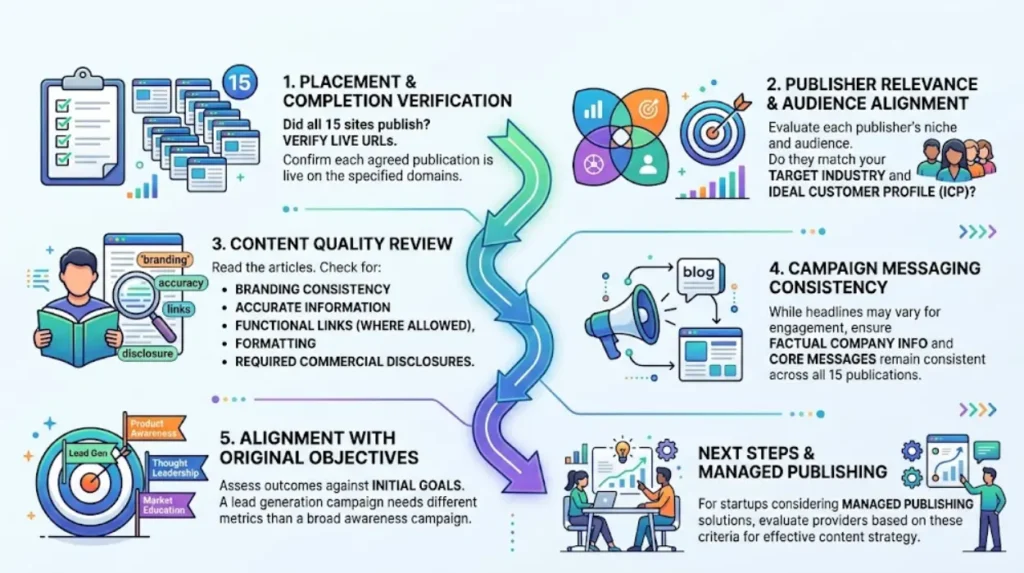
Startups evaluate a 15-site campaign by reviewing publisher relevance, content quality, publication completion, audience alignment, live URLs, campaign consistency, and measurable visibility outcomes against the original communication objective.
The evaluation begins with completion. All 15 planned placements need verification.
The second measure is relevance. The startup reviews whether each publisher matches the intended industry and audience.
The third measure is content quality. Published articles need accurate information, correct branding, functioning links where permitted, appropriate formatting, and required commercial disclosures.
The fourth measure is campaign consistency. Headlines and messaging can vary by publisher, but factual company information must remain accurate.
The final measure is objective alignment. A campaign designed for product awareness requires different evaluation criteria from a campaign designed for founder positioning or market education.
For startups considering a managed publishing approach,
Startup sponsored content provides the next stage for evaluating a specific solution.
What is the overall process for publishing 15 sponsored articles?
The complete process moves from campaign objective and audience definition to article creation, publisher selection, content adaptation, submission, publication, verification, and reporting. Each stage creates a controlled workflow for coordinated startup media distribution.
A practical workflow contains eight stages:
- Define the campaign objective.
- Identify the target UK audience.
- Create the core sponsored article.
- Research 15 relevant publication sites.
- Adapt content to publisher requirements.
- Coordinate submissions and approvals.
- Verify all 15 live publications.
- Record results and evaluate performance.
This structure keeps the campaign organised from planning through reporting.
Explore More Expert Insights:
How Financial Sponsored Content Reaches UK Audiences
How Retail Sponsored Stories Get Published on UK News
The central principle is relevance. Publishing across 15 sites creates broader exposure, but the quality of those placements depends on their relationship with the startup’s subject, audience, and market.
For UK startups, sponsored article distribution therefore works as a structured media publishing process rather than simple content duplication. A coordinated approach connects one campaign objective with multiple relevant publishing environments while maintaining consistent factual messaging.



