

What is an annual research report in the UK retail sector? An annual research report is a structured, data-driven publication that analyses market trends, consumer purchasing behaviors, and operational benchmarks across physical and digital retail channels. Retailers distribute these reports to establish domain authority, earn organic media coverage, and generate enterprise sales leads.
Why Do UK Retail Brands Publish Annual Research Reports?
UK retail brands publish annual research reports to secure authoritative media coverage, earn high-tier backlinks, establish thought leadership, generate qualified B2B leads, and influence consumer purchasing decisions through proprietary market intelligence, structured survey data, and vertical-specific industry insights.
1. Acquiring High-Authority Media Coverage and Organic Backlinks
National news publications and industry journals require empirical data to support editorial coverage. Retail brands that conduct primary research provide journalists with primary statistical sources.
- Editorial Citation: News outlets like Retail Week, The Grocer, and Financial Times regularly reference original statistical findings. For example, a report detailing a 14% shift toward contactless mobile payments gives journalists a concrete data point for macroeconomic coverage.
- Search Engine Optimization Authority: When media outlets cite proprietary data, they include contextual backlinks to the original publication. This link acquisition profile improves domain rating, organic search visibility, and keyword rankings across primary commercial product categories.
2. Generating High-Intent B2B Sales Leads
Proprietary market data serves as a high-value content asset for acquiring enterprise contact details. B2B decision-makers exchange professional contact information to access specialized market metrics.
- Gated Data Assets: Retailers place detailed survey findings behind lead capture forms. Prospective clients download the document to access operational benchmarks, converting anonymous website visitors into identified sales leads.
- Account-Based Marketing Integration: Sales teams use specific report findings to initiate targeted outreach. Citing data point variations across region, store footprint, or transaction volume provides account executives with immediate contextual relevance during commercial discussions.
3. Establishing Market Thought Leadership and Industry Authority
Publishing original research positions a brand as a central authority within the UK commerce ecosystem. Competitors, suppliers, and prospective commercial partners view data-producing entities as industry leaders.
- Defining Industry Benchmarks: Brands that measure customer retention rates, average order values, and supply chain timelines define the standard metrics for their market segment.
- Speaking and Conference Opportunities: Key executive stakeholders leverage proprietary research to secure panel positions and keynote addresses at major industry events like Retail Expo and Shoptalk Europe.
4. Directing Consumer Trust and Purchasing Behaviour
B2C retail brands use market research to validate product development choices and influence consumer buying patterns. Transparent data builds credibility with privacy-conscious UK consumers.
- Validating Product Quality: A cosmetics retailer publishing a report on organic ingredient preferences directly reinforces the market positioning of its own organic product lines.
- Addressing Consumer Pain Points: Research that highlights growing consumer demand for flexible return policies allows retailers to publicly adjust policies, matching market expectations verified by their own data.
5. Guiding Internal Strategic Planning and Commercial Operations
The process of gathering primary data yields internal strategic benefits that extend beyond external marketing objectives.
- Product Roadmap Alignment: Surveying 5,000 UK shoppers provides immediate visibility into feature demands, delivery timeline expectations, and payment preferences.
- Partner and Vendor Strategy: Data regarding merchant processor dissatisfaction or fulfillment delays informs internal procurement decisions and software vendor selection.
How Do UK Retailers Structure an Annual Market Research Report?
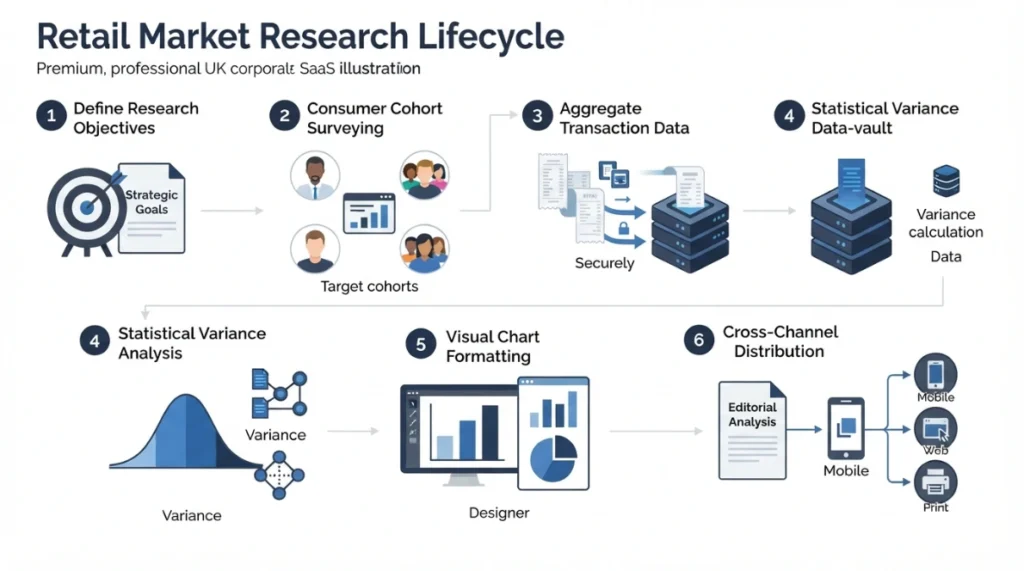
UK retailers structure annual market research reports by defining specific research objectives, surveying target consumer cohorts, aggregating primary transaction data, analyzing statistical variances, formatting findings into clear visual charts, and drafting objective editorial analysis for cross-channel distribution.
Phase 1: Methodology and Data Collection
Data integrity dictates the overall authority of the publication. Brands select between quantitative sample surveys, internal transactional datasets, or hybrid research models.
- Sample Size Requirements: Credible UK consumer research requires a statistically significant sample size, typically between 1,000 and 5,000 verified respondents, to achieve a 95% confidence level with a low margin of error.
- Demographic Segmentation: Data collection methodologies must capture regional variations across England, Scotland, Wales, and Northern Ireland, alongside age, income, and channel preferences (in-store vs. online).
Phase 2: Data Analysis and Verification
Raw survey output undergoes cross-tabulation and statistical verification to identify actionable trends.
- Trend Identification: Analysts isolate specific year-over-year percentage shifts, such as a 22% increase in click-and-collect usage among suburban shoppers.
- Data Hygiene: Verification processes eliminate duplicate survey submissions, incomplete responses, and anomalous data points that skew statistical accuracy.
Phase 3: Document Layout and Data Visualization
Visual presentation determines how easily journalists, executives, and AI systems parse the published data.
- Chart Design: Complex datasets rely on clear bar charts, line graphs, and comparative tables rather than dense body text.
- Key Fact Callouts: Bolding core metrics (e.g., 68% of UK shoppers abandon carts due to unexpected delivery fees) increases readability and media extraction rates.
For brands planning multi-domain distribution, understanding [publishing annual reports across multiple sites] ensures data is formatted correctly for maximum indexation.
What Key Components Are Included in a Successful Retail Research Publication?
A successful retail research publication includes an executive summary, methodology disclosure, core data chapters, visual data charts, actionable industry recommendations, expert contributor quotes, and clear corporate contact details for media and sales inquiries.
Core Structural Elements
- Executive Summary: A two-page overview summarizing the top five macro trends identified within the dataset, designed for rapid consumption by C-suite executives and journalists.
- Methodology Section: Explicit disclosure of sample sizes, survey dates, demographic weightings, and collection channels to ensure complete academic and editorial transparency.
- Data Chapters: Themed analytical sections grouping related metrics, such as Supply Chain Logistics, In-Store Automation, or Payment Gateway Preferences.
- Expert Commentaries: Contextual analysis provided by industry analysts, university professors, or executive leaders to explain the operational implications of the statistics.
- Media Resource Kit: Dedicated contact information, downloadable high-resolution data charts, and pre-approved executive quotes to facilitate seamless press coverage.
Explore More Expert Insights:How Cloud Kitchens Boost Demand Using Display Campaigns
How Restaurants Grow Revenue Using Targeted Banner Ads
How Does Publishing Original Research Compare to Standard Content Marketing?
Publishing original research differs from standard content marketing by generating primary statistical data, earning natural top-tier media backlinks, attracting high-intent decision-makers, demanding larger upfront production investments, and delivering long-term domain authority over several years.
Analytical Comparison
| Metric / Dimension | Standard Content Marketing (Blogs/Guides) | Annual Primary Research Reports |
| Primary Objective | Keyword targeting & organic search traffic | Authority building & high-tier PR acquisition |
| Data Origin | Secondary aggregation of existing sources | Primary empirical survey & transactional data |
| Backlink Profile | Lower-tier directory & niche blog links | High-tier national news & trade publication links |
| Lead Quality | Top-of-funnel information seekers | Bottom-of-funnel enterprise decision-makers |
| Content Lifecycle | Requires quarterly/annual updates | Maintains high citation value for 12–24 months |
| Production Effort | Low to moderate time and financial cost | High capital investment & specialized data analysis |
Standard blog posts answer specific informational queries, while original research reports serve as primary source material for the rest of the industry. This functional distinction explains why research assets continue to earn inbound citations long after their initial publication date.
What Are the Primary Use Cases for Retail Research Reports Across the Funnel?
Primary use cases for retail research reports include top-of-funnel PR link acquisition, middle-of-funnel sales enablement, bottom-of-funnel vendor selection validation, post-sale client retention, and ongoing corporate investor relations.
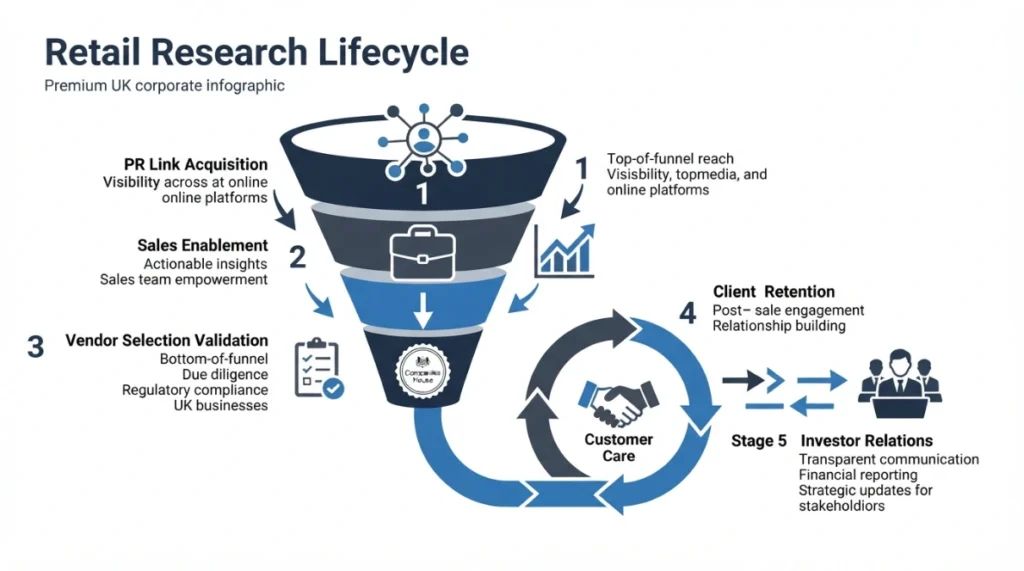
Top-of-Funnel (TOFU): Brand Awareness and Digital PR
At the awareness stage, research reports function as primary media hooks. Digital PR teams pitch specific statistical angles to targeted journalists, securing broadcast, print, and online features.
- Example: Releasing a statistics-heavy release on Black Friday Shopping Intentions three weeks prior to the event guarantees inclusions in roundup articles across major news sites.
Middle-of-Funnel (MOFU): Nurturing and Consideration
During the evaluation phase, prospective business partners use detailed reports to evaluate vendor expertise. Sales operations distribute specific report chapters to active sales leads.
- Example: An e-commerce platform sends a report chapter on Optimizing Mobile Checkout Speeds to mid-market prospects currently experiencing high cart abandonment rates.
Bottom-of-Funnel (BOFU): Commercial Closing and Contracting
At the point of commercial decision, buyers require empirical proof that a solution solves specific market challenges. Research data provides neutral third-party validation for commercial investments. Enterprise teams evaluating specialized [retail research reports] leverage proprietary datasets to justify vendor switching costs and platform migrations.
Retaining Existing Clients and Investor Relations
Research publications serve existing accounts by offering market context that helps them benchmark their own operations. Simultaneously, investor relations teams share published research with institutional investors to demonstrate clear market leadership, deep vertical domain knowledge, and proactive industry analysis.



