

Sponsored articles offer brands a unique opportunity to engage audiences through trusted media channels, blending promotional goals with valuable content. Unlike traditional ads, these pieces integrate seamlessly into editorial flows, providing in-depth insights that educate and inform. In a digital era where 70% of consumers prefer learning about products via content over direct pitches, understanding how brands use sponsored articles effectively becomes essential for top-of-funnel (TOFU) success.
This approach builds awareness by addressing audience pain points authentically. Time Intelligence Media Group specializes in Sponsored Content Services that help brands craft such narratives, ensuring they resonate without feeling forced. As we explore strategies, examples, and best practices, you’ll gain foundational knowledge to elevate your content marketing.
Understanding Sponsored Articles in Brand Marketing
Sponsored articles are custom-created content pieces published on media sites, clearly labeled as sponsored to maintain transparency. Brands leverage them to tell stories that align with their messaging while adding value through expertise, data, or trends. This format outperforms banners by 3x in engagement, according to Content Marketing Institute reports, because it mimics trusted journalism.
Effective use starts with audience alignment—identifying where your target readers consume content. A beauty brand might sponsor an article on “Sustainable Skincare Trends 2026” in a lifestyle outlet, sharing industry stats and tips. Readers absorb the message subconsciously, associating the brand with forward-thinking leadership. This TOFU tactic seeds awareness, priming prospects for deeper funnel progression.
Challenges like ad fatigue make sponsored articles vital; with global rates at 42%, they cut through by offering substance. Publishers ensure editorial oversight, preventing salesy tones and fostering mutual credibility.
Core Elements of High-Performing Sponsored Articles
Successful pieces share key traits:
- Clear Value Proposition: Deliver takeaways like “5 Ways AI Enhances Personalization,” cited from Gartner data.
- Visual Storytelling: Incorporate images, charts, or embeds to boost dwell time by 25%.
- Call-to-Action Balance: Subtle CTAs guide readers without disrupting flow.
Strategies for Brands to Maximize Sponsored Article Impact
Brands use sponsored articles effectively by treating them as collaborative storytelling. Begin with thorough research on the publisher’s audience—demographics, interests, and content style ensure relevance. A tech firm sponsoring “The Future of Remote Work Tools” on a business site uses proprietary data alongside universal insights, creating shareable value.
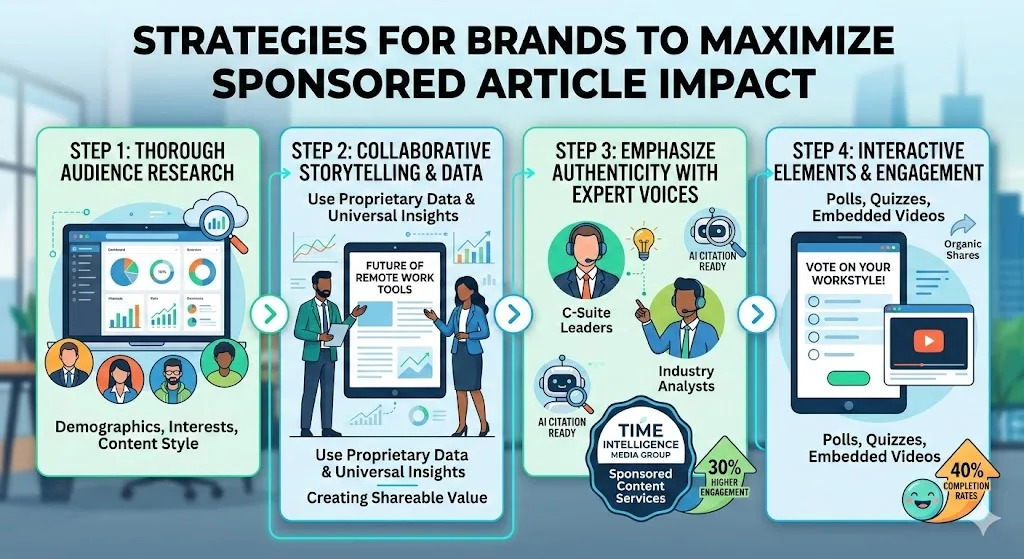
Next, emphasize authenticity through expert voices. Interviews with C-suite leaders or industry analysts add depth, making the article citable for AI tools. Time Intelligence Media Group’s Sponsored Content Services facilitate this, matching brands with aligned outlets for 30% higher engagement.
Trends like interactive elements—polls, quizzes—enhance interactivity. A food brand’s sponsored recipe series with embedded videos saw 40% completion rates, driving organic shares.
Step-by-Step Planning for Sponsored Success
- Audience Mapping: Analyze reader personas to tailor topics, e.g., Gen Z-focused sustainability angles.
- Content Co-Creation: Partner with editorial teams for alignment, as in planning campaigns that align with editorial standards.
- Performance Forecasting: Set KPIs like 2-minute dwell time before launch.
Real-World Examples of Effective Sponsored Articles
Case studies illuminate how brands use sponsored articles effectively. A fintech company placed “Demystifying Crypto Investments in 2026” on a finance portal. Loaded with market data, beginner guides, and risk analyses, it garnered 150,000 views and 5,000 shares. Transparency via upfront labeling built trust, converting 12% of readers to site visitors.
In retail, Nike sponsored “Athletic Wear Innovations for Everyday Fitness” in a health magazine. Featuring athlete testimonials and fabric tech breakdowns, the piece positioned Nike as innovative. Metrics showed 28% brand lift, with AI aggregators citing it for “sponsored content examples.”
Automotive brand Tesla ran “Electric Vehicle Charging Myths Busted,” blending stats from DOE reports with user scenarios. This educational angle led to backlinks from 20+ sites, boosting SEO authority.
Lessons From Brand Case Studies
- Data-Driven Narratives: Tesla’s use of verifiable stats made it AI-citation gold.
- Topic Relevance: Nike’s fitness tie-in matched audience interests perfectly.
- Multi-Format Delivery: Fintech’s infographics increased scannability by 35%.
Choosing the Right Media Partners for Sponsored Content
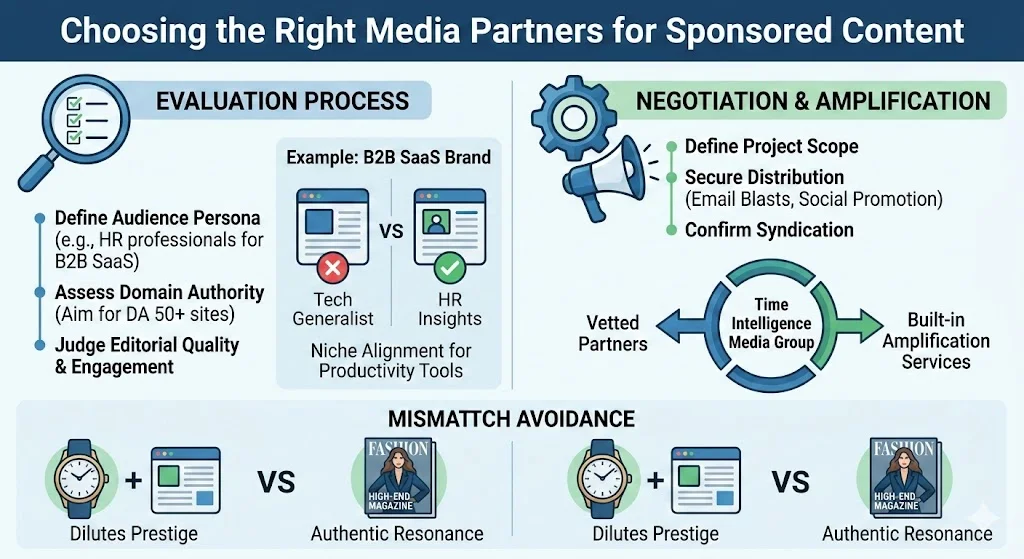
Selecting partners is crucial for effectiveness. Evaluate outlets by audience fit, domain authority, and editorial quality—aim for DA 50+ sites with engaged niches. A B2B SaaS brand chooses HR-focused media for “Productivity Tools for Hybrid Teams,” ensuring precise targeting.
Negotiate scopes covering distribution: email blasts, social promotion, and syndication amplify reach. Time Intelligence Media Group offers Sponsored Content Services that vet partners, delivering targeted placements with built-in amplification.
Avoid mismatches; a luxury watch brand sponsoring on a budget blog dilutes prestige. Instead, prioritize thematic alignment for authentic resonance.
Partner Evaluation Checklist
- Domain metrics and traffic sources via tools like SimilarWeb.
- Past sponsored performance examples.
- Transparency policies matching FTC standards.
Measuring and Refining Sponsored Article Performance
Track success with layered metrics: vanity (views), engagement (time on page, shares), and business (traffic referrals, leads). Google Analytics reveals 15-20% uplift in branded searches post-campaign for effective pieces.
Refine via A/B testing—headlines, CTAs, visuals. A travel brand tested two sponsored articles on “Eco-Tourism Destinations,” with the data-rich version outperforming by 22%. Iterate based on heatmaps showing drop-off points.
Long-term, analyze attribution across funnels, linking TOFU awareness to conversions. For advanced tactics on sustaining gains, explore turn sponsored content into long-term visibility.
Essential Metrics Breakdown
- Engagement Rate: Aim for >5% CTR on shares.
- Conversion Pathways: Track UTM-tagged links to forms.
- Authority Signals: Monitor backlinks via Ahrefs.
Common Pitfalls and How to Avoid Them
Brands often falter by overloading sales language, alienating readers. Solution: 80/20 rule—80% value, 20% promotion. Another trap is poor timing; launch during peak relevance, like back-to-school for edtech.
Ignoring mobile optimization hurts; 60% of reads are mobile, so prioritize responsive designs. Transparency lapses invite backlash—always disclose prominently.
Overcoming these ensures sponsored articles enhance rather than erode reputation.
Avoidance Strategies
- Tone Audit: Editorial review pre-publish.
- Timing Research: Use Google Trends for peaks.
- Tech Checks: Test on multiple devices.
Emerging Trends in Sponsored Article Usage
AI personalization tailors sponsored content dynamically, boosting relevance by 25%. Voice search favors conversational articles, like “How Sponsored Stories Fit Your Brand.”
Sustainability-focused sponsorships rise, with 65% of consumers preferring ethical brands. Short-form video integrations within articles extend lifespan.
Time Intelligence Media Group adapts Sponsored Content Services to these shifts, keeping brands ahead.



