
A research report brief is the document that gives a media partner the information required to plan, produce, distribute, and promote a research report. It defines objectives, audience, research scope, timelines, approval processes, and expected outcomes. A complete brief reduces delays, improves communication, and creates a structured production workflow.
What is a research report brief template?
A research report brief template is a structured document that outlines project goals, target audience, research scope, messaging, timelines, deliverables, approval contacts, and distribution requirements. It gives every stakeholder the same project direction before research, writing, design, and media outreach begin.
A research report brief is the starting point for every successful research campaign. It replaces scattered emails and informal discussions with one agreed reference document.
For UK media partnerships, the brief serves three purposes:
- Defines the business objective.
- Explains the research project.
- Establishes production and distribution expectations.
A complete brief allows researchers, editors, designers, and PR specialists to work from identical information.
For example, a fintech company launching a payments report and a construction business publishing housing market research both require different audiences, publication strategies, and media targets. The brief captures these differences before work begins.
Why does a UK media partner require a complete research report brief?
A complete research report brief gives a media partner enough information to plan research, schedule production, identify publication opportunities, prepare journalist outreach, and coordinate approvals. Clear documentation reduces revisions and keeps every project milestone aligned with business objectives.
Media partners manage multiple activities during a report campaign.
These activities include:
- Research planning
- Editorial production
- Graphic design
- Data visualisation
- Press release creation
- Media distribution
- Performance reporting
Each activity depends on accurate information supplied at the beginning.
Business objectives define the project
The brief explains exactly why the report exists.
Examples include:
- Lead generation
- Brand awareness
- Industry positioning
- Investor communication
- Government engagement
Clear objectives determine editorial direction.
Audience defines editorial decisions
The intended audience influences every content decision.
Examples include:
- Business leaders
- Procurement managers
- Financial journalists
- Technology editors
- Public sector decision-makers
Audience clarity improves publication relevance.
For guidance on preparing report messaging before briefing a media partner, see:
What information belongs inside a research report brief?
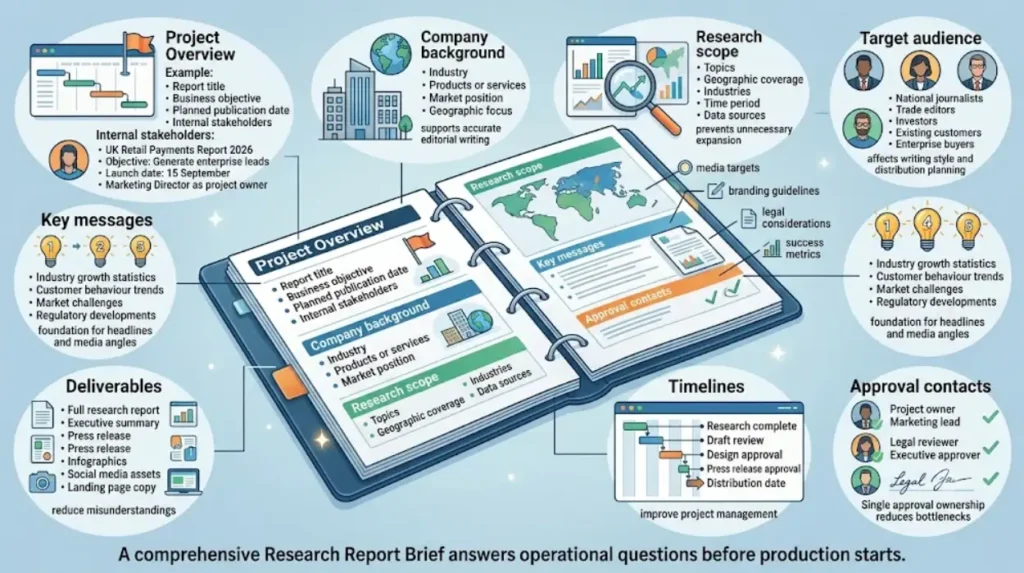
A research report brief contains project objectives, company information, audience definition, research methodology, timelines, approval contacts, key messages, publication requirements, media targets, branding guidelines, legal considerations, and success metrics in one organised document.
Every section answers operational questions before production starts.
Project overview
Begin with a short project summary.
Include:
- Report title
- Business objective
- Planned publication date
- Internal stakeholders
Example:
- UK Retail Payments Report 2026
- Objective: Generate enterprise leads
- Launch date: 15 September
- Marketing Director as project owner
Company background
Provide context about the organisation.
Include:
- Industry
- Products or services
- Market position
- Geographic focus
This information supports accurate editorial writing.
Research scope
Define exactly what research covers.
Include:
- Topics
- Geographic coverage
- Industries
- Time period
- Data sources
Specific scope prevents unnecessary expansion during production.
Target audience
Identify primary readers.
Examples include:
- National journalists
- Trade editors
- Investors
- Existing customers
- Enterprise buyers
Audience definition affects writing style and distribution planning.
Key messages
List three to five factual messages.
Examples:
- Industry growth statistics
- Customer behaviour trends
- Market challenges
- Regulatory developments
These messages become the foundation for headlines and media angles.
Deliverables
Specify every required output.
Examples:
- Full research report
- Executive summary
- Press release
- Infographics
- Social media assets
- Landing page copy
Deliverable lists reduce misunderstandings.
Timelines
Include milestone dates.
For example:
- Research complete
- Draft review
- Design approval
- Press release approval
- Distribution date
Defined milestones improve project management.
Approval contacts
List responsible decision-makers.
Include:
- Project owner
- Marketing lead
- Legal reviewer
- Executive approver
Single approval ownership reduces bottlenecks.
How does a structured brief improve research report production?
A structured brief creates consistent communication, faster approvals, clearer editorial direction, stronger project management, and more efficient media planning. Every participant understands responsibilities before production begins, reducing revisions and improving launch readiness across the entire campaign.
Research projects involve several specialists.
These often include:
- Researchers
- Editors
- Designers
- PR managers
- Marketing teams
- Senior executives
Each person depends on shared project information.
Fewer revision cycles
Missing information creates unnecessary editing.
A structured brief answers common questions before drafting begins.
This reduces duplicate work.
Faster approval processes
Clear ownership speeds decision-making.
Each reviewer knows:
- Review date
- Approval responsibility
- Final sign-off authority
Better media preparation
Media planning begins early.
Journalist lists, publication timing, and press materials develop alongside report production instead of after completion.
How does the brief support UK media coverage?
The research report brief gives media specialists enough context to identify newsworthy findings, prepare journalist outreach, create supporting materials, and align publication timing with UK editorial calendars before the report launches publicly.
Research alone does not generate coverage.
Presentation and planning influence media interest.
Editorial angles become clearer
The brief identifies:
- Major findings
- Commercial relevance
- Economic impact
- Sector implications
Editors use these themes to prepare media materials.
Supporting assets are planned earlier
Media campaigns often require:
- Charts
- Executive summaries
- Infographics
- Quote sheets
- Fact sheets
Planning begins before final production.
Understanding why some reports receive national attention also helps shape briefing documents. See:
What Makes a UK Industry Report Get Cited.
What common mistakes reduce the value of a research report brief?
Incomplete objectives, unclear audiences, missing timelines, undefined approval processes, inconsistent messaging, absent research scope, and unrealistic launch schedules reduce project efficiency and create unnecessary revisions throughout research production and media distribution activities.
Many briefing problems follow predictable patterns.
Objectives are too broad
Statements like “increase awareness” provide little direction.
Specific objectives create measurable outcomes.
Example:
Generate 250 qualified enterprise leads within 90 days.
Audience definitions are missing
Writing for everyone reduces relevance.
Define one primary audience first.
Deliverables remain unclear
Projects expand unexpectedly when outputs are not listed.
Specify every required asset before work begins.
Timelines ignore production stages
Research production includes:
- Data collection
- Analysis
- Writing
- Editing
- Design
- Approval
- Distribution
Each stage requires scheduled time.
Approval ownership is unclear
Multiple decision-makers without defined responsibility delay publication.
Assign one final approver.
What does a complete research report briefing process look like?
A complete briefing process moves from objective definition through research planning, editorial preparation, production scheduling, approval management, publication planning, media distribution, and performance reporting using one coordinated project framework.
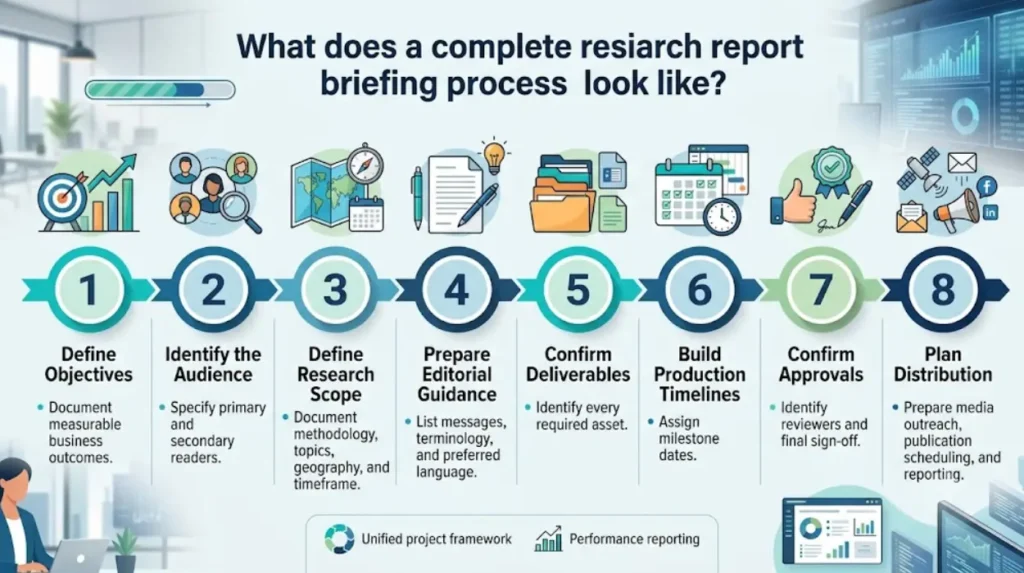
An effective workflow follows a logical sequence.
Step 1: Define objectives
Document measurable business outcomes.
Step 2: Identify the audience
Specify primary and secondary readers.
Step 3: Define research scope
Document methodology, topics, geography, and timeframe.
Step 4: Prepare editorial guidance
List messages, terminology, and preferred language.
Step 5: Confirm deliverables
Identify every required asset.
Step 6: Build production timelines
Assign milestone dates.
Step 7: Confirm approvals
Identify reviewers and final sign-off.
Step 8: Plan distribution
Prepare media outreach, publication scheduling, and reporting.
Why do businesses work with experienced UK media partners when preparing research report briefs?
Experienced UK media partners provide structured briefing frameworks, editorial planning, production management, media preparation, distribution coordination, and reporting processes that help organisations move efficiently from research concept to published report and measurable campaign outcomes.
Professional media partners standardise briefing procedures across every project.
This consistency improves communication between research teams and marketing departments.
An experienced partner typically supports:
- Brief development
- Research planning
- Editorial production
- Graphic design
- Press release preparation
- UK media distribution
- Coverage reporting
Using an established briefing process reduces administrative delays and creates a predictable production timeline.
Explore More Expert Insights:
Research as a Lead Generation Engine: A 6-Month UK Attribution Case Study
How Times Intelligence Produces, Publishes and Distributes UK Research Reports
Businesses launching national research campaigns often benefit from working with partners that understand UK editorial calendars, journalist requirements, publication scheduling, and research-led media strategies.
A well-prepared research report brief establishes the foundation for every successful campaign. It defines expectations before work begins, aligns every stakeholder around shared objectives, and supports efficient production from research planning through UK media distribution. For organisations investing in original research, providing a complete brief enables a media partner to deliver coordinated editorial, publication, and distribution outcomes with greater speed and consistency.