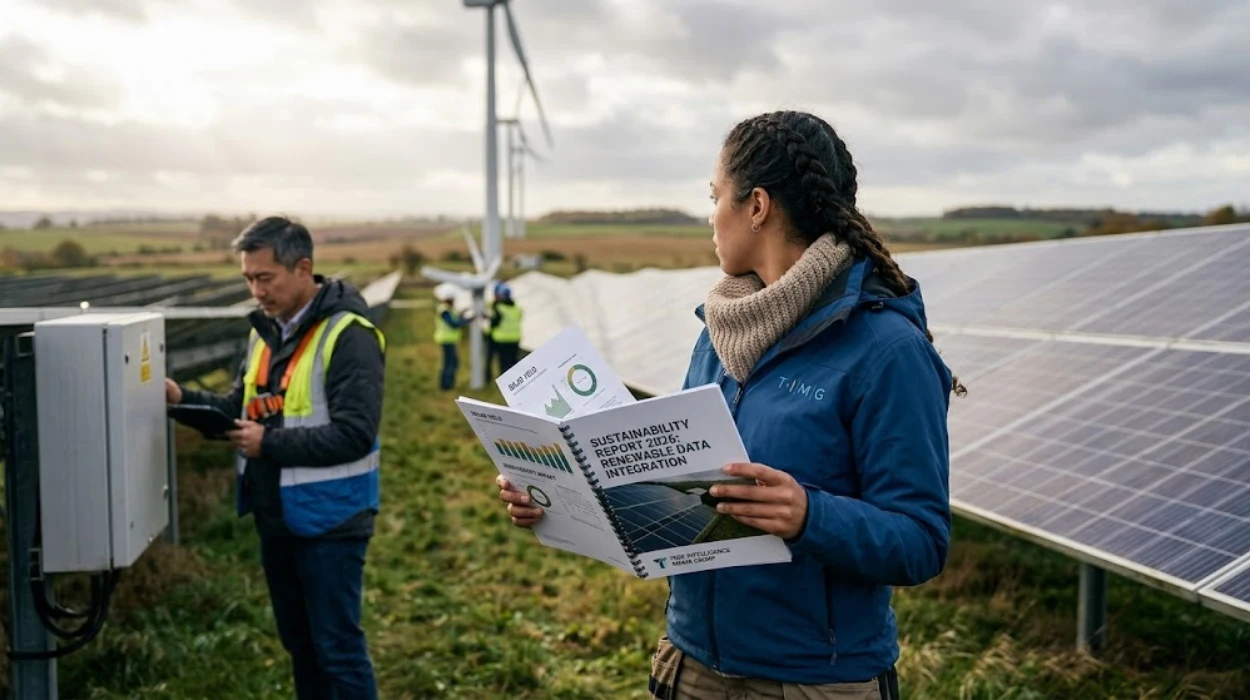
A UK research report delivers the greatest business value when it reaches the right audiences through multiple distribution channels. Promotion combines earned media, owned media, and paid media to increase visibility, generate qualified engagement, strengthen authority, and extend the lifespan of original research. A coordinated approach ensures consistent messaging across every touchpoint.
What does promoting a UK research report across earned, owned and paid channels mean?
Promoting a UK research report across earned, owned and paid channels means distributing the same research findings through media coverage, company-owned platforms, and paid advertising. This integrated strategy increases reach, reinforces credibility, attracts qualified audiences, and improves measurable marketing performance over an extended campaign period.
A UK research report is an original publication based on surveys, market analysis, customer data, or industry research. Publishing the report alone does not create visibility. Distribution determines how many people discover, reference, and share the findings.
Promotion normally includes three categories.
- Earned media refers to independent coverage from journalists, trade publications, podcasts, newsletters, and industry commentators.
- Owned media includes assets controlled by the organisation, such as websites, blogs, email newsletters, webinars, and social media profiles.
- Paid media includes sponsored content, search advertising, social advertising, and content promotion campaigns.
Each channel supports different marketing objectives. Earned media builds authority. Owned media captures and nurtures audiences. Paid media expands reach among targeted decision-makers.
For organisations developing long-term research strategies,
From Blog to Boardroom provides additional context on how reports support enterprise buyer engagement.
Why does a multi-channel promotion strategy outperform a single distribution method?
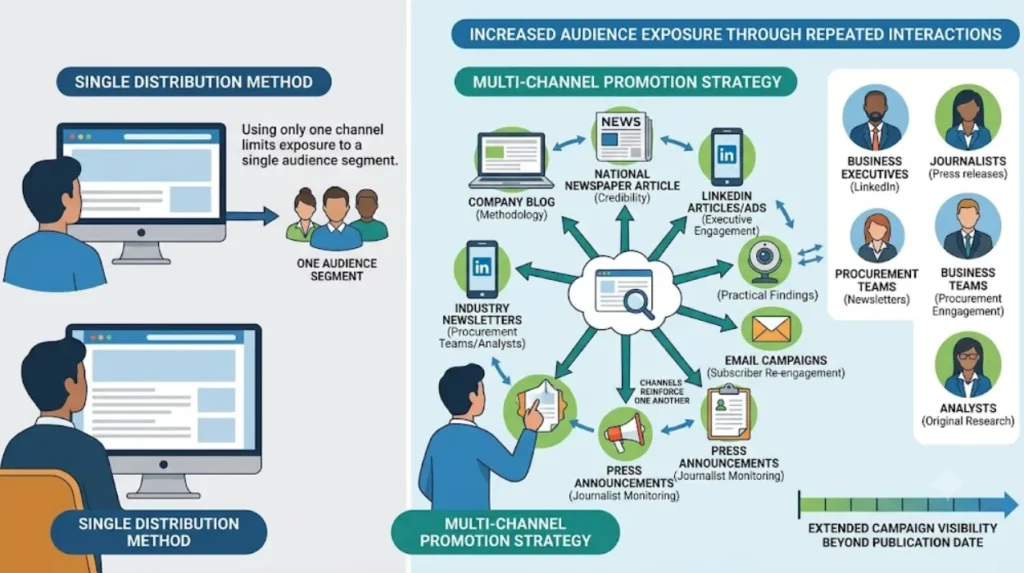
A multi-channel promotion strategy increases audience exposure through repeated interactions across different platforms. Consistent visibility improves recognition, strengthens trust, generates additional backlinks, supports lead generation, and creates more opportunities for journalists, buyers, and analysts to discover the research.
People consume information differently.
Business executives often read LinkedIn articles.
Journalists monitor press announcements.
Procurement teams subscribe to industry newsletters.
Analysts reference original research during market reviews.
Using only one channel limits exposure to a single audience segment.
Multiple channels also reinforce one another.
For example:
- A national newspaper article increases credibility.
- The company blog explains the methodology.
- A webinar discusses practical findings.
- LinkedIn advertisements promote report downloads.
- Email campaigns re-engage existing subscribers.
This coordinated approach extends campaign visibility beyond the publication date.
How does earned media increase the impact of a UK research report?
Earned media increases the impact of a UK research report by securing independent editorial coverage. Third-party reporting improves credibility, introduces findings to new audiences, generates backlinks, and encourages additional industry discussion without relying entirely on company-controlled communication channels.
Earned media depends on newsworthiness.
Journalists prioritise data that reveals new trends, unexpected findings, or measurable market changes.
What makes research newsworthy?
Research attracts media attention when it includes:
- Original survey results
- National or regional comparisons
- Industry benchmarks
- Consumer behaviour statistics
- Economic trends
- Sector forecasts supported by data
For example, a report showing that 61% of UK manufacturers plan to increase automation spending presents a clear headline supported by measurable evidence.
How can organisations improve media coverage?
Several practices increase media interest.
- Publish exclusive statistics.
- Segment findings by industry.
- Include regional comparisons.
- Provide expert commentary.
- Supply charts and graphics.
- Prepare concise press materials.
Trade publications often value industry-specific datasets. National media often prioritise wider economic or consumer trends.
How should owned channels support research promotion?
Owned channels provide complete control over messaging, audience experience, and lead capture. Organisations use websites, blogs, newsletters, webinars, and social platforms to explain findings, collect registrations, and maintain audience engagement long after initial publication.
Owned channels convert awareness into ongoing engagement.
The report landing page acts as the central destination.
Supporting content expands individual findings into additional resources.
Essential owned content assets
A comprehensive campaign commonly includes:
- Research landing page
- Executive summary
- Blog articles
- Download form
- Infographics
- Short videos
- Frequently asked questions
- Webinar registration
- Email newsletter
- Social media posts
Each asset serves a different stage of audience engagement.
For example:
A procurement director reads a media article.
They visit the landing page.
They download the report.
They register for a webinar.
They subscribe to future research updates.
Each interaction strengthens engagement.
When does paid promotion add value to research distribution?
Paid promotion adds value by expanding visibility beyond existing audiences. Advertising reaches targeted industries, job roles, geographic regions, and buying groups, increasing report downloads, event registrations, and marketing-qualified leads within defined campaign budgets.
Paid distribution complements earned and owned media rather than replacing them.
Different advertising formats serve different objectives.
Common paid channels
Search advertising captures users actively searching for industry information.
LinkedIn advertising targets decision-makers by job title, company size, and sector.
Sponsored newsletters reach specialised professional communities.
Display advertising increases awareness among relevant audiences.
Retargeting campaigns reconnect previous website visitors.
Each format supports different stages of the buyer journey.
A cybersecurity report, for example, often targets CISOs, IT directors, compliance managers, and technology consultants using LinkedIn audience segmentation.
How can one research report become multiple content assets?
One research report produces dozens of reusable content assets through structured content repurposing. Breaking larger reports into focused formats increases publication frequency, reaches different audience preferences, and extends campaign visibility across several months instead of several days.
Repurposing improves return on research investment.
Different audiences consume different content formats.
Examples of research repurposing
A single report can produce:
- 15 social graphics
- 10 blog articles
- 8 email campaigns
- 6 short videos
- 5 infographics
- 4 webinars
- 3 podcasts
- 2 executive presentations
- 1 annual benchmark report
Each asset references the original research while addressing different audience needs.
This approach maintains consistent messaging throughout the campaign.
Which metrics measure successful research promotion?
Successful research promotion is measured through visibility, engagement, lead generation, and business outcomes. Organisations monitor channel-specific metrics to identify high-performing distribution activities and optimise future research campaigns using measurable evidence instead of assumptions.
Different channels require different performance indicators.
Earned media metrics
Measure:
- Media mentions
- Publication quality
- Share of voice
- Backlinks
- Referral traffic
Owned media metrics
Measure:
- Landing page visits
- Report downloads
- Newsletter subscriptions
- Webinar registrations
- Average engagement time
Paid media metrics
Measure:
- Cost per click
- Click-through rate
- Cost per lead
- Conversion rate
- Return on advertising spend
Combining these datasets provides a complete picture of campaign performance.
Teams interested in long-term performance measurement can continue with
Research as a Lead Generation Engine to understand attribution across six months.
How can organisations coordinate earned, owned and paid promotion effectively?
Effective coordination follows a structured campaign schedule that aligns publication timing, media outreach, content releases, advertising, and performance monitoring. Sequential promotion keeps research visible for several weeks while maintaining consistent messaging across every communication channel.
Campaign coordination starts before publication.
Phase 1: Pre-launch
Prepare:
- Research report
- Landing page
- Press materials
- Visual assets
- Email sequences
- Advertising creatives
Phase 2: Launch
Publish:
- Press announcement
- Website landing page
- Executive summary
- Social media updates
- Email campaign
Begin media outreach and activate advertising simultaneously.
Phase 3: Expansion
Release:
- Industry-specific blog articles
- Regional data analysis
- Webinars
- Podcast interviews
- Executive commentary
Continue paid promotion for high-performing audience segments.
Phase 4: Ongoing optimisation
Review campaign performance every week.
Identify:
- Highest-converting channels
- Strongest media placements
- Most downloaded assets
- Highest-performing advertisements
Use these findings to improve future research campaigns.
What common mistakes reduce the impact of research report promotion?
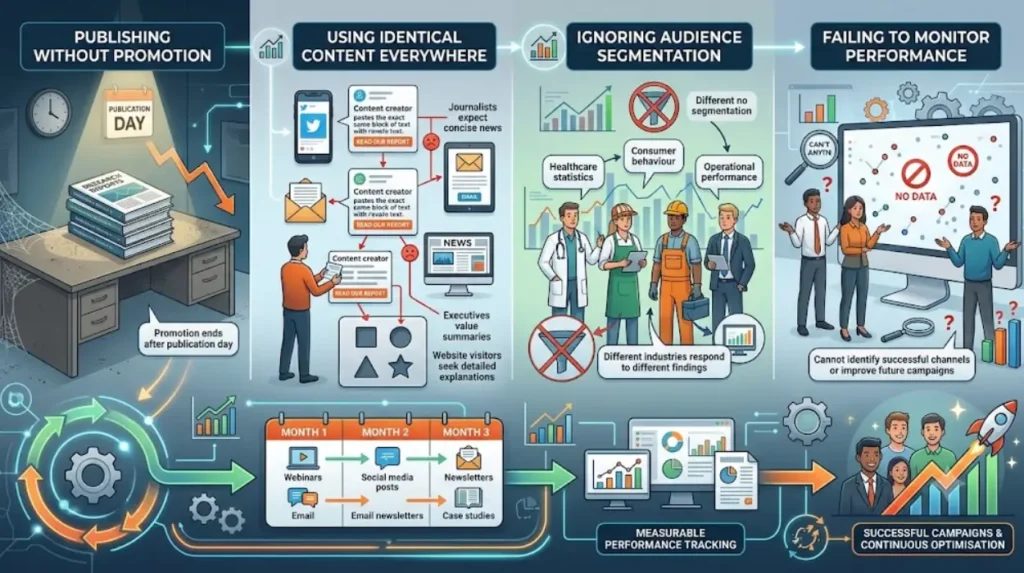
Research promotion loses effectiveness when organisations rely on limited distribution, inconsistent messaging, weak measurement, or one-time publication. Successful campaigns extend promotion over several months using coordinated communication across multiple channels supported by measurable performance tracking.
Several mistakes repeatedly reduce campaign performance.
Publishing without promotion
Many reports receive minimal attention because promotion ends after publication day.
Using identical content everywhere
Each channel requires an appropriate format.
Journalists expect concise news.
Executives value summaries.
Website visitors often seek detailed explanations.
Ignoring audience segmentation
Different industries respond to different findings.
Healthcare executives focus on healthcare statistics.
Retail businesses examine consumer behaviour.
Manufacturers prioritise operational performance.
Failing to monitor performance
Without measurement, organisations cannot identify successful channels or improve future campaigns.
Campaign reporting supports continuous optimisation.
Explore More Expert Insights:
Commissioning vs Conducting: Two Routes to UK Research Reports and Their Trade-offs
How to Use Third-Party Research to Build Authority in a Crowded UK Niche
Promoting a UK research report across earned, owned, and paid channels transforms original research into a long-term marketing asset. Earned media builds independent credibility. Owned media creates sustained engagement and captures leads. Paid promotion expands visibility among carefully targeted audiences. Together, these channels extend the lifespan of research, improve discoverability, and produce measurable business outcomes through a coordinated distribution strategy.