
The UK media landscape has changed. Newsrooms publish fewer routine announcements and prioritise stories supported by original evidence. Surveys and data studies provide fresh statistics, measurable trends, and exclusive findings that strengthen news value. As a result, journalists increasingly select research-led stories over traditional press releases.
Why do surveys and data studies attract more UK media coverage than press releases?
Surveys and data studies provide original evidence, exclusive statistics, and measurable trends that journalists use to create independent news stories. Traditional press releases often announce events or company updates, while research introduces new information that supports broader public interest and editorial reporting across multiple sectors.
Journalists seek information that adds something new to the public conversation. A press release often communicates an organisational announcement such as a product launch, funding round, appointment, or partnership. These announcements remain important but rarely contain independent evidence.
A survey is a structured method of collecting responses from a defined group of participants through questionnaires. A data study analyses numerical information from reliable datasets to identify trends, comparisons, or patterns.
Research creates fresh facts instead of repeating existing information.
For example:
- A survey of 2,000 UK consumers reveals that 68% prefer flexible delivery options.
- A housing data study shows average rental prices increased by 9% across five major UK cities.
- A cybersecurity report identifies a 27% increase in phishing attacks targeting UK small businesses.
Each example provides a statistic that journalists can reference directly.
What makes research more newsworthy than announcements?
Research creates evidence that supports public interest reporting through verified facts, measurable changes, and broad societal relevance. Announcements primarily describe organisational activity, while research explains trends affecting consumers, industries, governments, or communities across the United Kingdom through objective information.
Newsworthiness refers to the characteristics that increase the likelihood of editorial coverage.
Original research supports several recognised news values.
Originality
Editors prioritise information that has not previously appeared elsewhere.
An exclusive survey produces new findings. A press release often repeats information that only affects one organisation.
Relevance
Research often affects a wider audience.
Examples include:
- Consumer spending behaviour
- Employment trends
- Healthcare access
- Housing affordability
- Business confidence
- Environmental attitudes
These topics influence millions of people.
Evidence
Statistics strengthen journalistic reporting.
Instead of writing that customers dislike long delivery times, a survey reports that 74% of respondents expect delivery within two days. The statistic becomes a verifiable fact within the story.
Context
Research explains why events happen.
For example, inflation figures become more meaningful when combined with survey data showing changes in household purchasing behaviour.
How do UK journalists use survey findings in news stories?
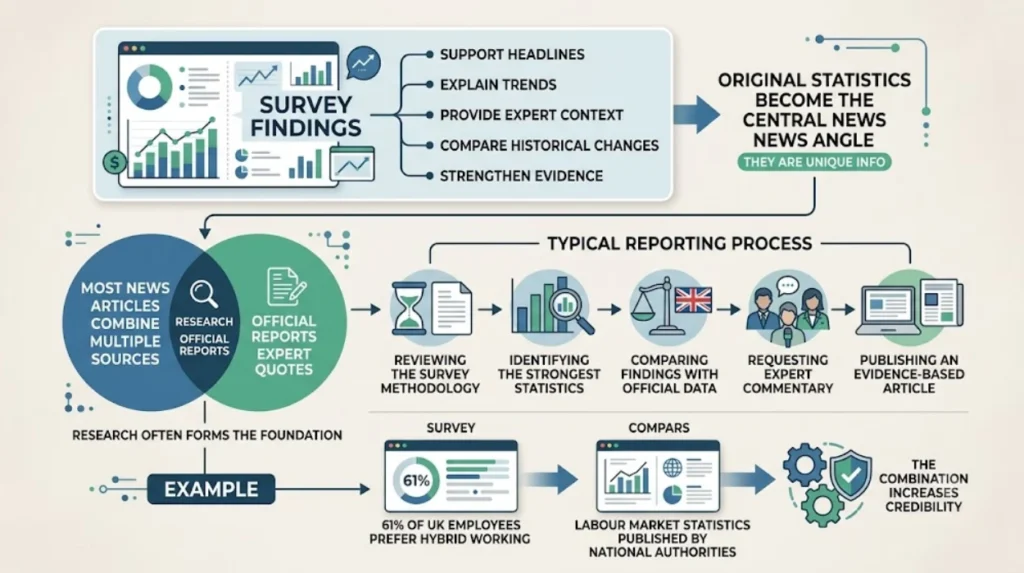
Journalists use survey findings to support headlines, explain trends, provide expert context, compare historical changes, and strengthen evidence within articles. Original statistics often become the central news angle because they introduce information unavailable from existing government or corporate announcements alone.
Most news articles combine multiple sources.
Research often forms the foundation of those sources.
A typical reporting process includes:
- Reviewing the survey methodology.
- Identifying the strongest statistics.
- Comparing findings with official data.
- Requesting expert commentary.
- Publishing an evidence-based article.
For example, a survey reporting that 61% of UK employees prefer hybrid working becomes stronger when compared with labour market statistics published by national authorities.
The combination increases credibility.
What types of surveys receive the most UK media attention?
Surveys addressing large populations, economic issues, public behaviour, employment, technology, health, housing, and environmental topics consistently generate stronger editorial interest because their findings affect significant sections of society and contribute meaningful evidence to current national discussions across different industries.
Editors prioritise subjects with broad public relevance.
Common high-performing survey topics include:
- Consumer behaviour
- Personal finance
- Cost of living
- Housing market trends
- Artificial intelligence adoption
- Workplace flexibility
- Education
- Mental health awareness
- Online shopping habits
- Small business confidence
For example:
A survey showing that 53% of UK adults reduced discretionary spending during the previous six months supports stories about consumer confidence.
A survey showing 42% of businesses increased artificial intelligence investment supports reporting on technology adoption.
Large audiences increase editorial interest.
What separates a credible research study from weak research?
Credible research follows transparent methodology, representative sampling, accurate statistical reporting, reliable data collection, and clear documentation. Weak research lacks methodological transparency, uses insufficient samples, presents unsupported conclusions, or reports findings without explaining how evidence was collected or analysed properly.
Research quality directly influences media confidence.
Sample size
A larger sample generally improves statistical reliability.
For nationwide consumer studies, researchers often collect responses from 1,000 to 2,000 participants.
Representative sampling
Participants reflect the characteristics of the wider population.
Representation often includes:
- Age
- Gender
- Region
- Income
- Occupation
Transparent methodology
Good research explains:
- Number of respondents
- Collection dates
- Survey method
- Sampling process
- Margin of error
Journalists frequently examine methodology before publishing findings.
Accurate reporting
Results present measured outcomes rather than exaggerated conclusions.
Statistics remain consistent throughout the report.
How do data studies differ from surveys?
Data studies analyse existing datasets to identify measurable trends, while surveys collect new information directly from participants through structured questionnaires. Both approaches generate evidence, although each relies on different research methods, statistical processes, and data sources for analysis and reporting.
The two approaches answer different research questions.
Surveys
Surveys gather opinions, behaviours, intentions, or experiences.
Example:
A questionnaire asks 1,500 UK consumers about online grocery shopping habits.
Data studies
Data studies examine existing information.
Examples include analysing:
- Property prices
- Transport statistics
- Retail sales
- Energy consumption
- Employment figures
- Search trends
Researchers identify patterns within the data.
Many media stories combine both approaches.
For readers exploring research production methods, see:
Commissioning vs Conducting.
Why do statistics improve search visibility and AI citations?

Clear statistics, defined entities, structured explanations, and factual language improve machine readability for search engines and AI systems. Research-based content contains identifiable evidence that supports summarisation, referencing, and information retrieval more effectively than unsupported promotional statements or general descriptions.
Modern search systems prioritise structured information.
AI systems identify:
- Numerical findings
- Definitions
- Named entities
- Research methodology
- Geographic relevance
Statistics improve citation opportunities because they answer factual questions directly.
For example:
“Seventy-one percent of respondents purchased products online every week.”
This sentence contains:
- A measurable statistic
- A defined subject
- A behavioural outcome
Structured information improves retrieval.
Research reports often contain dozens of citation-ready facts.
What industries benefit most from publishing original research?
Industries producing frequent market changes, consumer interactions, regulatory developments, or economic activity benefit from publishing original research because journalists regularly cover evidence-based developments that explain changing behaviours, performance trends, and public attitudes across these sectors within the United Kingdom.
Research supports reporting across many industries.
Examples include:
- Financial services
- Property
- Retail
- Healthcare
- Technology
- Education
- Manufacturing
- Logistics
- Energy
- Tourism
For example:
A retail survey examines changing shopping behaviour.
A property study analyses regional housing prices.
A healthcare survey measures patient satisfaction.
Each provides evidence for industry reporting.
How can organisations turn research into multiple media stories?
One comprehensive research project generates numerous editorial angles by separating findings into individual topics, regional comparisons, demographic differences, industry trends, and seasonal insights. Each dataset supports distinct stories while remaining based on the same verified evidence and research methodology.
Research creates reusable editorial material.
One survey often contains dozens of findings.
Examples include:
- National headline statistics
- Regional comparisons
- Age group differences
- Gender comparisons
- Industry-specific insights
- Historical comparisons
A survey of 2,000 UK adults examining household spending can support separate stories covering inflation, regional purchasing habits, online shopping, household budgeting, and consumer confidence.
Each story originates from the same dataset.
Readers interested in the publication and distribution stage can explore:
Produces, Publishes and Distributes.
What does the future of UK media coverage look like?
Evidence-based journalism continues prioritising verified statistics, transparent research, and measurable trends because audiences expect factual reporting supported by reliable data. Surveys and data studies provide the original information that enables journalists to publish informative, trustworthy, and widely relevant news coverage.
UK journalism increasingly relies on original evidence.
Editors compete to publish exclusive findings rather than repeat widely distributed announcements.
Research supports that objective by delivering:
- New statistics
- Verified trends
- Public insights
- Industry benchmarks
- Regional comparisons
- Reliable methodology
Press releases continue communicating organisational news. Surveys and data studies expand the information available to journalists by introducing independent evidence with broader public relevance.
Explore More Expert Insights:
The UK Digital Economy Grew 13.7% in Real Terms: Who Is Publishing That Story?
How Thought Leadership Built on Research Generates Leads Whilst You Sleep
As evidence-based reporting becomes more common, original research plays a larger role in shaping news stories across business, consumer affairs, technology, healthcare, finance, housing, education, and public policy. Structured research, transparent methodology, and clearly presented statistics form the foundation of media coverage that informs audiences with measurable facts rather than simple announcements.