
Choosing the right send window for a UK press release directly affects when journalists receive, review, and publish news. Timing influences email visibility, newsroom workflow, publication schedules, and audience engagement. A structured release schedule increases the likelihood of editorial consideration and timely coverage.
Why does the send window matter for a UK press release?
The send window determines when editors, reporters, and news desks first receive a press release. Sending during active newsroom hours improves visibility, aligns with editorial workflows, reduces inbox competition, and supports faster review and publication across UK media outlets.
A send window is the specific period when a press release is distributed to journalists and media contacts. It differs from the publication date because journalists often need time to review, verify, and prepare content before publishing.
UK newsrooms operate according to daily editorial schedules. Reporters begin reviewing emails early in the working day, assign stories during editorial meetings, and update news coverage throughout the afternoon. Press releases arriving outside these workflows often remain buried beneath newer messages.
The correct timing also depends on the purpose of the announcement. Breaking news follows different schedules from product launches, financial announcements, charity campaigns, or event promotions.
Understanding newsroom timing creates a stronger foundation before learning about distribution methods in DIY Timing vs Managed Distribution.
What is a send window?
A send window refers to the planned time period during which a press release reaches journalists’ inboxes. It includes the day, hour, and sometimes the exact minute of distribution.
For example:
- A retail product launch scheduled for 9:00 a.m.
- A financial results announcement released at 7:00 a.m.
- An event reminder distributed two days before the event at 10:30 a.m.
Each timing matches a different editorial need.
When are UK journalists most likely to review press releases?
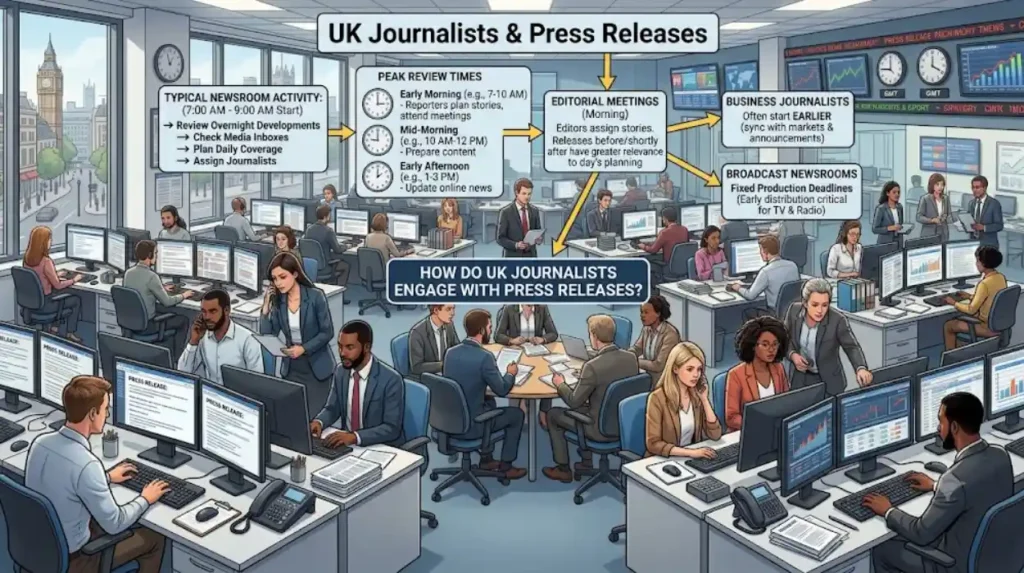
Most UK journalists review new emails during standard newsroom working hours. Early morning, mid-morning, and early afternoon receive consistent editorial activity because reporters plan stories, attend meetings, and prepare content during these periods.
Most national and regional newsrooms begin work between 7:00 a.m. and 9:00 a.m.
Editorial meetings commonly occur during the morning, when editors assign stories for the day. Releases arriving before or shortly after these meetings have greater relevance to that day’s planning.
Typical newsroom activity includes:
- Reviewing overnight developments
- Checking media inboxes
- Planning daily coverage
- Assigning journalists
- Updating online news
Business journalists often start earlier than lifestyle or feature writers because financial markets and corporate announcements begin before standard office hours.
Broadcast newsrooms also work to fixed production deadlines, making early distribution important for television and radio coverage.
Which days work best for sending a UK press release?
Tuesday, Wednesday, and Thursday provide consistent newsroom activity across most UK publications. These weekdays balance editorial staffing, planned news production, and reduced disruption from weekend planning or Monday backlog management.
Different weekdays create different newsroom conditions.
Monday
Monday inboxes contain emails received over the weekend and late Friday.
Editors also spend time reviewing the week’s priorities before assigning stories.
Tuesday
Tuesday offers stable editorial planning and active newsroom staffing.
Many organisations schedule announcements on Tuesday because journalists have completed Monday planning activities.
Wednesday
Wednesday provides another strong distribution day.
Editors continue assigning stories while preparing features and business coverage for later in the week.
Thursday
Thursday supports announcements connected to weekend events, retail promotions, entertainment, and community activities.
Friday
Friday distribution depends heavily on the subject.
Business announcements often perform well during early Friday mornings, while feature stories receive less editorial attention as newsrooms prepare weekend editions.
Weekend distribution generally targets breaking news rather than planned announcements.
What time of day delivers the strongest visibility?
Morning distribution aligns with newsroom planning, editorial meetings, and daily assignment cycles. Early working hours allow journalists sufficient time to evaluate announcements before production deadlines, increasing opportunities for same-day or next-day publication.
Timing varies according to the type of news.
Early morning
Financial reports, government updates, and corporate announcements frequently appear between 7:00 a.m. and 8:30 a.m.
This timing supports business journalists covering market developments.
Mid-morning
Many public relations teams schedule releases between 9:00 a.m. and 11:00 a.m.
Editors remain actively reviewing emails while assigning new stories.
Early afternoon
Releases distributed between 1:00 p.m. and 2:30 p.m. often support feature stories or follow-up announcements.
Late afternoon distribution receives less attention because reporters focus on publication deadlines.
Evening distribution primarily suits embargoed announcements or overnight news preparation.
How do different industries affect the ideal send window?
Industry sectors follow different news cycles because reporters specialise in distinct publication schedules. Matching release timing with sector-specific editorial routines increases relevance and improves newsroom efficiency for journalists covering specialised topics.
Different sectors operate according to different editorial calendars.
Business
Examples include:
- Quarterly earnings
- Company acquisitions
- Executive appointments
Business announcements often appear before market opening.
Technology
Examples include:
- Software launches
- Cybersecurity reports
- Artificial intelligence research
Technology publications frequently update throughout the working day.
Healthcare
Examples include:
- Clinical research
- NHS initiatives
- Medical technology
Healthcare stories often require additional editorial verification before publication.
Retail
Examples include:
- Seasonal promotions
- Consumer research
- Store openings
Retail announcements commonly align with shopping periods and seasonal campaigns.
Sports
Examples include:
- Tournament announcements
- Sponsorship agreements
- Player signings
Sports coverage follows fixture schedules and live event timing.
What factors influence the best send window?
Editorial calendars, competing news events, public holidays, embargoes, audience behaviour, and publication deadlines all influence release timing. Evaluating these factors produces a structured schedule that supports newsroom planning and improves editorial relevance.
Several variables affect timing decisions.
National news events
Major political announcements or significant national stories dominate newsroom attention.
Routine company announcements receive reduced visibility during these periods.
Public holidays
Holiday periods reduce newsroom staffing.
Publication schedules also change during Christmas, Easter, and national bank holidays.
Embargoes
An embargo instructs journalists not to publish information before a specified date and time.
Embargoes help coordinate simultaneous publication across multiple outlets.
Audience behaviour
Consumer-focused announcements often align with periods of increased public interest.
Examples include:
- Summer travel campaigns
- Christmas retail launches
- Back-to-school announcements
How can organisations plan a press release schedule?
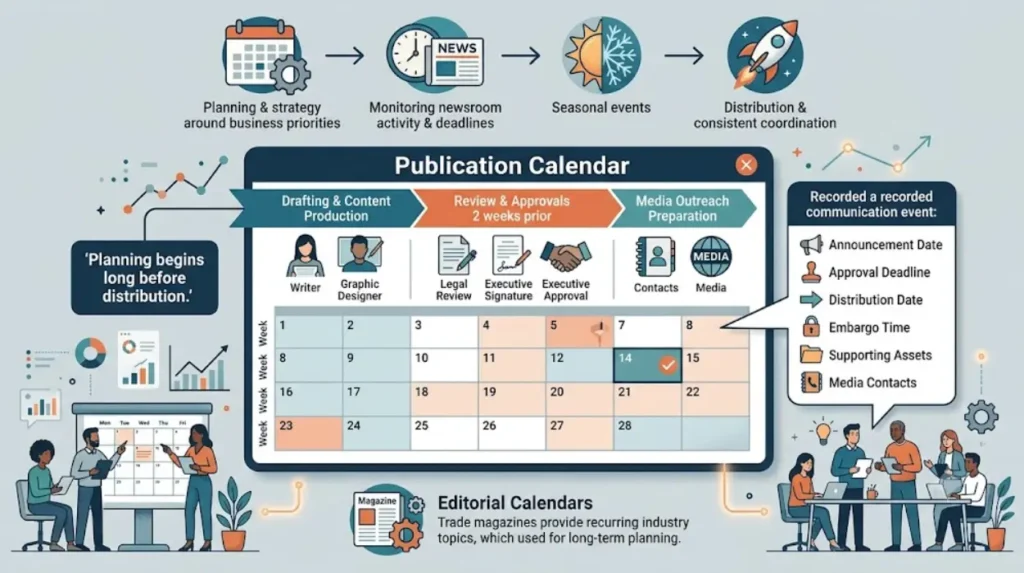
A structured publication calendar organises announcements around newsroom activity, business priorities, seasonal events, and publication deadlines. Consistent planning improves coordination, reduces scheduling conflicts, and supports more effective media communication throughout the year.
Planning begins long before distribution.
A communication calendar records:
- Announcement date
- Approval deadline
- Distribution date
- Embargo time
- Supporting assets
- Media contacts
Planning several weeks ahead also provides time for legal review, executive approval, and supporting content production.
Editorial calendars published by trade magazines also identify recurring industry topics throughout the year.
Explore More Expert Insights:
Why “No Comment” Costs UK Brands More Than a Bad Headline
How UK Property and Construction Firms Earn Media Coverage
What mistakes reduce press release visibility?
Poor timing reduces newsroom visibility by placing announcements outside editorial workflows. Common mistakes include late-day distribution, holiday scheduling, conflicting national news, inadequate planning, and ignoring publication deadlines used by UK journalists.
Several timing errors occur repeatedly.
Sending during major breaking news
Examples include:
- General elections
- National emergencies
- Major sporting finals
Large national stories dominate editorial resources.
Sending after newsroom deadlines
Late afternoon distribution limits opportunities for same-day coverage.
Many journalists have already finalised assignments.
Ignoring seasonal schedules
Journalists prepare Christmas features months before December.
Retail announcements arriving too late receive less attention.
Releasing incomplete information
Missing images, quotations, statistics, or contact details delay editorial review.
Journalists often move to the next available story rather than requesting additional material.
How does timing fit into a broader media strategy?
Timing represents one element of successful media communication alongside relevance, accuracy, audience targeting, news value, and editorial quality. Effective scheduling supports these elements by delivering information when journalists actively evaluate potential stories.
A well-timed press release cannot compensate for weak news content.
Successful media communication combines:
- Clear headlines
- Accurate information
- Verified statistics
- Relevant quotations
- Appropriate media targeting
- Proper scheduling
These elements work together to improve editorial efficiency.
Organisations comparing planning approaches can continue learning through:
DIY Timing vs Managed Distribution before exploring practical evaluation methods in:
Book a UK Press Release Timing Review With Time Intelligence Media Group.
Choosing the right send window for a UK press release involves understanding newsroom workflows, editorial calendars, publication deadlines, and industry-specific news cycles. Planned distribution supports timely review, stronger editorial relevance, and more effective communication across national, regional, trade, and digital media.
Timing is a measurable component of media planning rather than a random decision. Selecting appropriate weekdays, aligning announcements with newsroom schedules, avoiding major competing news events, and maintaining a structured publication calendar help organisations deliver press releases when journalists are most prepared to assess and publish relevant stories.