
Global organisations often distribute the same announcement across multiple countries. However, UK journalists expect content that reflects the British market, audience, regulations, and economic environment. A global announcement without local context often fails to meet editorial standards because it lacks relevance for UK readers.
Localising a global announcement means adapting the content to reflect UK facts, terminology, statistics, stakeholders, and implications while preserving the original message. This process increases editorial relevance and makes the announcement easier for UK newsrooms to evaluate.
What does it mean to localise a global announcement for the UK press?
Localising a global announcement means adapting international news into content that explains its direct relevance to the United Kingdom through UK data, regulations, organisations, locations, and audience impact while keeping the original announcement accurate and consistent across all markets.
A global announcement presents information intended for audiences in multiple countries. A localised announcement explains why that information matters within a specific market.
For UK media, localisation focuses on practical relevance instead of translating language. Editors assess whether the announcement affects UK businesses, consumers, industries, investors, employees, or public institutions.
What elements are commonly localised?
Key elements include:
- UK statistics
- British English spelling and terminology
- UK regulatory references
- Local market data
- UK customer examples
- British locations
- Quotes from UK executives
- References to UK industries
For example, an international technology company announcing a software launch can include UK adoption figures, compliance with UK data protection law, and customer examples from Manchester, Birmingham, or London instead of relying only on global performance metrics.
Why do UK journalists expect local relevance?

UK journalists prioritise stories that explain how international developments affect people, businesses, industries, or public organisations within the United Kingdom. Editorial decisions depend on local significance, factual evidence, and audience interest rather than global scale alone.
Editors receive hundreds of announcements every day. Local relevance helps them identify stories that fit their publication’s audience.
A global expansion into 25 countries becomes more relevant when the announcement explains:
- How many UK jobs are created
- Which UK cities are involved
- Which British industries benefit
- Which UK customers gain access
- Whether UK regulations apply
How is news relevance evaluated?
Editors commonly evaluate:
- Geographic relevance
- Economic impact
- Industry significance
- Timeliness
- Public interest
- Availability of supporting evidence
Announcements that answer these questions require fewer editorial revisions before publication.
How do you adapt a global announcement for a UK audience?
The localisation process follows a structured sequence that replaces broad international messaging with verified UK-specific information, terminology, examples, statistics, and context while maintaining factual consistency with the original global announcement.
A structured localisation process improves clarity and reduces inconsistencies.
Step 1: Identify the UK impact
Determine how the announcement affects:
- UK businesses
- UK consumers
- UK investors
- UK government organisations
- UK industries
The impact becomes the central theme of the local version.
Step 2: Replace global statistics
International figures rarely communicate local relevance.
Instead of stating:
8 million global users
Include:
420,000 active UK users
Specific local figures strengthen the announcement.
Step 3: Use British English
Language should follow UK editorial conventions.
Examples include:
| Global Version | UK Version |
|---|---|
| Organization | Organisation |
| Program | Programme |
| License | Licence (noun) |
| Center | Centre |
| Analyze | Analyse |
Consistent British English improves readability for UK publications.
Step 4: Include UK locations
Rather than referencing Europe generally, identify specific UK locations.
Examples include:
- London
- Bristol
- Edinburgh
- Glasgow
- Leeds
- Belfast
- Cardiff
- Manchester
Named locations provide stronger geographical context.
Step 5: Add UK expert commentary
Where appropriate, include comments from executives responsible for UK operations or specialists familiar with the British market.
Their observations should focus on measurable facts instead of promotional statements.
What information makes an announcement relevant to UK media?
UK-focused announcements contain factual information that connects international developments with British markets, regulations, organisations, employment, investment, technology, or public interest through verifiable evidence and clearly defined local implications.
Several types of information consistently increase local relevance.
UK market data
Include measurable information such as:
- UK revenue
- Customer numbers
- Market share
- Investment value
- Regional growth
UK regulation
Where applicable, explain compliance with UK legal frameworks.
Examples include:
- UK GDPR
- Financial Conduct Authority requirements
- Competition law
- Employment legislation
- Environmental reporting obligations
Local partnerships
Identify UK organisations involved in the announcement.
Examples include:
- Universities
- Local authorities
- Research institutions
- Trade associations
- UK suppliers
These references establish stronger domestic connections.
UK case studies
Examples improve clarity.
Instead of mentioning “European customers,” identify specific UK organisations or sectors.
Examples include:
- NHS suppliers
- Manufacturing firms in the Midlands
- Financial institutions in London
- Renewable energy projects in Scotland
How can global statistics be presented for UK readers?
Statistics become more meaningful when international totals are supported by verified UK figures, percentages, regional comparisons, or measurable outcomes that demonstrate the announcement’s direct importance within the British market.
Large international numbers often lack context.
Instead of presenting only worldwide achievements, include UK comparisons.
For example:
| Global Figure | UK Context |
|---|---|
| £2 billion investment | £180 million invested in UK operations |
| 40 countries | Operations across England, Scotland, Wales, and Northern Ireland |
| 3,500 employees | 420 employees based in the UK |
| 500 customers | 75 UK enterprise customers |
These comparisons improve editorial usefulness.
Supporting data from recognised government bodies, industry associations, or official reports also strengthens credibility.
How does localisation improve media coverage opportunities?
Localised announcements satisfy editorial requirements by increasing factual relevance, reducing unnecessary revisions, providing market-specific context, and making stories easier for journalists to incorporate into existing UK news coverage.
Editors seek material that fits current reporting priorities.
Announcements containing UK information reduce additional research.
Benefits include:
- Greater editorial relevance
- Faster newsroom assessment
- Clearer audience connection
- Stronger factual context
- Improved geographic specificity
These characteristics align with common newsroom workflows.
What common localisation mistakes reduce UK press interest?
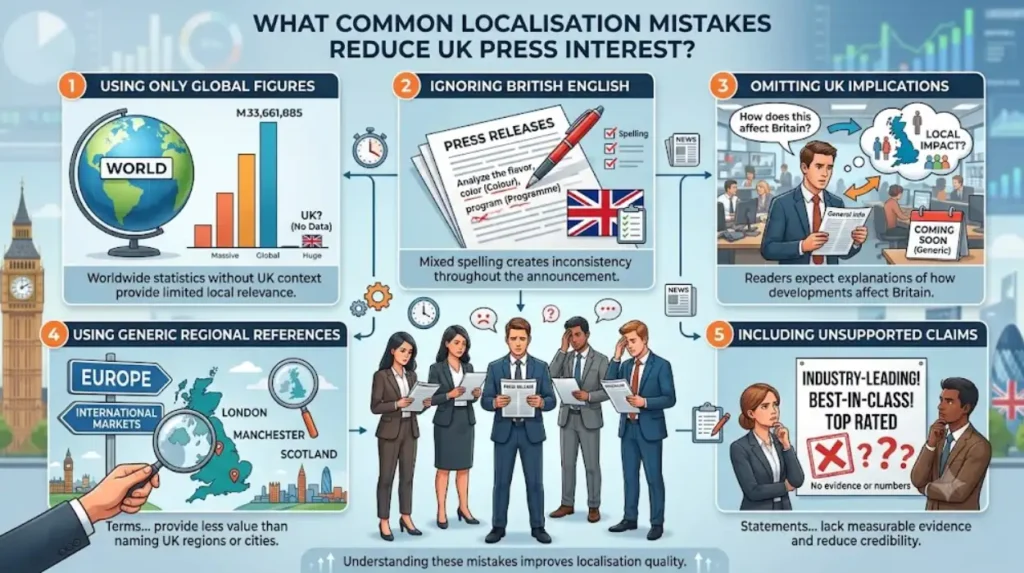
Several recurring mistakes reduce editorial relevance by leaving international announcements too broad, too promotional, or insufficiently connected to the United Kingdom through evidence, context, or measurable local impact.
Understanding these mistakes improves localisation quality.
Using only global figures
Worldwide statistics without UK context provide limited local relevance.
Ignoring British English
Mixed spelling creates inconsistency throughout the announcement.
Omitting UK implications
Readers expect explanations of how developments affect Britain.
Using generic regional references
Terms such as “Europe” or “international markets” provide less value than naming UK regions or cities.
Including unsupported claims
Statements such as “industry-leading” or “best-in-class” lack measurable evidence and reduce credibility.
Explore More Expert Insights:
What Counts as Newsworthy to UK Business Editors in 2026
How Bank Holidays and Parliament Recess Affect UK PR Timing
When is localisation especially important?
Localisation becomes essential whenever an announcement crosses national markets and requires explanation of its specific effects within the United Kingdom through market data, regulations, geography, industry context, or public relevance.
Many announcement types benefit from localisation.
Examples include:
- Product launches
- Business expansions
- Funding announcements
- Technology deployments
- Sustainability initiatives
- Research findings
- Partnership announcements
- Manufacturing investments
- Employment growth
- Regulatory updates
Each example requires different UK-specific information, but the principle remains the same: explain the domestic impact using verifiable facts.
Businesses seeking to evaluate how their distribution compares with similar organisations can explore:
How to Benchmark Your UK PR Distribution Against Competitors for additional educational guidance on measuring media performance.
How can organisations maintain consistency while localising announcements?
Consistency is maintained by preserving the core global message while adapting supporting evidence, terminology, statistics, examples, and contextual information to match UK editorial expectations without changing the announcement’s factual meaning.
Local versions should communicate the same central announcement across every country.
Only supporting details change.
Organisations commonly maintain consistency by:
- Using one approved global message
- Updating regional statistics separately
- Applying country-specific terminology
- Including verified local quotations
- Reviewing regulatory references for accuracy
This approach preserves factual consistency while improving relevance.
Organisations interested in understanding long-term approaches to UK distribution can continue with:
Why UK SMEs Trust Time Intelligence Media Group for Ongoing Distribution, which explores ongoing distribution strategies in greater depth.
Localising a global announcement for the UK press involves more than changing spelling or currency. It requires adapting international information into content that demonstrates clear relevance to British audiences through verified UK data, local regulations, geographic context, industry examples, and measurable outcomes.
Effective localisation follows a structured process: identify the UK impact, replace global figures with UK-specific evidence, apply British English, reference UK organisations and locations, and maintain consistency with the original announcement. These practices improve editorial relevance, help journalists assess stories efficiently, and create announcements that better align with the expectations of UK news publications.