
Business editors in the United Kingdom receive hundreds of press releases, announcements, and story pitches every week. Only a small percentage become published news. Editors select stories that deliver new, verified, relevant, and timely information for their audiences.
Understanding what qualifies as newsworthy helps businesses, startups, charities, public organisations, and industry experts communicate information that meets editorial standards. In 2026, business journalism continues to prioritise evidence, measurable impact, transparency, and relevance over promotional messaging.
This guide explains how UK business editors assess newsworthiness, which story types attract attention, and why some announcements receive coverage while others do not.
What does newsworthy mean to UK business editors?
Newsworthy information provides verified, timely, relevant, and meaningful developments that affect businesses, industries, consumers, investors, employees, or public policy. UK business editors evaluate stories according to editorial value rather than marketing objectives, ensuring published content serves readers with factual information and measurable significance.
Newsworthiness refers to the editorial value of a story.
Business editors ask a simple question before considering publication:
“Why does this matter today?”
If a story answers that question clearly, it has stronger editorial potential.
Editors commonly evaluate several factors together rather than relying on one characteristic alone.
Timeliness
The information must relate to a current event, recent development, or upcoming change.
Examples include:
- A funding round completed this week
- New government business legislation
- Quarterly financial results
- A product launch with a confirmed release date
Older information loses editorial value quickly.
Relevance
Editors publish stories that affect their audience.
For example:
- Manufacturers care about supply chain regulations.
- Fintech readers follow payment technology developments.
- Retail audiences monitor consumer spending trends.
The same announcement can be newsworthy for one publication but irrelevant for another.
Impact
Editors examine how many people or organisations are affected.
Examples include:
- 2,000 new jobs
- £50 million investment
- National policy changes
- Major factory expansion
- Industry-wide cybersecurity risks
Greater measurable impact generally increases editorial interest.
Why do some business announcements receive coverage while others do not?

Editors reject announcements that lack new information, measurable significance, supporting evidence, or audience relevance. Stories containing verified facts, clear data, identifiable impacts, and timely developments match editorial requirements more closely than promotional updates or routine business activities.
Many business announcements describe ordinary operations rather than genuine news.
Routine business activities rarely justify editorial coverage.
Examples include:
- Office relocations
- Website redesigns
- Minor staff appointments
- Updated logos
- General marketing campaigns
Editors instead prioritise developments that change something important.
Common reasons stories are rejected
Business editors frequently reject announcements because they contain:
- No new development
- No verified statistics
- Excessive promotional language
- Weak evidence
- No industry relevance
- Missing spokesperson attribution
- No public interest
For example:
Instead of writing:
“Our company continues delivering excellent customer service.”
Editors expect measurable information such as:
“Customer base increased by 38% during the first half of 2026 following expansion into three UK regions.”
Specific evidence improves editorial value.
Which types of business stories attract UK editors in 2026?
Business editors consistently publish stories involving funding, employment, innovation, regulation, acquisitions, financial performance, research, sustainability, technology adoption, and economic trends because these developments provide measurable information with clear relevance for professional audiences across multiple industries.
Certain categories appear repeatedly across UK business publications.
Funding announcements
Investment remains one of the strongest news categories.
Examples include:
- Seed funding
- Series A investment
- Venture capital rounds
- Growth capital
- Government innovation grants
Editors expect verified funding amounts, participating investors, intended use of funds, and business objectives.
Employment growth
Job creation reflects economic activity.
Examples include:
- Hiring 150 engineers
- Opening a regional office employing 80 staff
- Apprenticeship programmes
- Manufacturing workforce expansion
Employment figures provide measurable impact.
Financial performance
Business publications regularly report:
- Revenue growth
- Annual profits
- Quarterly earnings
- Export performance
- Market expansion
Editors prefer precise financial data instead of percentage claims without context.
Innovation
Innovation remains newsworthy when supported by evidence.
Examples include:
- New manufacturing technology
- Artificial intelligence implementation
- Medical device approval
- Renewable energy development
- Patent registrations
Innovation stories require explanation of practical impact.
Policy and regulation
Changes in government policy influence many sectors.
Examples include:
- Tax reforms
- Employment legislation
- Financial regulation
- Environmental standards
- Trade agreements
Business readers expect practical implications rather than political commentary.
How do editors evaluate evidence before publishing?
Editors verify factual accuracy using official documents, financial records, public filings, named sources, and supporting data. Evidence strengthens credibility, reduces factual errors, and enables journalists to report developments confidently while meeting editorial standards and publication policies.
Verification forms part of every newsroom workflow.
Editors examine supporting information before publication.
Common evidence sources
Editors frequently review:
- Companies House filings
- Annual reports
- Regulatory announcements
- Government statistics
- Court documents
- Financial statements
- Academic research
- Official datasets
Named sources improve transparency.
Anonymous claims receive greater scrutiny.
Quotations
Editors also assess quotations carefully.
Effective quotes explain:
- Why the development matters
- Business objectives
- Industry implications
- Future activities
Quotes repeating marketing slogans add little editorial value.
How important are data and measurable outcomes?
Verified numbers provide objective evidence that helps editors assess significance quickly. Financial figures, employment data, customer growth, investment totals, production capacity, and research findings strengthen business stories because measurable outcomes support factual reporting and independent verification.
Numbers help editors understand scale.
Compare these examples.
Less effective:
- Rapid growth
- Significant expansion
- Strong customer demand
More effective:
- Revenue increased from £4.8 million to £7.2 million.
- Production capacity increased by 45%.
- Customer registrations reached 180,000.
- Export sales expanded into 12 countries.
- Carbon emissions fell by 28%.
Specific figures communicate measurable impact.
Where possible, editors also look for comparisons across previous reporting periods.
How does industry relevance influence editorial decisions?
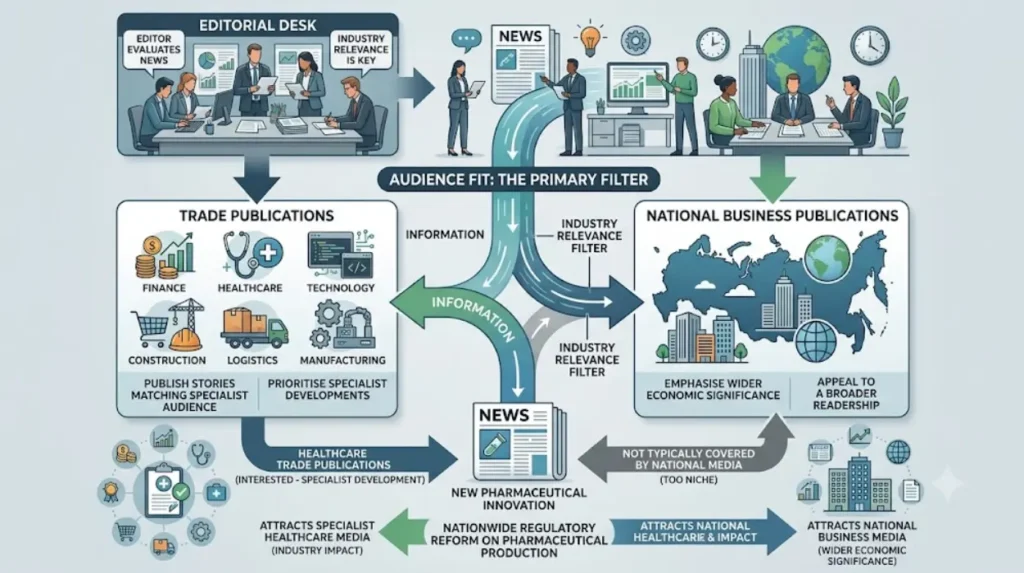
Business editors publish stories matching their publication’s specialist audience. Industry relevance determines whether information benefits readers working within finance, manufacturing, healthcare, technology, retail, logistics, construction, or other sectors covered by the publication.
Every publication serves a defined readership.
Trade publications prioritise specialist developments.
National business publications emphasise wider economic significance.
For example:
A pharmaceutical manufacturing innovation interests healthcare trade publications.
A nationwide regulatory reform affecting pharmaceutical production attracts both specialist and national business media.
Editors therefore evaluate audience fit alongside overall news value.
Readers wanting to understand how news coverage is evaluated after publication can explore:
What a Good UK Coverage Report Should Include.
What role does timing play in business news?
Timing influences editorial interest because journalists prioritise current developments linked to reporting cycles, financial calendars, economic events, government announcements, industry conferences, and breaking news. Well-timed information aligns naturally with active editorial planning and newsroom priorities.
Even highly relevant stories lose value if released too late.
Business journalism follows predictable reporting periods.
Examples include:
- Annual financial reporting season
- Budget announcements
- Interest rate decisions
- Trade exhibitions
- Economic forecasts
- Company earnings periods
Editors also monitor breaking developments throughout the day.
Stories connected to current events often receive faster attention.
Timeliness increases relevance when combined with verified information.
Explore More Expert Insights:
How Bank Holidays and Parliament Recess Affect UK PR Timing
Why Most UK Startup Funding Announcements Get No Pickup
How can organisations improve the news value of their announcements?
Organisations improve news value by presenting verified developments, measurable outcomes, supporting evidence, relevant context, identifiable sources, and clear public significance. Editorial quality increases when factual information replaces promotional language and unsupported claims throughout the announcement.
Businesses benefit from preparing announcements using an editorial perspective.
Useful steps include:
Explain what changed
State the new development immediately.
Avoid lengthy introductions.
Quantify the impact
Include measurable information.
Examples include:
- Investment value
- Jobs created
- Revenue figures
- Production increases
- Market expansion
- Research findings
Provide context
Explain why the development matters within the wider industry.
Context helps editors compare developments across competing stories.
Include supporting evidence
Reference:
- Reports
- Official statistics
- Public filings
- Independent research
- Regulatory approvals
Evidence increases credibility.
Use factual language
Editors expect objective wording.
Avoid exaggerated marketing expressions.
Instead of describing an announcement as “groundbreaking,” explain the measurable outcome that justifies attention.
Businesses planning future funding communications often continue their research with:
How Time Intelligence Media Group Supports UK Startup Funding Announcements.
Newsworthiness remains the foundation of UK business journalism in 2026. Editors evaluate every story using consistent editorial standards centred on timeliness, relevance, measurable impact, evidence, and audience value.
Announcements supported by verified facts, specific numbers, credible sources, and clear business significance receive greater editorial consideration than promotional updates lacking objective information.
Understanding these principles helps organisations communicate developments that align with modern newsroom expectations while improving clarity, transparency, and factual accuracy across business communications.