Public relations timing influences whether journalists notice, review, and publish a press release. In the United Kingdom, the news cycle changes during bank holidays and Parliament recess periods. Newsroom staffing, editorial priorities, and government activity follow different patterns during these periods. Understanding these seasonal changes helps organisations plan announcements around predictable shifts in media attention.
What are bank holidays and Parliament recess in the UK?
Bank holidays are nationally recognised public holidays when many businesses and public institutions close or reduce operations. Parliament recess refers to scheduled periods when the UK Parliament does not sit. Both events change newsroom priorities, government communications, and the overall news agenda.
Bank holidays are official public holidays observed across the United Kingdom, although dates differ between England, Wales, Scotland, and Northern Ireland. During these holidays, many journalists work reduced shifts, while some newsrooms operate with smaller editorial teams.
Parliament recess is a scheduled break in parliamentary business. During recess, the House of Commons and House of Lords do not conduct their normal legislative sessions. Government departments continue operating, but parliamentary debates, committee meetings, and many political announcements decrease.
Bank holidays in the UK
Common UK bank holidays include:
- New Year’s Day
- Good Friday
- Easter Monday
- Early May Bank Holiday
- Spring Bank Holiday
- Summer Bank Holiday
- Christmas Day
- Boxing Day
Main Parliament recess periods
Typical recess periods include:
- Christmas Recess
- Easter Recess
- Whitsun Recess
- Summer Recess
- Conference Recess
The exact parliamentary calendar changes each year.
How do bank holidays change the UK news cycle?
Bank holidays reduce newsroom staffing, alter publication schedules, and increase competition for limited editorial attention. News organisations prioritise breaking news, emergencies, major sports events, and significant public interest stories while reducing coverage of routine business announcements.
Most national newspapers continue publishing during bank holidays. However, editorial resources are often smaller than during a standard working week.
Business reporters frequently take annual leave around long weekends. Editors allocate remaining staff to high-priority coverage.
Reduced newsroom capacity
News organisations often operate with:
- Smaller editorial teams
- Fewer business journalists
- Reduced commissioning activity
- Shorter editorial meetings
Routine corporate news competes against fewer available journalists.
Different editorial priorities
Bank holiday coverage often focuses on:
- Travel disruption
- Weather
- Retail activity
- Public transport
- Tourism
- Emergency services
- Major sporting events
- Entertainment
These stories directly affect large sections of the public.
Why does Parliament recess affect political and business communications?
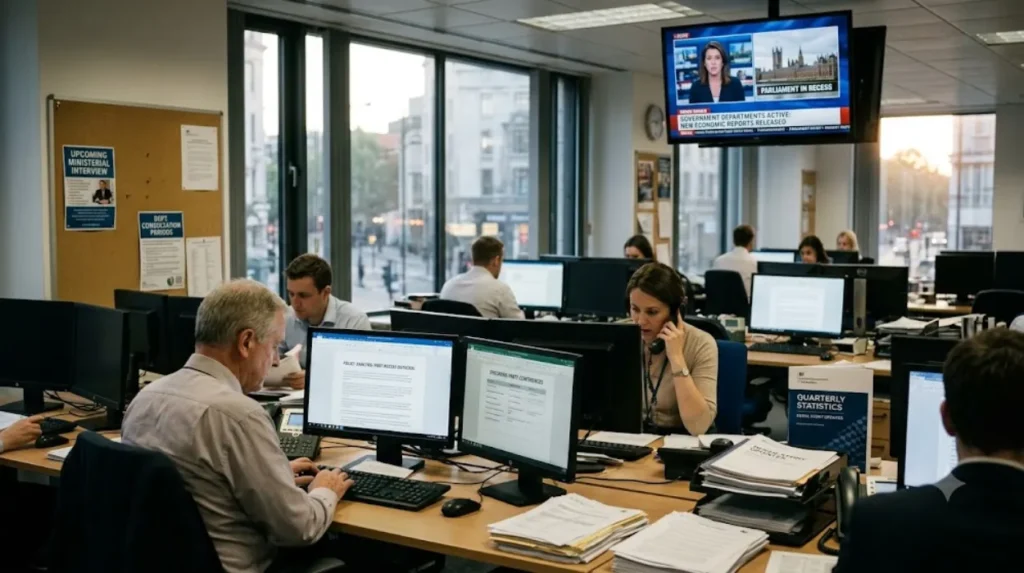
Parliament recess reduces parliamentary debates, ministerial statements, and committee activity. Political news volume often declines, creating a different editorial environment where government-related announcements receive less immediate parliamentary scrutiny but compete with alternative seasonal news topics.
Many political correspondents adjust their coverage during recess.
Without daily parliamentary proceedings, political reporting often shifts toward:
- Policy analysis
- Party conferences
- Ministerial interviews
- Long-form investigations
- International affairs
Government departments remain active
Parliament recess does not stop government activity.
Departments continue publishing:
- Official statistics
- Consultation documents
- Regulatory updates
- Procurement notices
- Economic reports
Some scheduled publications continue regardless of parliamentary sitting dates.
Business implications
Organisations connected to public policy often monitor recess periods because parliamentary questions and committee hearings pause during these scheduled breaks.
When is the best time to issue a UK press release around bank holidays?
Press releases receive more consistent editorial review during normal working weeks with full newsroom staffing. Avoiding public holidays and long weekends improves alignment with standard editorial workflows and increases opportunities for journalist engagement.
Timing affects visibility.
Many communications teams avoid distributing routine announcements immediately before bank holiday weekends.
Before a bank holiday
Late Friday distributions before a long weekend often receive limited attention because journalists are preparing future editions or beginning leave.
During a bank holiday
Only high-priority announcements typically attract immediate coverage.
Examples include:
- Emergency public safety information
- Major mergers
- Significant government announcements
- National economic developments
Routine company updates often receive less editorial attention.
After a bank holiday
The first working day frequently brings:
- Large email backlogs
- Numerous press releases
- Catch-up reporting
- Rescheduled interviews
Competition for editorial attention increases.
Which industries are affected most by seasonal PR timing?
Industries that depend on timely news coverage experience the greatest effect from seasonal editorial changes. Public sector organisations, financial services, healthcare, technology, retail, and travel frequently align announcements with predictable newsroom availability and public interest.
Different industries follow different communication calendars.
Financial services
Banks, fintech firms, insurers, and investment companies often coordinate announcements around:
- Economic data releases
- Financial reporting periods
- Regulatory updates
These events attract specialist business journalists.
Public sector
Government agencies often publish consultations, statistics, and policy documents according to statutory schedules.
Retail
Retail announcements often align with:
- Christmas
- Black Friday
- Easter
- Summer holidays
These seasonal periods already receive extensive consumer coverage.
Travel
Travel companies often communicate around:
- School holidays
- Summer travel
- Winter travel
- Weather disruptions
These events naturally generate public interest.
How do journalists plan editorial calendars around holidays?
Editors organise editorial calendars months in advance using predictable national events, seasonal trends, government schedules, and industry reporting cycles. Holiday periods are planned early because staffing levels and publication priorities require advance coordination.
Editorial planning follows structured processes.
Many publications maintain annual calendars covering:
- Budget announcements
- Economic releases
- Elections
- Sporting tournaments
- Industry conferences
- Seasonal consumer trends
Feature planning
Long-form articles often replace some daily news coverage during quieter periods.
Examples include:
- Consumer guides
- Industry analysis
- Market forecasts
- Holiday features
These pieces are prepared well in advance.
Advance commissioning
Journalists frequently commission interviews and background research before holiday periods begin.
This allows publications to maintain consistent output despite reduced staffing.
How can organisations build a yearly PR calendar?
A yearly PR calendar combines business milestones with predictable external events including bank holidays, parliamentary schedules, industry conferences, economic releases, and seasonal consumer behaviour. Planning these dates improves consistency and reduces scheduling conflicts.
An annual calendar provides structure.
Useful planning categories include:
- Product launches
- Financial reporting
- Research publication
- Events
- Awards
- Industry exhibitions
- Government consultations
- Seasonal campaigns
Include national events
Important UK calendar events include:
- Bank holidays
- Budget announcements
- General elections
- Party conference season
- Parliament recess
- Office for National Statistics releases
These events shape media attention throughout the year.
Coordinate internal deadlines
Preparation includes:
- Draft approval
- Legal review
- Executive availability
- Photography
- Media assets
- Interview scheduling
Early preparation reduces last-minute changes.
Readers exploring planning approaches can also review:
Retainer vs Project-Based PR Distribution for a comparison of ongoing and one-off distribution models.
What common timing mistakes reduce press coverage?

Poor timing often places announcements into crowded news cycles, holiday periods, or major national events. Careful scheduling avoids unnecessary competition and aligns communications with predictable editorial capacity and newsroom workflows.
Several recurring timing mistakes affect visibility.
Releasing during major national events
Large news stories dominate headlines.
Examples include:
- General elections
- National emergencies
- Major sporting tournaments
- Significant government announcements
Routine company news receives less editorial attention during these periods.
Ignoring seasonal calendars
Many organisations focus only on internal deadlines.
External events often have greater influence on media availability.
Insufficient preparation
Late approvals compress distribution schedules.
This reduces opportunities for journalist briefings, interviews, and embargo planning.
Explore More Expert Insights:
Why Most UK Startup Funding Announcements Get No Pickup
What a Slow News Day Means for Your UK Press Release Timing
How do bank holidays and Parliament recess fit into an overall PR strategy?
Bank holidays and Parliament recess are predictable elements of the UK communications calendar. Understanding these recurring periods helps organisations align announcements with newsroom capacity, government activity, and seasonal editorial priorities throughout the year.
Effective communication planning combines internal business objectives with external media conditions.
A structured annual calendar includes:
- Business milestones
- National holidays
- Parliamentary schedules
- Economic announcements
- Industry events
- Seasonal news cycles
These factors influence when journalists review, prioritise, and publish news.
Organisations planning future communications often progress from understanding timing principles to evaluating distribution approaches. For further context,
Why UK Fintech Founders Choose Time Intelligence Media Group for Distribution appears later in the decision-making journey, while this article remains focused on understanding how timing influences UK media activity.
Bank holidays and Parliament recess create predictable changes in the UK news environment. Newsrooms adjust staffing levels, editorial priorities shift, and government activity follows scheduled patterns. These changes affect how journalists manage incoming stories and allocate reporting resources.
Understanding the annual communications calendar provides a structured foundation for planning announcements throughout the year. By recognising how public holidays, parliamentary schedules, and seasonal news cycles interact, organisations can better understand the factors that influence media attention and editorial workflows without relying on assumptions or last-minute scheduling.