
A PR distribution partner is an organisation that distributes press releases to media, journalists, and databases; vetting confirms reach, compliance capability, and delivery accuracy before contracting.
A PR distribution partner distributes press releases to targeted media lists, online newswires, trade publications, and journalist contacts. Entities include national wire services, specialist trade distributors, and digital platforms that syndicate content. Vetting ensures the partner has verified media contacts, operates within legal and regulatory frameworks, and measures delivery outcomes. Effective vetting reduces risk of poor coverage, regulatory breaches, and wasted spend.
Define the partner’s role clearly in contracts. Confirm whether the partner will only transmit copy or also offer targeting, formatting, translation, multimedia hosting, and analytics. Distinguish between distribution channels: national newswires deliver to mainstream outlets, trade distributors target sector publications, and online syndication amplifies reach across aggregator sites. Understanding these roles helps set expectations for measurable outcomes.
How do you verify a partner’s media reach and audience targeting?
Request concrete distribution lists, recent sample placements, and audience metrics to confirm claimed reach and relevance for your UK targets.
Ask the partner for named media lists that match your sector and region. Review recent sample placements with publication names, dates, and links. Verify that claimed national reach includes specific outlets such as UK national newspapers, national broadcast outlets, or major digital news sites. For trade or sector targeting, require examples in named trade journals, industry newsletters, and specialist blogs.
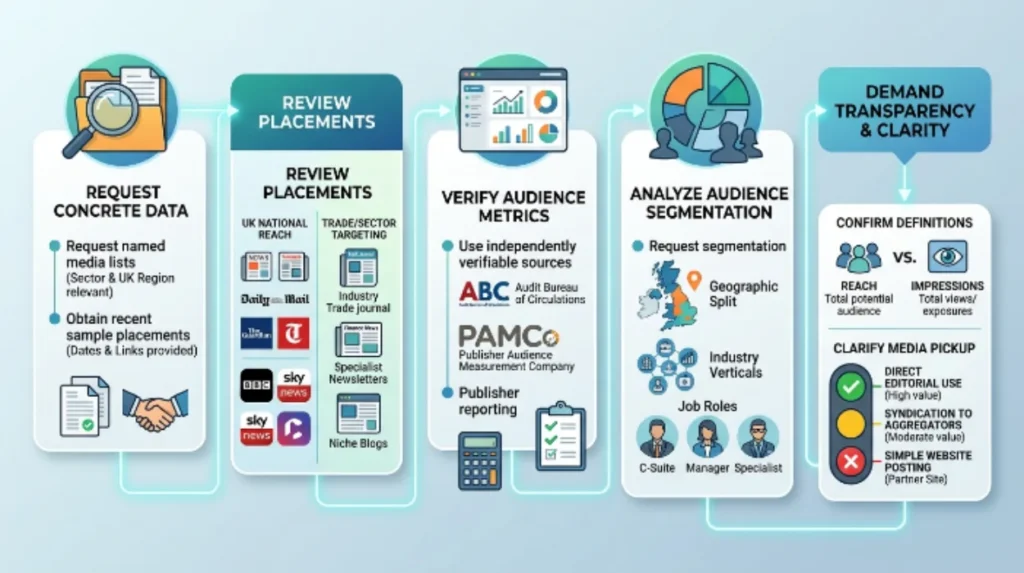
Check audience metrics using independently verifiable sources such as ABC circulation figures, PAMCo digital audience data, or publisher reporting. Request audience segmentation details: geographic split, industry verticals, and job roles. Confirm how the partner defines reach and impressions. Demand transparency on whether claimed “media pickup” includes direct editorial use, syndication to aggregator sites, or simple posting on the partner’s website.
What compliance and regulatory capabilities must a UK distribution partner show?
A compliant partner demonstrates knowledge of FCA and ASA rules, a review process for regulated content, and documented approval workflows for financial promotions.
For communications that involve financial services, investments, pensions, or regulated products, require evidence the partner understands FCA financial promotion rules. Verify whether the partner implements classification checks to identify regulated content before distribution. Confirm the partner enforces client-provided risk disclosures and preserves prominence of mandatory wording.
For advertising and promotional content generally, confirm the partner applies the ASA’s CAP Code standards when distributing commercial communications. Ask whether the partner retains records of distributed content, timestamps, and audience targeting to support regulatory audits. Obtain sample audit trails and retention policies showing storage for at least the period required by your compliance team.
What technical capabilities and production standards matter?
Technical capabilities include multimedia hosting, SEO optimisation, secure file handling, and formatting standards aligned with major outlet requirements.
Confirm the partner supports rich media such as high-resolution images, video, and PDF attachments. Check maximum file sizes and format requirements. Verify whether the partner provides responsive, SEO-optimised press release pages with structured metadata and canonical tags. Ask about distribution protocols: secure FTP, API integration, or web portals for submission.
Confirm the partner’s quality control procedures for proofreading, link integrity, and metadata accuracy. Verify multilingual production if you require non-English materials. Confirm publication timestamps and time zone handling for UK press cycles. Request details on how the partner handles embargoes and corrections to published content.
How should pricing and contract terms be evaluated?
Evaluate pricing by comparing fixed fees, per-distribution charges, add-on service costs, and any long-term contract clauses, and demand transparent reporting on deliverables.
Request a detailed price schedule showing base distribution costs, optional services such as multimedia hosting, targeted journalist outreach, and translation. Compare the cost per outlet or per geographical segment where possible. Confirm whether pricing includes guaranteed placements or only syndication.
Review contract terms for exclusivity, minimum terms, termination rights, and refund policies for failed distributions. Confirm liability limits and indemnities related to inaccurate or non-compliant content. Insist on service-level agreements specifying uptime, distribution timeframes, and error handling. Ensure reporting cadence and metrics are contractually required.
What reporting and measurement should you demand after distribution?
Require delivery confirmations, publication links, reach metrics, and performance analytics including clicks, reads, and media mentions with time stamps.
After distribution, insist on a report that includes a delivery log showing which outlets received the release and when. Ask for direct links to published placements and screenshots for outlets without accessible links. Request analytics for page views, unique visitors, click-through rates on embedded links, and social shares. For journalist outreach, require lists of contacts pitched and responses received.
Confirm whether the partner provides attribution for syndicated placements versus original editorial use. Require conversion metrics where the press release links to assets on your site, using UTM tags or tracking pixels. Validate the raw data behind summary metrics to allow internal verification.
What red flags indicate a poor vetting outcome?
Red flags include vague media lists, unverifiable metrics, no compliance checks for regulated content, and long, inflexible contracts.
Avoid partners that provide only aggregate reach figures without named outlets or that list outlets but cannot produce recent sample placements. Be cautious where metrics derive solely from the partner’s website views rather than independent publisher data. Reject partners that do not have procedures for classifying regulated financial content or that refuse to retain distribution records.
Do not accept contracts with automatic renewals, high cancellation penalties, or unclear refund policies for failed distributions. Be wary of partners that over-promise guaranteed editorial placements; editorial decisions lie with publishers and cannot be guaranteed. Prioritise partners with transparent processes and verifiable evidence.
Explore More Expert Insights:
Which UK Media Databases Are Worth the Subscription in 2026
Owned Newsroom vs Paid Distribution: What Works Better for UK Brands
What use cases align with different distribution models?
Choose national wires for mainstream coverage, trade distributors for sector reach, and targeted journalist outreach for bespoke campaigns with evidence-based measurement.
National wire services suit announcements that require immediate national visibility such as regulatory filings, product launches, or executive appointments. Trade distributors serve industry-specific releases like technical product updates, funding rounds in a sector, or policy commentary in specialist fields. Targeted journalist outreach fits high-value stories that require curated pitches to named journalists and personalised follow-up.
Select a distribution model that matches campaign objectives and budget. For SEO and long-term discoverability, prefer partners that host releases on SEO-optimised pages and provide durable links. For investor relations, choose partners with proven pickup by financial news desks and compliance processes for financial promotions. Balance cost against required reach and measurable outcomes.
How should organisations conclude the vetting process and decide?
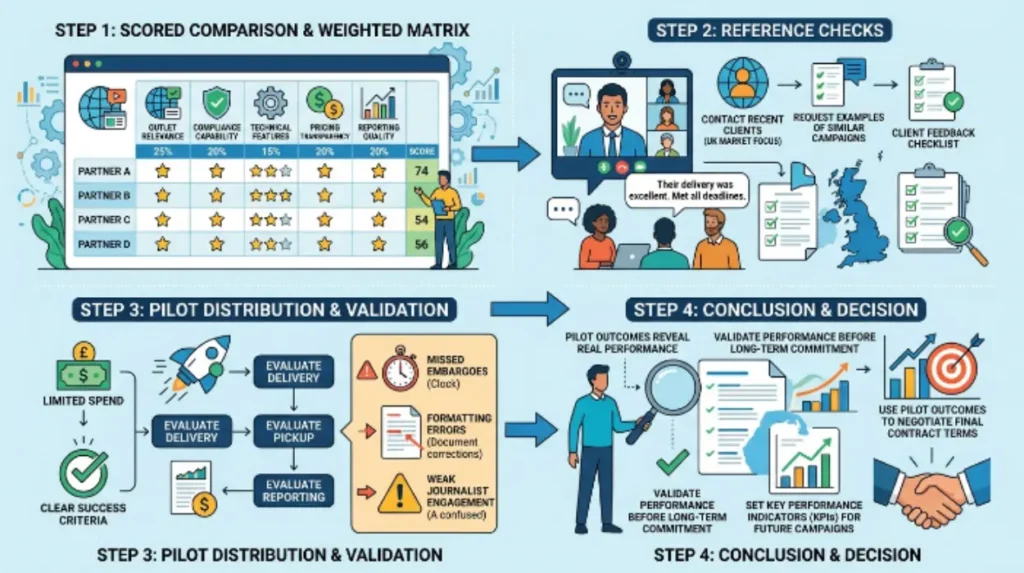
Conclude vetting with a scored comparison, reference checks, and a pilot distribution to validate performance before long-term commitment.
Develop a scoring matrix that weights factors such as outlet relevance, compliance capability, technical features, pricing transparency, and reporting quality. Contact references for recent clients in the UK market and request examples of campaigns similar in scope. Where possible, run a pilot distribution with clear success criteria and a limited spend to evaluate delivery, pickup, and reporting.
A pilot provides objective evidence of the partner’s claims and reveals operational issues such as missed embargoes, formatting errors, or weak journalist engagement. Use pilot outcomes to negotiate final contract terms and to set key performance indicators for future campaigns.
Read More for Better Understanding:
What FCA and ASA Rules Mean for Regulated UK Press Releases
Vetting a UK PR distribution partner requires verification of media reach, confirmation of regulatory compliance for FCA and ASA rules, assessment of technical and production standards, transparent pricing and contract terms, and rigorous reporting requirements. Use a structured evaluation, reference checks, and a pilot test to validate claims and select a partner aligned with campaign goals and compliance needs.
Complete Details Available Here:
What UK Clients Get With Time Intelligence Media Group’s Distribution Service