

Essential KPIs measure audience quality, engagement depth, lead quality, pipeline influence, and delivery accuracy to link publisher activity with commercial outcomes.
Define each KPI before use. Audience quality measures role and industry match. Engagement depth measures time-on-content and repeat visits. Lead quality measures form completeness and verified corporate details. Pipeline influence measures revenue influenced and opportunity creation. Delivery accuracy measures impressions delivered, viewability, and reporting timeliness.
What is audience quality and how is it measured?
Audience quality is the degree to which a publisher’s audience matches target buyer personas and is measured by role match rate, industry match rate, and verified corporate emails.
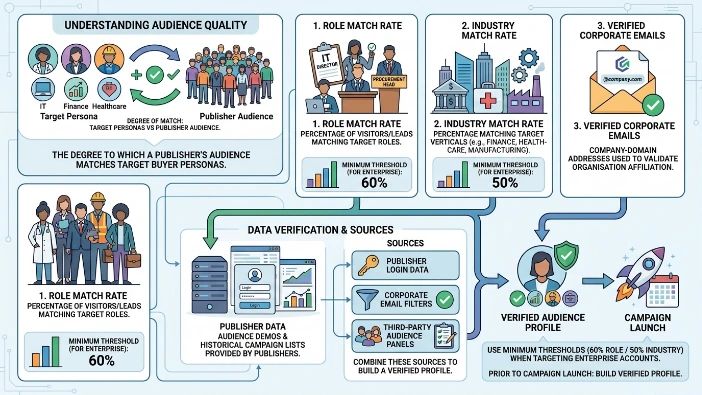
Role match rate equals the percentage of visitors or leads matching target roles such as IT director or procurement head. Industry match rate equals the percentage matching target verticals like finance, healthcare, or manufacturing. Verified corporate emails are company-domain addresses used to validate organisation affiliation. Publishers provide audience demos and historical campaign lists to verify these metrics. Use a minimum threshold of 60% role match and 50% industry match when targeting enterprise accounts.
Sources include publisher login data, corporate email filters, and third-party audience panels. Combine these sources to build a verified audience profile prior to campaign launch.
How should engagement depth be defined and tracked?
Engagement depth is the measurable time and interaction a user has with content, tracked via average session duration, scroll depth, and repeat visitation within 30 days.
Average session duration measures seconds spent on a content asset. Scroll depth records the percentage of content viewed. Repeat visitation counts distinct visits by the same user within 30 days. Webinars use attendance duration and question submissions as engagement metrics. Set target benchmarks: session duration above 180 seconds for long-form content and webinar attendance retention above 50% of registrants.
High engagement durations indicate consideration-stage behavior. Use engagement thresholds to trigger marketing automation workflows and sales outreach for accounts exceeding set limits.
What defines lead quality from a media partnership?
Lead quality is a composite of contact completeness, role seniority, company size, and explicit interest signals captured at form fill or webinar interaction.
Contact completeness includes name, corporate email, job title, and company name. Role seniority classifies contacts as manager, director, or C-suite. Company size segments into employee bands such as 100–499 or 1,000+. Explicit interest signals include intent keywords, content downloads, and webinar questions. Require at least five data points per lead and a verified corporate email to classify leads as marketing-qualified in enterprise contexts.
Create a lead-scoring model that assigns points for role seniority, company size, engagement depth, and explicit signals. Use a threshold to convert leads into sales-qualified opportunities.
How is pipeline influence measured and reported?
Pipeline influence measures direct and assisted revenue from publisher-sourced leads and is reported through CRM attribution and revenue-influence windows.
Direct revenue counts deals that originate from publisher referrals and close within a set attribution period, typically 6 to 12 months. Assisted revenue counts deals where publisher activity appears in the opportunity touchpoint history. Use multi-touch attribution models and define an influence window of 180–365 days to capture long enterprise sales cycles. Report influence as influenced pipeline value, influenced opportunity count, and influenced closed revenue.
Use a multi-touch attribution model that assigns weight to publisher touchpoints during discovery and evaluation stages. Reconcile publisher reports with CRM data via unique campaign identifiers.
What operational delivery KPIs ensure campaign accuracy?
Operational KPIs cover impressions delivered, viewability rate, reporting timeliness, and data-transfer success to ensure contractual fulfillment.
Impressions delivered tracks the number of ad or content impressions against agreed volume. Viewability rate measures the percentage of impressions meeting viewability standards. Reporting timeliness requires publisher reports delivered within agreed days after campaign end. Data-transfer success measures secure receipt of lead and event data into CRM or MMP systems. Include contractual SLAs to enforce these KPIs and define penalties for non-delivery.
Set minimum thresholds such as 90% of guaranteed impressions delivered, 70% viewability, and reporting delivered within five business days after campaign close.
Which creative and content KPIs measure message effectiveness?
Creative KPIs measure click-through rate, conversion rate on landing pages, and content consumption completion to assess message resonance.
Click-through rate tracks the percentage of impressions that lead to content landing pages. Conversion rate measures the percentage of visitors who complete a form or download. Content consumption completion measures download completion or video completion rate. Test variations of headlines and CTAs to improve these KPIs. Use A/B comparison across publisher placements to attribute creative performance to specific audience segments.
Benchmarks include a 1.0% baseline CTR for sponsored placements and a 20% conversion rate on gated whitepapers for role-matched enterprise audiences.
How do data and privacy requirements affect KPI selection in the UK?
Data and privacy rules require consent management, data minimisation, and secure transfer; KPIs must rely on compliant identifiers and aggregated reporting where necessary.
UK data protection law requires lawful basis for processing personal data. Obtain consent for tracking where needed and use hashed identifiers for secure transfers. Minimise personally identifiable fields in reports and prefer aggregated metrics when individual-level transfer lacks a legal ground. Ensure publishers and partners execute data processing agreements and follow retention limits. Non-compliant KPIs increase legal and reputational risk.
Controls include consent capture at form fill, pseudonymisation of identifiers, and contractual clauses for data processing and deletion timelines.
How do you align KPIs with commercial goals and sales workflows?
Align KPIs by mapping publisher KPIs to funnel stages, defining lead handover criteria, and integrating campaign events into sales pipelines.
Map engagement thresholds to funnel stages such as awareness, consideration, and decision. Define explicit handover criteria: lead score threshold, required contact fields, and engagement signals. Integrate campaign events into CRM with campaign IDs and assign ownership for follow-up. Use KPI dashboards to show performance against agreed sales targets and iterate targets quarterly based on conversion data.
Define that a lead enters sales outreach when lead score exceeds 70, includes a verified corporate email, and records engagement over two content assets.
Explore More Expert Insights:
How to Negotiate a UK Publisher Partnership That Protects Your Brand and Budget
Content Licensing vs Co-Creation: Which Media Partnership Model Suits Your Brand?
What reporting cadence and formats work best for media partnerships?
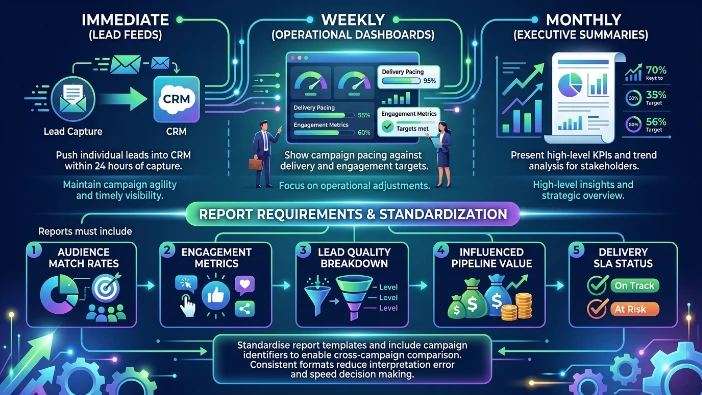
Monthly executive summaries, weekly operational dashboards, and immediate lead feeds provide timely visibility and maintain campaign agility.
Monthly summaries present high-level KPIs and trend analysis for stakeholders. Weekly dashboards show campaign pacing against delivery and engagement targets. Immediate lead feeds push individual leads into CRM within 24 hours of capture. Standardise report templates and include campaign identifiers to enable cross-campaign comparison. Consistent formats reduce interpretation error and speed decision making.
Reports must include audience match rates, engagement metrics, lead quality breakdown, influenced pipeline value, and delivery SLA status.
What use cases demonstrate effective KPI implementation for UK media partnerships?
Use cases include executive-targeted thought leadership, product launch demand capture, and ABM-supported account acceleration with measurable pipeline outcomes.
Thought leadership campaigns target C-suite and produce high engagement with co-authored reports. Product launch campaigns use gated content and webinars to capture qualified demo requests. ABM-supported partnerships use publisher role targeting to accelerate named accounts through high-value content and measurable sales touches. Each use case requires tailored KPI sets and defined success criteria tied to revenue influence.
A UK sector report promoted via a publisher produced a 35% lead-to-opportunity conversion for named accounts and accelerated average deal close time by 6 weeks.
Click Here to Explore More:
Why 75% of Enterprise B2B Firms Are Increasing Media Partnership Budgets This Year
KPIs for UK media partnerships must measure audience quality, engagement depth, lead quality, pipeline influence, operational delivery, creative effectiveness, and compliance. Define each KPI clearly, set numeric thresholds, integrate with CRM, and report on standardised cadences. Align KPIs to commercial goals and sales workflows to convert publisher activity into measurable revenue influence.
Explore More Expert Insights:
Media Partnership Onboarding: What Happens After You Sign With a UK Group



