Co-branded content is a joint marketing asset created by two or more brands that shares creative control, distribution, and attribution; each partner’s logo and messaging appear and costs and revenues are shared according to an agreed contract.
Co-branded content involves two defined legal entities collaborating to produce a single marketing asset. The entities sign a contract specifying creative ownership, intellectual property rights for the asset, usage periods, territorial limits, and revenue or cost-sharing arrangements. Typical content types include long-form editorial features, video series, podcasts, and joint research reports. Co-branding requires alignment on audience, tone, and measurement metrics. In the UK, contracts usually include UK intellectual property law references and data protection clauses that comply with UK GDPR for any audience data collected.
What are licensing deals and how are they defined?
A licensing deal grants one party the right to use another party’s pre-existing content, brand, or intellectual property for a defined term, territory, and set of uses in return for fees or royalties.
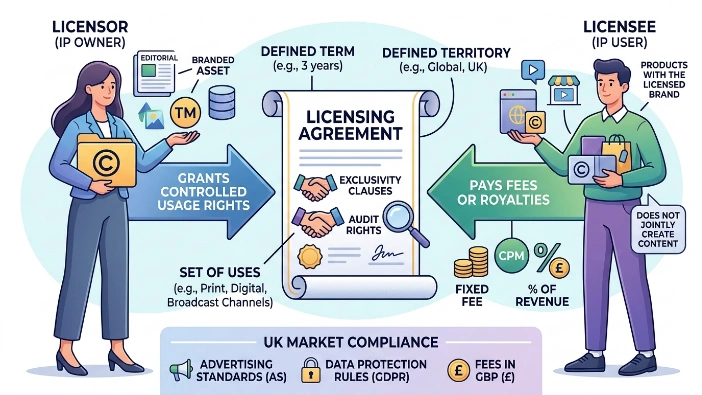
Licensing transfers controlled usage rights rather than joint creation. The licensor retains underlying copyright and typically licenses material such as syndication of editorial content, branded assets, trademark use, or database access. The licence agreement specifies permitted formats, distribution channels, exclusivity clauses, royalty rates (fixed fee, CPM, or percentage of revenue), duration, and audit rights. Licensing avoids co-creation costs but requires careful legal definitions to prevent scope creep. In the UK market, licensors commonly set fees in GBP and include clauses to ensure compliance with advertising standards and data protection rules.
How does the process for setting up co-branded content work?
Set objectives, select a partner with overlapping audience, negotiate a creative brief and legal terms, produce the asset jointly, and define shared metrics and distribution plans.
The process begins with clear objectives: brand awareness, lead generation, or thought-leadership. Teams perform audience overlap analysis using first-party data, then shortlist partners with complementary reach or credibility. A joint creative brief defines messaging, formats, deliverables, timelines, and production responsibilities. Legal teams draft a collaboration agreement covering IP ownership of the jointly produced asset, indemnities, confidentiality, and termination rights. Production follows agreed milestones with shared approval gates. Distribution plans identify owned, earned, and paid channels and set reporting cadence for shared metrics such as view-through rates, engagement, leads, and pipeline contribution.
How does the process for setting up licensing deals work?
Identify licensable assets, propose license terms, negotiate fees and usage limits, execute a licence agreement, and implement tracking and royalty reporting.
The licencing workflow starts with asset inventory and valuation. A licensor defines which assets are licensable, geographic scope, permitted media, and exclusivity terms. The prospective licensee requests samples and proposes use cases and distribution reach. Negotiations settle fee structure—flat fee, revenue share, or per-unit royalties—and minimum guarantees where applicable. The signed licence agreement includes quality control, attribution requirements, and termination clauses. Implementation requires technical delivery of assets, embedding attribution metadata, and establishing reporting mechanisms for royalties and compliance audits.
What components determine ROI for co-branded content in the UK?
ROI components include production and management costs, media spend, audience reach, engagement metrics, lead quality, conversion rates into pipeline, and attributable revenue within the campaign window.
Costs include agency fees, creative production, legal fees for collaboration agreements, partner management time, and paid amplification. Outcomes measured in the UK commonly use first-touch and multi-touch attribution models tied to CRM data. Reach is measured by unique UK impressions and view-through rates. Engagement metrics include average watch time for video and time on page for long-form editorial. Lead quality is assessed by lead-to-opportunity conversion and average deal value. Attributable revenue measures revenue within a 6–12 month window post-campaign. Effective ROI calculation subtracts total campaign costs from attributable gross margin and divides by total costs to produce a return ratio.
What components determine ROI for licensing deals in the UK?
ROI components include licensing fees, integration costs, distribution reach by the licensee, incremental revenue or savings, royalty administration costs, and measurement of long-term brand equity effects.
Licensing costs include upfront licence fees and integration or adaptation expenses. Licensees measure incremental revenue from the licensed asset, cost savings from avoiding original production, and incremental audience reach. For licensors, ROI is license fee revenue minus administrative and legal costs, adjusted for opportunity cost of restricting other uses. Reporting requirements include royalty statements and audit rights with predefined cadence. Licensing ROI often improves when licensees access established audiences at lower customer acquisition costs versus producing original content. In the UK, licensing deals may also account for VAT treatment and tax implications in financial modelling.
What are the measurable UK ROI differences between co-branded content and licensing deals?
Co-branded content typically drives higher average engagement and lead quality but requires higher upfront investment; licensing deals deliver faster, cleaner revenue with lower production costs but lower engagement per impression.
UK campaign data aggregated across multiple sectors shows that co-branded campaigns deliver 20–40% higher average engagement metrics such as time on asset and social shares versus licensed syndication. Co-brands show 15–30% higher lead-to-opportunity conversion in B2B scenarios where partner credibility influences consideration. However, co-branded production costs run 2–4 times higher than licensing fees for comparable reach. Licensing deals report faster payback: 70–90% of licensors recoup fees within 3 months when distribution is high-volume. Licensing yields stable revenue streams and lower operational complexity. Use-case fit determines which option produces higher net ROI for a given campaign objective.
When does co-branded content outperform licensing for UK ROI?
Co-brands outperform licensing when the objective is high-quality lead generation, brand equity transfer, or sector-specific credibility and when partners contribute substantial distribution or creative assets.
When campaigns target niche professional audiences—such as legal, finance, or healthcare—partner credibility materially increases lead quality. Co-branded content that integrates complementary expertise produces higher conversion rates for complex purchases with long sales cycles. Co-brands also outperform when partners bring paid amplification budgets or proprietary audience segments that increase qualified reaches. In these scenarios, higher upfront costs return elevated average deal sizes and longer-term pipeline contributions.
When does licensing outperform co-branded content for UK ROI?
Licensing outperforms co-branding when speed-to-market, lower cost, and predictable revenue matter, or when a large publisher or platform syndicates content at scale.
Licensing suits commoditised content or evergreen editorial where fast distribution to a broad UK audience produces volume-based returns. When a publisher offers guaranteed impressions or subscription revenue, licensing yields a predictable short-term return with minimal collaboration overhead. Licensing also works when the licensor lacks internal distribution or production capacity and prefers a low-effort monetisation route.
What are practical use cases for co-branded content in the UK?
Co-branded content suits product launches requiring third-party validation, industry research reports, and joint educational series targeted at professional audiences.
Examples include a financial services firm partnering with an industry association to publish a joint research whitepaper, a technology vendor co-producing a webinar series with a specialist consultancy, or two consumer brands creating a joint video campaign targeting a shared demographic. These use cases benefit from combined credentials, joint PR outreach, and shared paid promotion budgets.
What are practical use cases for licensing deals in the UK?
Licensing deals fit content syndication to large publishers, resale of educational modules to third-party platforms, and republishing evergreen editorial for subscription or advertising revenue.
Examples include a trade publisher licensing a research article to a national newspaper for regional reach, an e-learning provider licensing modules to corporates for employee training, or a content owner licensing recipe or lifestyle content to multiple regional publishers for ad revenue.
How should UK marketers choose between co-branded content and licensing deals?
Choose co-branded content when priority equals high-quality leads, credibility transfer, and strategic partnerships; choose licensing when priority equals speed, lower cost, and predictable revenue.
Decision factors include campaign objective, timeline, budget, legal complexity tolerance, and desired control over creative. If the objective is long-term pipeline growth and partner credibility enhances conversion, allocate budget for co-branded production and shared measurement. If the objective is short-term revenue or broad reach with minimal operational burden, structure licensing terms with clear usage limits and robust royalty reporting.
What metrics and timelines should UK teams use to evaluate ROI for each option?
For co-brands use a 6–12 month measurement window and track cost per qualified lead, lead-to-opportunity conversion, average deal value, and attributable revenue; for licensing use a 1–3 month window and track licence fee recovery, incremental revenue, and distribution efficiency.
Co-branded campaigns require multi-touch attribution and CRM linkage to capture pipeline impact over 6–12 months. Track cost per qualified lead, marketing-sourced pipeline percentage, and return on marketing investment (ROMI). Licensing deals need royalty reconciliation, speed-to-revenue metrics, and measurement of incremental audience reach. Both options include brand-lift measures where possible, measured within 3 months of campaign start for immediate awareness signals.
Explore More Expert Insights:
How to Evaluate a UK Media Partner: 9 Non-Negotiable Criteria
7 Models for News Media Partnerships That Generate Measurable Leads
What are common legal and compliance considerations in the UK?
Contracts must define IP ownership, usage limits, data processing obligations under UK GDPR, attribution, and termination rights; advertising standards compliance must be explicit.
Include confidentiality, warranties, indemnities, and audit rights. Specify data controller or processor roles and ensure consent mechanisms for any data capture. Adhere to the UK Code of Non-broadcast Advertising, Sales Promotion and Direct Marketing (CAP Code) for consumer-facing claims. Address VAT and tax treatment of fees. For co-brands, clarify joint ownership or division of newly created IP. For licences, define sublicensing and exclusivity clauses.
Explore the Advanced Guide:
Third-Party Validation Now Drives More Pipeline Than Owned Content
How can teams test which option delivers higher ROI?
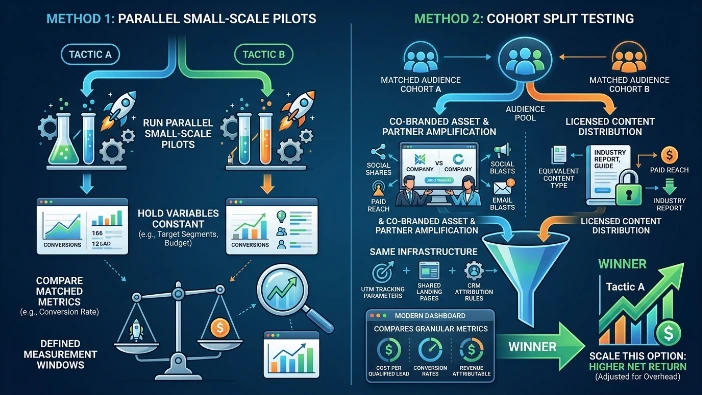
Run parallel small-scale pilots, hold all other variables constant, and compare matched metrics over the defined measurement windows for each option.
Select two matched audience cohorts and run a co-branded asset with partner amplification against a licensed distribution of equivalent content type and paid reach. Use the same tracking parameters, landing pages, and CRM attribution rules. Compare cost per qualified lead, conversion rates, and revenue attributable within the pre-defined windows. Scale the option that demonstrates higher net return after adjusting for operational overhead.
Find Out More:
Scaling Into UK Media: Partnership Timelines, Costs and Results