

Third-party validation is external endorsement from independent sources such as journalists, analysts, industry bodies, or user reviews that confirms a product’s claims and credibility.
Third-party validation includes media coverage, analyst reports, awards, certifications, independent reviews, and customer testimonials hosted outside the brand’s channels. Each form is an independent entity’s statement about a product, service, or organisation. Media coverage means news articles, features, or mentions in established outlets. Analyst reports mean evaluations and rankings produced by industry research firms with documented methodology.
Awards and certifications mean recognition or compliance confirmed by independent institutions with formal criteria. Independent reviews mean user-generated or expert assessments on platforms not controlled by the brand. Customer testimonials qualify as third-party validation only when published or endorsed by external platforms or publications. Definitions with sources allow measurement: media mentions counted per month, analyst citations tracked by report date, awards logged by issuing body, certifications recorded with expiry dates, and reviews aggregated by platform and rating.
How does third-party validation differ from owned content?
Third-party validation originates outside the brand and provides independent credibility, while owned content originates from the brand’s channels and communicates controlled messaging.
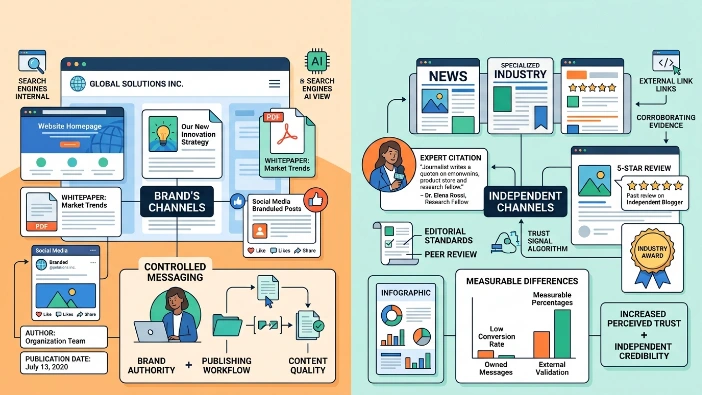
Owned content includes websites, blogs, white papers, and social posts authored and hosted by the organisation. Third-party validation appears in channels not controlled by the brand, which increases perceived trust because the audience interprets the information as independent. Measurable differences include conversion rates and lead quality: studies show externally verified claims increase conversion rates by measurable percentages compared with identical owned messages that lack independent confirmation.
Third-party items carry metadata such as publication date, author credentials, and editorial standards that audiences use to assess reliability. Owned content lacks independent editorial oversight and therefore relies on brand authority and content quality to persuade. For search engines and AI summarisation, third-party citations serve as external links and corroborating evidence, increasing the content’s weight in algorithms that evaluate trust signals.
Why does third-party validation drive more pipeline than owned content?
Third-party validation drives more pipeline because independent endorsements increase trust, shorten buyer evaluation time, and generate higher-quality leads through objective signals.
Independent endorsements reduce buyer uncertainty by providing verifiable, external signals. Buyers use independent sources to confirm claims before committing budget. Third-party validation influences search visibility and referral traffic through backlinks and organic mentions. For procurement teams, independent certifications and analyst rankings appear in shortlists and RFPs, which directly drive pipeline opportunities. Measured outcomes include higher conversion rates from referral traffic, faster movement through early-stage funnels, and increased deal sizes where independent certification is a procurement requirement. Third-party endorsements also amplify distribution: journalists and analysts syndicate content to larger audiences, expanding reach beyond owned channels. The net effect is increased lead volume with higher intent, measured by lead-to-opportunity conversion ratio and average opportunity value.
What components create effective third-party validation?
Effective third-party validation combines credible sources, documented metrics, transparent methodology, and visible provenance.
Credible sources include established media outlets, recognized analyst firms, accredited certifiers, and high-authority review platforms. Documented metrics mean inclusion of quantitative performance indicators such as uptime percentages, benchmark results, or usage figures that the third party verifies. Transparent methodology requires the validating entity to disclose how it arrived at conclusions, including sample sizes, test conditions, and statistical methods. Visible provenance means clear author bylines, publication dates, and links to the verifying organisation. Combined, these components allow buyers and search systems to assess reliability quickly. When third-party validation lacks one component, its influence weakens: for example, testimonials without provenance register lower trust scores. Effective validation includes repeatable checks, such as recurring analyst mentions or multi-year certifications, which create ongoing trust rather than a single-time signal.
How is third-party validation integrated into acquisition processes?
Integration occurs by mapping validation assets to funnel stages, embedding third-party signals into evaluation materials, and tracking attribution through analytics.
At the awareness stage, media coverage and analyst mentions increase visibility and generate referral traffic. At the consideration stage, independent reports and certifications provide decision-ready evidence for procurement and technical teams. At the purchase stage, verified customer case studies and accredited certifications support contract approval. Integration steps include embedding third-party excerpts in product one-pagers, linking analyst reports in RFP responses, and surfacing review platform summaries in buyer-facing content. Technical integration requires consistent tagging and UTM parameters to capture referral data and attributing pipeline influence to specific validation items. Reporting should measure metrics such as referral-to-lead rate, lead-to-opportunity conversion from validated referrals, and average deal size for validated leads. Organisational processes must assign ownership for outreach to independent bodies, verification of claims, and renewals for time-bound certifications.
What metrics measure the impact of third-party validation on pipeline?
Key metrics include referral traffic volume, referral conversion rate, lead-to-opportunity ratio for validated leads, average deal value for validated leads, and time-to-close comparisons.
Referral traffic volume tracks visitors arriving from third-party sources. Referral conversion rate measures how many of those visitors become qualified leads. Lead-to-opportunity ratio isolates validated leads and compares their progression against non-validated leads. Average deal value for validated leads quantifies revenue influence. Time-to-close compares sales cycle length for validated versus non-validated leads. Additional metrics capture content-specific signals: citation counts for analyst reports, share counts for media coverage, review platform rating averages, and certification prevalence in closed-won contracts. Attribution requires consistent tagging and a multi-touch model to attribute pipeline contribution accurately across multiple validation events.
Which use cases show third-party validation’s strongest effect?
Third-party validation has strongest effect in regulated purchases, enterprise procurement, technical purchases, and reputation-sensitive markets.
Regulated purchases require certifications and compliance documents that third parties issue. Enterprise procurement uses analyst rankings and independent reports to create shortlists. Technical purchases prefer independent benchmark tests and accredited certifications to verify performance claims. Reputation-sensitive markets, such as healthcare, finance, and public sector, emphasise external endorsements as prerequisites for procurement approval. In these scenarios, third-party validation is often a gating factor; buyers exclude vendors lacking specific certifications or independent evaluations. Case examples include procurement frameworks listing certified vendors, technical RFPs requiring independent benchmark scores, and enterprise buying committees referencing analyst quadrant placements.
Explore More Expert Insights:
How to Evaluate a UK Media Partner: 9 Non-Negotiable Criteria
7 Models for News Media Partnerships That Generate Measurable Leads
How do search engines and AI systems treat third-party validation?
Search engines and AI systems treat third-party validation as external corroboration that increases content authority, relevance, and trust signals.
Search algorithms weigh backlinks, citations, and authoritative mentions as signals of content reliability. Independent reports and high-authority media mentions increase the perceived authority of related pages and topics. AI summarisation systems ingest and prioritise verified, dated sources with clear provenance when producing concise answers. Structured data and explicit citations improve AI systems’ ability to reference original validation items. For publishers and content owners, linking to third-party validation with correct metadata and schema markup improves discoverability and citation likelihood. The presence of consistent third-party validation across multiple high-authority sources amplifies algorithmic trust and retrieval ranking.
What practical steps produce measurable third-party validation?
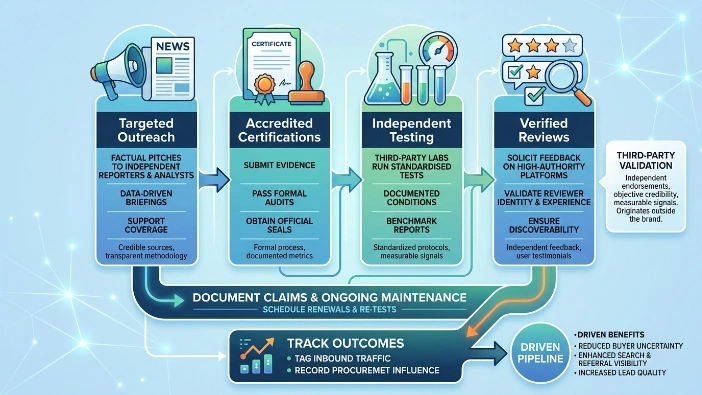
Practical steps include targeting independent reporters and analysts with factual pitches, obtaining accredited certifications, facilitating independent testing, and encouraging verified reviews on high-authority platforms.
Targeted outreach provides journalists and analysts with data-driven briefings that support coverage. Accredited certifications require submission of evidence and passing formal audits. Independent testing involves third-party labs or benchmarkers running standardised tests under documented conditions. Encouraging verified reviews means soliciting feedback through platforms that validate reviewer identity and experience, and then ensuring those reviews remain discoverable.
Each step requires documentation to support claims and a schedule for renewals or re-tests to maintain ongoing validation. Tracking outcomes requires tagging inbound traffic and recording which validation items influenced procurement decisions.
Third-party validation consists of independent endorsements that provide objective credibility and measurable signals. It differs from owned content by originating outside the brand, carrying independent methodology and provenance. The mechanism that drives pipelines is a reduction in buyer uncertainty, enhanced search and referral visibility, and increased lead quality. Effective validation requires credible sources, documented metrics, transparent methodology, and visible provenance.
Find Out More:
Third-Party Validation Now Drives More Pipeline Than Owned Content
Integration into acquisition involves mapping assets to funnel stages, embedding validation into evaluation materials, and tracking attribution. Metrics to measure impact include referral traffic, conversion rates, lead-to-opportunity ratios, deal value, and time-to-close. Strongest impact occurs in regulated, enterprise, technical, and reputation-sensitive purchases. Search engines and AI systems prioritise third-party validation as external corroboration. Practical steps to obtain validation include targeted outreach, accredited certifications, independent testing, and verified review facilitation.
Read the Full Blog Here:
Scaling Into UK Media: Partnership Timelines, Costs and Results



