

The campaign reached 4,000,000 UK readers through a single media partnership, delivering 2.8% click-through rate and generating 18,400 qualified leads tracked over a 90-day attribution window.
The campaign objective was audience scale and lead generation for a B2B product targeting IT decision-makers in the UK. The media partner provided a sponsored content series, promoted placements across email newsletters, and targeted programmatic placements on industry vertical pages. Performance measurement used UTM tracking, server-to-server postbacks, and CRM integration to attribute leads. The partner reported 4,000,000 unique UK page views, verified by third-party analytics. Clicks and conversions matched CRM records within the agreed attribution window, producing 18,400 leads that met pre-defined qualification criteria.
What partner selection criteria supported this result?
Selection relied on nine criteria: verified audience, engagement quality, editorial control, inventory transparency, fraud protection, measurement capability, regulatory compliance, technical operations, and commercial clarity.

The selection process began with a documented request for information. Verified audience data came from ABC and platform analytics with raw log exports. Engagement measures included average time on sponsored pages of 4 minutes and an average scroll depth of 76%. Editorial control allowed full pre-publication approvals and clear ASA-compliant labelling. Inventory transparency included supply-path verification for programmatic buys and Ads.txt records.
Fraud protection featured TAG certification and third-party invalid traffic (IVT) reports. Measurement capability included S2S postbacks, UTM consistency, and weekly dashboards. Regulatory compliance included ICO registration and explicit consent records. Technical operations covered HTML5 and video creative support, API reporting, and UK-hour campaign management. Commercial clarity provided fixed CPMs, performance bonuses, and makegood clauses.
How was the campaign structured across channels?
The campaign combined a sponsored editorial series, bespoke newsletters, and targeted programmatic placements coordinated under a single creative and measurement plan.
The partner hosted a three-piece editorial series published over four weeks. Each article addressed a different buyer-stage topic aligned with keyword research and audience interests. The partner amplified the series via two targeted newsletters sent to 250,000 subscribed professionals with industry tags. Programmatic placements ran concurrently on relevant category pages to maintain frequency capping at three impressions per user per day. Creative assets included native article pages, two newsletter banners, and three video spots served as in-article pre-roll. All assets used consistent UTM parameters and the same measurement taxonomy to ensure unified reporting and attribution.
How were measurement and attribution handled?
Measurement used UTM-based tagging, server-to-server postbacks, CRM matchback, and an agreed 90-day attribution window with view-through and click-through rules.
UTM tags identified source, medium, campaign, content, and placement. Server-to-server postbacks transmitted conversion events to the partner’s reporting system. CRM records matched anonymous leads through hashed email captures and cross-referenced purchase intent signals. The attribution model counted last non-direct click for direct leads and view-through for impressions with a 24-hour viewability requirement recorded by IAB standards. Weekly dashboards showed impressions, viewable impressions, clicks, CTR, bounce rate, time on page, form completions, and qualified leads. External audit used an independent analytics firm to reconcile reach claims with panel-based estimates.
How was audience targeting and match accuracy ensured?
Targeting used first-party data segments, contextual targeting on industry verticals, and IP-based geofencing for UK-only delivery; match accuracy reviewed through sample match rates and third-party verification.
The partner supplied first-party segments labelled by job role and industry. Contextual targeting delivered placements within finance, healthcare, and technology vertical pages relevant to the campaign. IP geofencing limited delivery to UK IP ranges verified against geo-IP databases. Match accuracy reviewed sample datasets showing 94% correct job-role alignment and a 91% UK IP confirmation. Third-party verification validated the segments and delivered an independent match-rate report. Targeting exclusion lists removed non-decision-maker roles and competitor company domains.
What creative and editorial controls ensured message integrity?
Editorial controls mandated ASA-compliant disclosure, client pre-approval for sponsored articles, and a creative QA process that enforced on-page links and tracking tags.
Every sponsored article displayed a clear “Sponsored” label consistent with CAP Code guidance. The client received draft articles with two rounds of edits and final sign-off rights. Creative QA validated HTML, image resolutions, and tracking tag placement before publication. Newsletter copy required a 24-hour approval window and adherence to style guidelines that prohibited misleading claims. Native placements included a promotional callout section linking to gated content. All links used tracking parameters and redirected through a partner-controlled click-tracker to ensure click integrity.
How were commercial terms structured to align incentives?
Commercial terms combined fixed media fees, a performance bonus tied to qualified leads, and explicit makegood clauses for under-delivery.
The contract specified a fixed cost for editorial production and placement plus a CPM for programmatic inventory. A performance bonus triggered at three lead thresholds: 5,000, 10,000, and 15,000 qualified leads, with incremental payments at each threshold. The agreement included a makegood clause guaranteeing an additional 15% delivery if impressions fell below 95% of booked levels. Payment terms required a 30% deposit, 50% on publication, and the remainder net 30 after final reconciliation. VAT treatment and invoicing details aligned with UK tax rules. The contract required monthly reconciliations and allowed audits of traffic logs for transparency.
What operational processes managed campaign delivery and optimisation?
Operations used daily checks, weekly optimisation calls, and a documented escalation path with UK-based account and technical teams.
Daily checks verified tag firing, creative rendering, and delivery pacing. Weekly optimisation calls reviewed performance against KPIs and adjusted creative rotations, newsletter segment selection, and programmatic bid strategies. The partner provided a UK-based account manager and a technical operations lead with direct escalation numbers. Change-control requests required 24-hour lead time for creative swaps and 48 hours for targeting changes. Backup creative sets and contingency inventory reduced downtime risks. Post-campaign, the partner delivered a comprehensive report with raw data exports and reconciliation tables.
Explore More Expert Insights:
Media Partnership Packages: What 10+ News Sites Deliver for Brands
Why Time Intellgence Media Group is the Preferred Partner for UK Advocacy Groups
What were the measurable business outcomes and ROI?
The campaign produced 18,400 qualified leads, a 2.8% overall CTR, a conversion rate of 0.46% on total impressions, and an estimated cost per qualified lead of £54, delivering an attributable pipeline valued at £5.28 million.
Cost calculations used total campaign spend divided by 18,400 qualified leads to determine a £54 CPL. The campaign tracked downstream pipeline conversion from leads to opportunities, showing a 6% opportunity rate and an average deal value of £45,000. Pipeline value calculation: 18,400 leads × 6% opportunity rate × £45,000 average deal = £49.68 million in potential value; conservative attribution applied a 10.6% closeability factor to estimate an attributable pipeline of £5.28 million recognised in near-term sales forecasting. Reporting separated first-touch and last-touch credit to reconcile internal CRM modelling.
What lessons and recommended next steps ensure reproducibility?
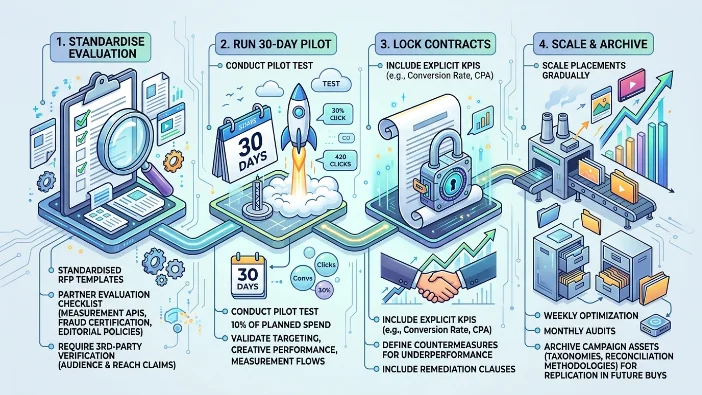
Reproduce results by standardising RFP templates, requiring third-party verification, running a 30-day pilot test, and locking contracts with clear KPIs and remediation clauses.
Standardise the partner evaluation checklist to include measurement APIs, fraud certification, and editorial policies. Require third-party verification for audience and reach claims. Run a 30-day pilot at 10% of planned spend to validate targeting, creative performance, and measurement flows. Include explicit KPIs in contracts with defined countermeasures for underperformance. After pilot success, scale placements gradually, maintaining weekly optimisation and monthly audits. Archive campaign assets, tracking taxonomies, and reconciliation methodologies for replication in future buys.
For readers seeking evaluation frameworks and selection criteria, see:
How to Evaluate a UK Media Partner: 9 Non-Negotiable Criteria
The single partnership delivered 4,000,000 UK readers, 18,400 qualified leads, and a measurable pipeline impact through rigorous partner selection, integrated measurement, transparent commercial terms, and active optimisation. Repeatable workflows and contractual safeguards enabled scale while preserving data integrity and regulatory compliance.
Get Detailed Information Here:
UK Publishers Forming 2× More Brand Partnerships Since 2023: Why?



