A media partnership package is a predefined set of publisher services and deliverables sold to a brand to drive awareness, leads, or revenue with measurable outcomes. A package bundles inventory, content production, distribution, audience targeting, and reporting. Inventory includes homepage placements, section sponsorships, and newsletter slots.
Content production covers research reports, native articles, and webinar support. Distribution uses onsite articles, social amplification, and newsletter sends. Audience targeting relies on publisher first-party data, contextual placement, and audience segments by industry, role, or geography. Reporting provides campaign metrics, lead feeds, and reconciliation with CRM outcomes. Contracts specify pricing, delivery timelines, and KPIs tied to conversions and revenue attribution.
What components do reputable news-site packages include?
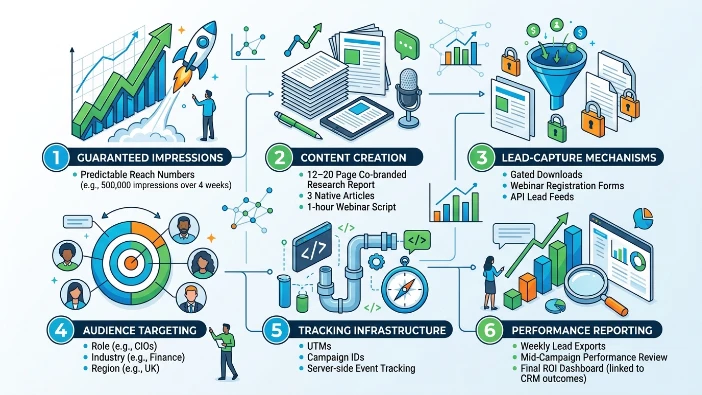
Core components include guaranteed impressions, content creation, lead-capture mechanisms, audience targeting, tracking infrastructure, and performance reporting. Guaranteed impressions provide predictable reach numbers such as 500,000 impressions over four weeks. Content creation includes a co-branded research report of 12–20 pages, three native articles, and a one-hour webinar script.
Lead-capture mechanisms involve gated downloads, webinar registration forms, or API lead feeds. Audience targeting segments by role (for example CIOs), industry (for example finance), and region (for example UK). Tracking infrastructure uses UTMs, campaign IDs, and server-side event tracking. Performance reporting supplies weekly lead exports, a mid-campaign performance review, and a final ROI dashboard linking to CRM outcomes.
How do packages structure lead capture and attribution?
Packages structure lead capture with gated assets and publisher registration systems and attribute performance using campaign IDs, time-bound windows, and agreed credit rules. Gated assets require contact fields and optional qualification questions. Publisher registration systems for webinars collect attendee data and pass records by API. Campaign IDs and unique landing pages tie interactions to specific placements. Attribution windows commonly use 30, 60, or 90 days to assign credit for influenced pipeline.
Credit rules assign full revenue-source credit where partners own the lead, or multi-touch credit where several channels share proportional attribution. Reconciliation matches publisher leads to CRM records weekly and conducts a final audit to confirm revenue attribution.
What audience targeting options do news sites offer?
News sites offer targeting by demographic segments, intent signals, topic affinity, geographic location, and custom first-party segments provided by the publisher. Demographic segments include role and seniority such as C-level or director-level. Intent signals derive from article engagement and search behavior tracked on the publisher domain.
Topic affinity groups users by frequent consumption of vertical content such as technology or healthcare. Geographic targeting allows national and regional focus within the UK. Custom first-party segments use publisher data modeled from subscription and registration attributes to match a brand’s ideal customer profiles. Publishers can supply lookalike segments built from a client’s existing customer set when privacy rules and data-sharing agreements permit.
What reporting and governance come with premium packages?
Premium packages include weekly lead feeds, a campaign dashboard, monthly performance reviews, and contractual terms for data ownership and compliance. Weekly lead feeds transmit captured contacts with campaign metadata. Campaign dashboards aggregate impressions, engagement metrics, lead quality scores, and pipeline attribution. Monthly reviews examine KPI progress and suggest optimisations such as creative swaps or audience tweaks.
Contracts define data ownership, consent provenance, and GDPR-compliant matching processes. Escalation clauses specify remedies if delivery or quality targets fail. Governance ensures traceable lead origins, documented attribution rules, and agreed procedures for disputes during reconciliation.
How do pricing tiers differ across 10+ publishers?
Pricing tiers vary by audience scale, exclusivity, content depth, and measurement sophistication, ranging from low-cost newsletter sponsorships to six-figure integrated research programs. Entry-tier packages often focus on newsletter placements and a single native article with prices in the low thousands of pounds. Mid-tier packages add a gated report, two native articles, and a webinar slot with prices in the tens of thousands.
Premium-tier packages include bespoke research, multi-week homepage dominance, targeted email clusters, and advanced attribution with prices starting at £75,000 and rising above £250,000 for national exclusivity. Price differences reflect publisher audience size, access to niche decision-maker segments, and the inclusion of guaranteed lead volume or pipeline commitments.
What outcomes do brands achieve with bundled packages?
Outcomes include increased qualified lead volume, measurable pipeline creation, shortened sales cycles for engaged contacts, and documented ROI when integrated with CRM. Qualified lead volume often increases by 30–200% compared to baseline newsletter-only programs depending on content relevance. Measurable pipeline arises when gated research and webinars feed MQLs and SQLs into sales workflows.
Sales cycles shorten when publisher content educates procurement stakeholders before initial outreach. Documented ROI requires CRM integration and attribution, which enables reporting of closed revenue tied to package activity within the agreed window. Example outcomes in the UK include research programs producing five-figure pipelines within six weeks and webinar series converting 4–8% of registrants to SQLs.
Which package formats best suit short vs long sales cycles?
Short sales cycles benefit from newsletter sponsorships and native articles that drive fast volume; long sales cycles require research reports, webinars, and multi-touch programs that build trust over months. Newsletter sponsorships generate immediate reach and clicks, suitable for offers with quick decision paths under 90 days. Native articles drive awareness and quick form fills for low-friction offers.
Research reports and webinars target senior stakeholders and support procurement timelines that extend beyond 90 days. Multi-touch programs sequence native placements, webinars, and follow-up newsletters to reinforce messages across quarters. Brands choose formats based on expected deal size, typical buyer journey length, and the number of stakeholders involved in purchase decisions.
How do brands evaluate lead quality and ROI from packages?
Brands evaluate lead quality with firmographic matches, engagement depth, and conversion progression; ROI uses pipeline-to-close ratios and revenue attributed within the chosen attribution window. Firmographic matches measure alignment to target industry, company size, and role. Engagement depth looks at time on content, repeat visits, and multiple asset interactions. Conversion progression tracks movement from MQL to SQL to closed deal. Pipeline-to-close ratios apply historical win rates to pipeline value generated by the package to estimate expected revenue. The final ROI calculation compares net revenue attributed to the programme against total investment, including production and media costs.
Explore More Expert Insights:
Why Time Intelligence Media Group is the Preferred Partner for UK Advocacy Groups
Start Your 60 Day Growth Sprints With Time Intelligence Media Group Experts
What operational steps ensure successful delivery?
Operational steps include defined creative deadlines, CRM mapping, weekly lead reconciliation, and a shared campaign playbook for publisher and brand teams. Creative deadlines lock in landing pages, form fields, and creative assets. CRM mapping ensures campaign IDs populate lead records and sales actions. Weekly lead reconciliation verifies feed integrity and corrects mismatches. A shared campaign playbook documents audience definitions, scoring rules, handoff SLAs, and reporting templates. Formalising these steps reduces friction and speeds sales engagement with new leads.
When should a brand choose a bespoke package over a standard bundle?
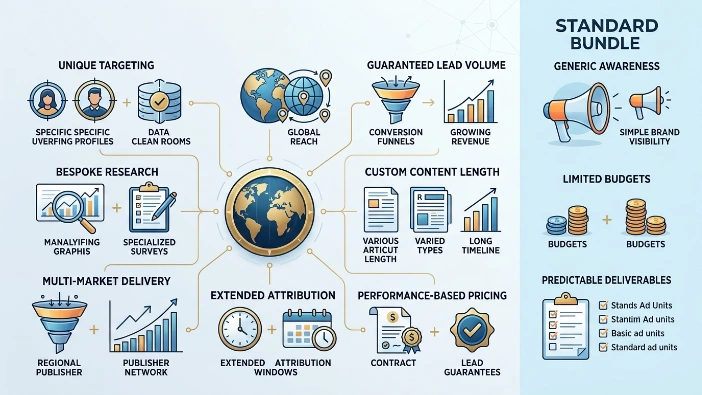
Choose bespoke when the campaign requires unique audience segments, bespoke research, multi-market delivery, or guaranteed lead volume tied to revenue goals. Bespoke packages custom-design content length, sampling methodologies for research, and cross-market distribution across regional publisher networks. They include advanced matching using data clean rooms or extended attribution windows for long procurement cycles. Brands with specific pipeline targets or multi-account strategies benefit from bespoke terms that include performance-based pricing or lead guarantees. Standard bundles suit brands with generic awareness goals or limited budgets that need predictable deliverables.
Learn More Here:
How Media Partnerships Drove 40% More B2B Revenue in 2025
Media partnership packages across 10+ news sites deliver a range of options from low-cost newsletter placements to high-investment integrated research programmes. Packages combine inventory, content production, audience targeting, lead capture, and reporting. Pricing scales with guaranteed reach, audience specificity, and attribution rigour. Brands in the United Kingdom achieve measurable pipeline and revenue when they select packages that match sales cycle length, integrate publisher leads into CRM, and enforce weekly reconciliation and contractual governance. Proper selection and operational discipline convert publisher reach into accountable commercial outcomes.
For More Information, Explore:
7 Models for News Media Partnerships That Generate Measurable Leads