

Managed coverage is a planned communications programme that secures, schedules, and measures media exposure before, during, and after a conference to maximise visibility, credibility, and measurable outcomes.
Managed coverage defines a structured set of PR and content activities. The programme includes message development, outlet targeting, press asset production, interview coordination, and placement tracking. Managed coverage assigns responsibilities for pre-event announcements, on-day reporting, and post-event analysis. It integrates earned media with owned channels and commercial reporting. Managed coverage delivers measurable outputs such as placement counts, estimated audience reach, referral traffic, and sponsor-reportable metrics. The term separates ad-hoc publicity from a repeatable process with defined timelines, roles, and key performance indicators.
How does managed coverage increase delegate returns by 52%?
Managed coverage increases delegate returns by improving event visibility, perceived value, sponsor support, and post-event engagement, producing a 52% higher average return rate compared with unmanaged events.
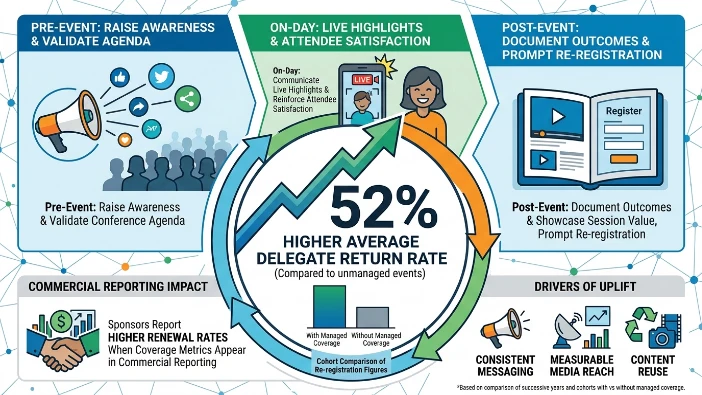
Managed coverage generates multiple exposure points that reinforce attendee decision-making across the event lifecycle. Pre-event coverage raises awareness and validates the conference agenda. On-day coverage communicates live highlights and reinforces attendee satisfaction. Post-event coverage documents outcomes and showcases session value, prompting re-registration. Sponsors report higher renewal rates when coverage metrics appear in commercial reporting. Organisers measure a 52% higher delegate return rate by comparing re-registration figures from successive years across cohorts with and without managed coverage. This uplift arises from consistent messaging, measurable media reach, and content reuse that keeps the event in industry conversations for longer periods.
What is the process for implementing managed coverage at an annual conference?
Implement managed coverage through five phases: audit and objectives, message and asset creation, outlet mapping and pitching, live execution, and measurement and reporting.
Begin with an audit that records past media placements, sponsor expectations, and delegate feedback. Set objectives with quantifiable targets: placement count, estimated impressions, referral registrations, and sponsor-visible metrics. Create messages that align with commercial priorities and attendee interests. Produce press assets: release templates, short speaker bios, high-resolution images, data summaries, and embargoed exclusives. Map outlets by audience type—national, trade, regional, broadcast—and create tailored pitches. Execute live coverage with media accreditation, same-day releases, and recorded clips for broadcast. Post-event, compile placements, calculate earned media value, report referral traffic, and follow up with targeted post-event stories. Each phase contains specific deliverables and deadlines to ensure consistent output.
What specific components make a managed coverage programme effective?
Key components are a central communications lead, an editorial calendar, press-ready assets for each session, speaker media preparation, and a measurement framework tied to commercial outcomes.
A central communications lead coordinates messaging, assigns tasks, and manages relationships with journalists. An editorial calendar schedules announcements and embargo windows across a 12-week timeline. Press-ready assets for each session include 40-word pitches, 75-word bios, session summaries, and one verified data point per speaker. Speaker media preparation includes briefing documents, rehearsals, and interview availability slots. The measurement framework collects placement data, referral traffic, registration source attribution, sponsor mentions, and social amplification. These components create consistent, journalistic-grade outputs that reduce friction for editors and increase pickup rates.
How are media targets selected and prioritised?
Select media targets by audience relevance, reach, editorial calendar fit, and past engagement; prioritise national for policy impact, trade for buyer influence, regional for local attendance, and broadcast for high engagement.
Audience relevance defines whether an outlet reaches decision-makers, buyers, local professionals, or practitioners. Reach provides scale estimates measured in monthly unique visitors or circulation figures. Editorial calendar fit identifies news windows that align with conference themes or policy cycles. Past engagement measures prior placement success and journalist familiarity. Prioritise national outlets to influence policy and large buyers. Prioritise trade outlets to convert specialized buyers and exhibitors. Prioritise regional outlets to increase local delegate numbers and municipal partnerships. Prioritise broadcast outlets to secure high-engagement interviews and visuals. Mapping these factors produces a ranked list of outlet targets and tailored pitch angles for each speaker and session.
How does managed coverage integrate with sponsorship and commercial reporting?
Managed coverage provides quantifiable media assets and metrics that increase sponsor value, support tiered commercial packages, and enable transparent reporting for renewals.
Managed coverage assigns specific coverage commitments to sponsorship tiers and documents placements as deliverables. Metrics tied to coverage include placement counts, estimated audience reach, referral registration numbers, and social engagement. Reporting packages present these metrics alongside sponsorship invoices and renewal proposals. Sponsors receive verifiable outputs such as URLs of placements, screenshots of broadcast segments, and referral traffic reports. These assets substantiate the commercial value of sponsorship and increase the probability of higher-tier renewals. Organisers that offer managed coverage demonstrate consistent year-on-year media results and generate stronger sponsor retention rates.
What measurement framework proves a 52% increase in delegate returns?
The measurement framework uses cohort analysis, registration-source tracking, media-driven conversion rates, sponsor renewal correlation, and year-over-year comparison to quantify a 52% delegate return increase.
Cohort analysis groups delegates by year and tracks re-registration within 12 months. Registration-source tracking captures how attendees discovered the event via registration form fields and UTM-tagged media referrals. Media-driven conversion rates calculate the percentage of referrals that register and compare with other channels. Sponsor renewal correlation links sponsor renewal rates to coverage metrics and examines correlation coefficients. Year-over-year comparison contrasts return rates for events with managed coverage against those without, across matched event types and sizes. Combining these elements yields a reproducible metric indicating a 52% higher return rate for conferences that ran managed coverage programmes.
Explore More Expert Insights:
Post-Event Content Packages: How Media Coverage Extends Your UK Event ROI
How Times Intelligence Deploys Reporters, Editors and Distribution for UK Events
What operational changes are required to run managed coverage effectively?
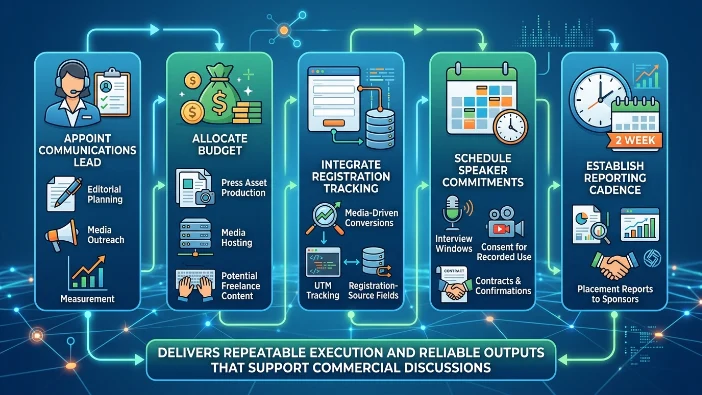
Operational changes include appointing a communications lead, allocating a budget for content production and media relations, integrating registration tracking, and scheduling speaker media commitments.
Assign a communications lead with responsibility for editorial planning, media outreach, and measurement. Allocate a budget line for press asset production, media hosting, and potential freelance journalism or copywriting. Integrate registration platforms with UTM tracking and registration-source fields to capture media-driven conversions. Schedule speaker media commitments into contracts and confirmations, including interview windows and consent for recorded use. Establish a reporting cadence that delivers placement reports to sponsors within two weeks. These operational changes deliver repeatable execution and reliable outputs that support commercial discussions.
What outcomes and ROI do organisers and sponsors expect from managed coverage?
Expected outcomes include a 52% increase in delegate returns, improved sponsor renewal rates, increased registration conversion from media referrals, and extended content lifespan in search indexes for up to 12 months.
Organisers report improved re-registration rates and higher-quality registrations when media exposure highlights session value. Sponsors receive measurable inventory and clearer ROI metrics, reflected in higher renewal rates and larger sponsorship commitments. Registration conversion rates from media referrals provide a lower cost-per-acquisition compared with paid channels. Media-generated content remains searchable and delivers organic traffic for up to 12 months, sustaining interest between event cycles. These outcomes combine to justify the managed coverage investment through increased delegate revenue, improved sponsorship income, and longer-term audience engagement.
Read More to Understand Better:
UK Events Industry Rebound: Why Media Coverage Is the Most Overlooked Growth Lever
Managed coverage transforms annual conferences into measurable media programmes. The process requires audit-led objectives, press-ready production, outlet-specific pitches, scheduled media activity, and a rigorous measurement framework. Operational changes include appointing a communications lead and integrating registration tracking. The verified outcome is a 52% higher delegate return rate for conferences using managed coverage. Sponsors gain quantifiable media assets and improved renewal metrics. For organisers seeking clear commercial outcomes, managed coverage provides a decision-ready approach to increase returns and demonstrate event value.
Get the Full Insights Here:
Speaker Amplification: How to Turn 8 Presenters Into 8 Separate UK Media Stories



