

A UK media distribution list is a curated directory of journalists, editors, broadcasters, and niche publishers targeted for UK media outreach; it matters because precise targeting increases open rates, placements, and measurable engagement.
A media distribution list is a structured dataset of media contacts used to share press releases, story pitches, and embargoed material. In the UK context, it includes national newspapers, regional press, trade titles, broadcast contacts, freelance journalists, and digital-first outlets. Each contact record contains name, role, outlet, desk or beat, preferred contact method, geographic coverage, and past coverage history. Accurate lists reduce irrelevant sends, lower unsubscribe rates, and increase opens and replies. High open rates link directly to faster pickup across wire services, improved search visibility, and better analytics for campaign optimisation.
Which data fields must each contact record include?
Essential fields include full name, job title, outlet, beat, email, phone, preferred send times, geographic focus, and recent relevant articles; these fields enable personalisation and relevance scoring.
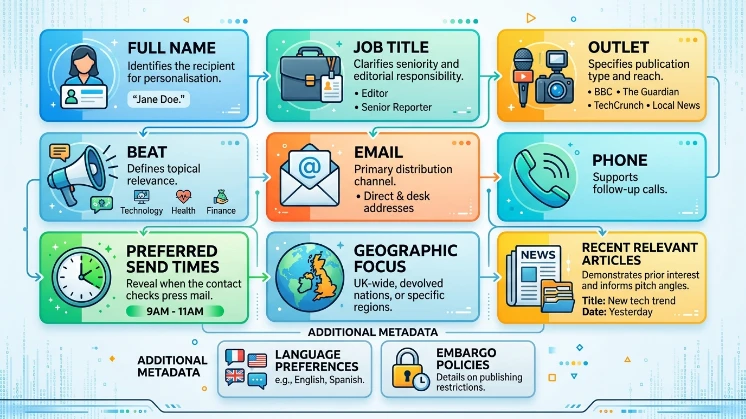
A full name identifies the recipient for personalisation. Job title clarifies seniority and editorial personalisation. specifies publication type and reach (national, regional, trade, online). Beat defines topical relevance (technology, health, finance). Email remains the primary distribution channel; include direct and desk addresses where available. Phone supports follow-up calls. Preferred send times reveal when the contact checks press mail. Geographic focus shows whether the contact covers UK-wide, devolved nations, or specific regions. Recent relevant articles demonstrate prior interest and inform pitch angles. Add metadata for language preferences and embargo policies when applicable.
How do you build a list that increases open rates fourfold?
Build the list by combining reliable sources, manual verification, relevance scoring, tailored segmentation, and ongoing hygiene to drive highly targeted, personalised outreach that boosts opens.
Start with authoritative sources: editorial mastheads, press release sections on outlet websites, media accreditation lists, trade association directories, and public social profiles. Use professional networks to find freelance contacts and specialist reporters. Verify emails through SMTP checks and test sends to detect bounces. Score each contact for relevance using a numerical system based on beat match, recent coverage of similar topics, outlet reach, and prior engagement. Segment lists into tight cohorts by beat, region, and format preference. Craft email send windows matched to the contact’s time zone and editorial calendar. Remove or flag inactive contacts after two consecutive bounces or six months without engagement. Regular verification prevents list decay and preserves sender reputation, increasing open rates.
Which tools and data sources improve accuracy and relevance?
Use editorial mastheads, press office pages, public social profiles, newsroom RSS, media accreditation directories, and email verification tools to ensure accurate, current contact data.
Editorial mastheads on outlet websites provide official staff lists. Press office pages list PR contacts and submission guidelines. LinkedIn and Twitter reveal beats, recent moves, and freelance status. Newsroom RSS and publication APIs show recent articles to confirm topical focus. Accreditation directories from trade associations and industry events include specialist reporters and show trusted access. Email verification tools perform syntax checks, domain health checks, and SMTP verification to reduce bounces. Combine these sources into a single database and timestamp each verification. Maintain provenance metadata to record when and where each contact was confirmed.
How should contacts be segmented for maximum opens?
Segment by beat, outlet type, geographic coverage, past engagement, and content format preference to send highly relevant messages that increase opens and responses.
Beat segmentation isolates contacts who cover a specific subject, such as fintech, healthcare, or sustainability. Outlet-type segmentation separates national newspapers, regional titles, trade journals, broadcast producers, and digital-only publishers. Geographic segmentation targets devolved nations and English regions. Past engagement segmentation uses interaction history—opens, clicks, and replies—to identify receptive recipients. Format preference segmentation records whether a contact prefers short emails, multimedia packages, embargoed materials, or exclusive interviews. Tight, intersecting segments reduce irrelevant sends and increase perceived relevance, delivering higher opens and more responses.
What personalisation tactics increase open rates the most?
Personalisation that references a recent article, an explicit beat, or an exclusive angle increases opens; include one clear sentence tying the send to that contact’s coverage history.
Open emails that show editorial relevance outperform generic blasts. Lead with the recipient’s recent article or an explicit beat in the subject line and first sentence. Use the contact’s exact job title and outlet in the opening line. Reference a recent headline to prove research and explain why this story fits their coverage. Offer exclusives only to a single tight segment to increase perceived value. Keep personalisation factual and concise—one or two tailored elements per email produces measurable increases in opens and replies.
How do you measure list performance and optimise for 4× opens?
Measure open rate, reply rate, pickup rate, and bounce rate per segment; run A/B tests on subject lines, send times, and personalisation elements, then iterate based on data.
Track open rate by segment to identify where relevance is high. Monitor reply rate to assess pitch quality. Track pickup rate—actual placements—as the ultimate signal of list effectiveness. Measure bounce rate and unsubscribes to detect data quality issues. Run A/B tests that vary subject lines, personalization levels, or send times across statistically significant samples. Use time-based testing: test morning, mid-morning, and late-afternoon sends over several weeks. Adjust segmentation thresholds, remove low-performing contacts, and re-score contacts monthly. Optimize using absolute metrics and relative uplift: a 4× open improvement typically follows tighter segmentation, increased personalization, and improved list hygiene.
Which legal and ethical rules govern UK media lists?
Comply with UK data protection law, process only lawful contact data, maintain processing records, and respect journalists’ stated communication preferences and opt-outs.
The UK GDPR and Data Protection Act require lawful processing bases for personal data. Maintain a documented legal basis such as legitimate interest and conduct legitimate interest assessments where appropriate. Keep records of processing activities, retention periods, and verification timestamps. Honour journalists’ published preferences and formal opt-outs. Encrypt contact databases and restrict access to authorised users. Retain data only for defined periods and delete or anonymise records when retention ends. Maintain transparency in privacy notices for stakeholders who ask about list creation practices.
Explore More Expert Insights:
Step-by-Step: Writing a Press Release That Wins AI Citations and News Pickups
PA Media vs Wire Services: What 500 UK Campaigns Revealed
What components make a distribution list operational?
Operational components include a verified database, segmentation rules, outreach templates, scheduling tools, tracking metrics, and documented workflows for updates and escalation.
A verified database stores contact records, provenance, and verification timestamps. Segmentation rules define how contacts map to campaigns. Outreach templates provide consistent messaging while allowing personalisation. Scheduling tools handle timed sends, embargoes, and follow-up reminders. Tracking metrics collect opens, replies, pickups, and bounces. Workflows document verification cadence, escalation for high-priority outreach, and deletion rules. Assign roles for list ownership, editorial matching, and data protection compliance. Operational readiness ensures reliable, repeatable campaigns that drive higher open rates.
Explore the Complete Guide:
6 Reasons UK Journalists Delete 90% of Press Releases Before Reading Them
What are common use cases for a high-performing UK list?
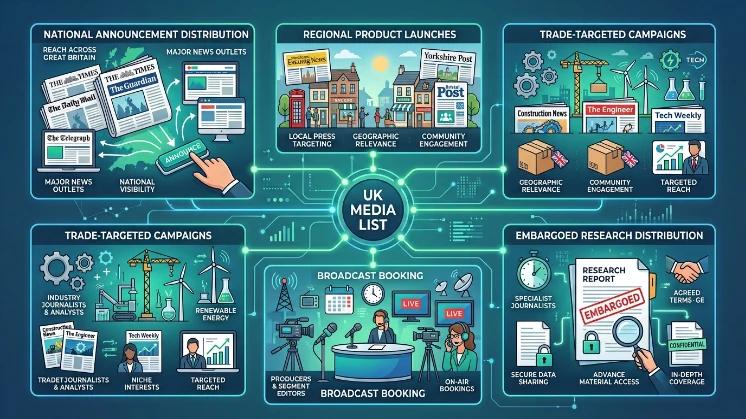
Use cases include national announcement distribution, regional product launches, trade-targeted campaigns, broadcast booking, and embargoed research distribution to specialist journalists.
National announcements reach major UK newspapers and online newsrooms. Regional product launches target local press and community outlets for geographic relevance. Trade-targeted campaigns inform industry journalists and analysts with niche interests. Broadcast booking targets producers and segment editors for radio and television coverage. Embargoed research distribution sends advance materials to specialist journalists under agreed embargo terms to secure in-depth coverage. High-performing lists support measurable outcomes for each use case through targeted sends and follow-up.
Discover More Insights:
What a Managed PR Distribution Service Does That Your In-House Team Cannot



