

Planning a full-year media strategy requires more than historical performance data and seasonal assumptions. UK brands increasingly rely on audience insights to understand consumer behaviour, identify emerging trends, and allocate budgets with greater precision. Audience data transforms media planning from a reactive process into a structured decision-making framework.
As media consumption becomes fragmented across platforms, channels, and content formats, audience intelligence provides a consistent foundation for planning. Brands use these insights to determine where consumers spend time, what influences purchasing decisions, and how preferences evolve throughout the year.
How do audience insights help UK brands plan full-year media buys?
Audience insights provide measurable information about consumer behaviour, media consumption, interests, purchasing intent, and engagement patterns. UK brands use these insights to forecast demand, allocate budgets, select channels, and optimise campaign performance throughout the entire planning cycle.
Audience insights refer to structured data collected from consumer interactions, media consumption habits, surveys, website behaviour, and market research. This information helps brands understand who their audiences are and how they engage with content.
Instead of planning campaigns around broad demographic assumptions, brands use audience intelligence to identify specific consumer segments and predict media effectiveness.
The process connects marketing objectives directly to audience behaviour, creating a data-driven foundation for annual planning.
What audience data is most valuable during planning?
Several categories of audience data influence media buying decisions:
- Demographic data
- Geographic data
- Behavioural data
- Purchase intent data
- Content engagement data
- Device usage data
- Channel preference data
Each category contributes to a more complete view of the target audience.
How does audience intelligence improve forecasting?
Audience insights reveal patterns that support forecasting activities. Brands can identify recurring seasonal trends, category growth opportunities, and changes in consumer interests.
These insights help planners estimate future demand and align media investment with expected audience activity.
What is the process of turning audience data into media-buying decisions?
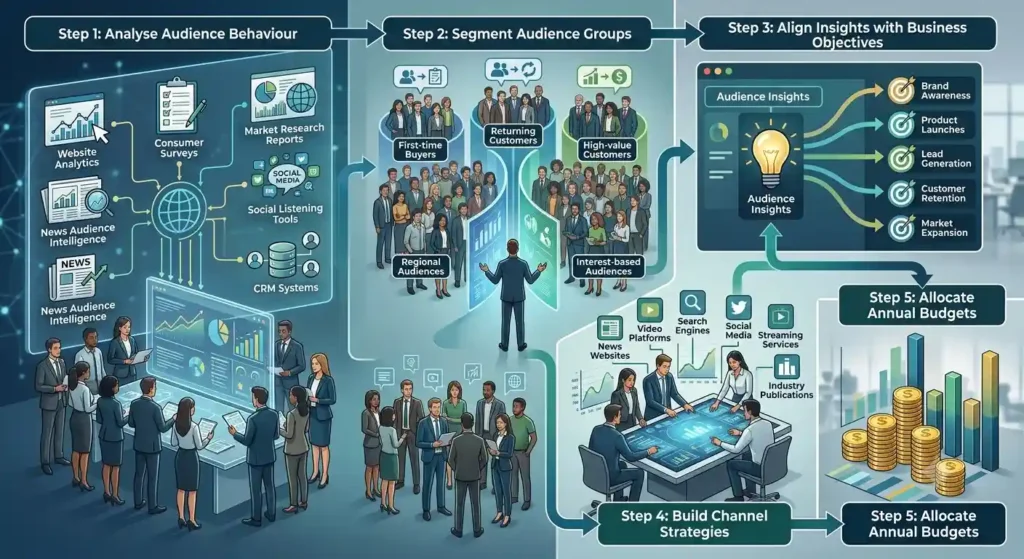
The process begins with audience analysis, followed by segmentation, objective alignment, channel selection, budget allocation, forecasting, campaign execution, and performance measurement. Each stage converts raw data into actionable planning decisions that support business goals and marketing outcomes.
Media planning teams follow a structured workflow when using audience intelligence.
Step 1: Analyse audience behaviour
The first stage involves collecting audience data from multiple sources.
Examples include:
- Website analytics
- Consumer surveys
- Market research reports
- News audience intelligence platforms
- Social listening tools
- CRM systems
This information establishes a baseline understanding of consumer behaviour.
Step 2: Segment audience groups
Brands divide audiences into meaningful segments.
Examples include:
- First-time buyers
- Returning customers
- High-value customers
- Regional audiences
- Interest-based audiences
Segmentation enables more accurate targeting throughout the year.
Step 3: Align insights with business objectives
Every media investment supports a defined objective.
Examples include:
- Brand awareness
- Product launches
- Lead generation
- Customer retention
- Market expansion
Audience insights help determine which segments contribute most effectively to each objective.
Step 4: Build channel strategies
Planners evaluate where target audiences spend time.
This assessment includes:
- News websites
- Video platforms
- Search engines
- Social media
- Streaming services
- Industry publications
Channel selection becomes evidence-based rather than assumption-driven.
Step 5: Allocate annual budgets
Audience concentration and engagement levels influence budget distribution.
Higher-performing channels receive larger allocations, while lower-performing placements receive reduced investment.
Which audience insight metrics influence annual planning decisions?
Several audience metrics directly influence media-buying strategies. UK brands examine reach, engagement, frequency, attention, purchase intent, content affinity, audience growth, and conversion indicators to determine where budgets generate the strongest business impact throughout the year.
Metrics provide measurable evidence for planning decisions.
Reach
Reach measures the number of unique individuals exposed to content.
Brands use reach data to estimate campaign scale.
Engagement
Engagement reflects audience interaction levels.
Examples include:
- Clicks
- Shares
- Comments
- Video completions
- Content consumption time
Higher engagement often indicates stronger audience relevance.
Purchase Intent
Purchase intent measures consumer readiness to buy.
Brands use intent signals to identify valuable audience segments.
Content Affinity
Content affinity shows which topics attract specific audiences.
This insight supports contextual advertising strategies.
Attention Metrics
Attention metrics measure the quality of audience exposure.
Examples include:
- Viewability
- Active attention time
- Completion rates
These indicators help evaluate media effectiveness beyond impressions.
For a deeper understanding of measurement frameworks, brands often review:
How to Brief Your Creative Team Using News Audience Data for Better UK Performance during planning discussions.
Why are UK news audiences important for full-year media planning?
News audiences provide valuable behavioural signals because they actively consume information, engage with current events, and demonstrate identifiable interests. UK brands use news audience intelligence to understand trends, improve targeting accuracy, and strengthen media relevance throughout annual campaigns.
News environments generate rich audience intelligence.
Consumers engage with news content daily, creating consistent behavioural data that planners can analyse.
What insights do news audiences provide?
News audience analysis reveals:
- Emerging consumer interests
- Regional engagement patterns
- Topic preferences
- Economic sentiment indicators
- Industry-specific trends
These insights support both strategic planning and campaign execution.
How does news audience data improve relevance?
Audience data derived from news engagement helps planners understand which messages resonate with specific groups.
This improves:
- Creative relevance
- Audience targeting
- Media efficiency
- Campaign performance
Brands that incorporate news audience intelligence often achieve stronger alignment between media placement and consumer interests.
How do brands allocate budgets using audience insights?
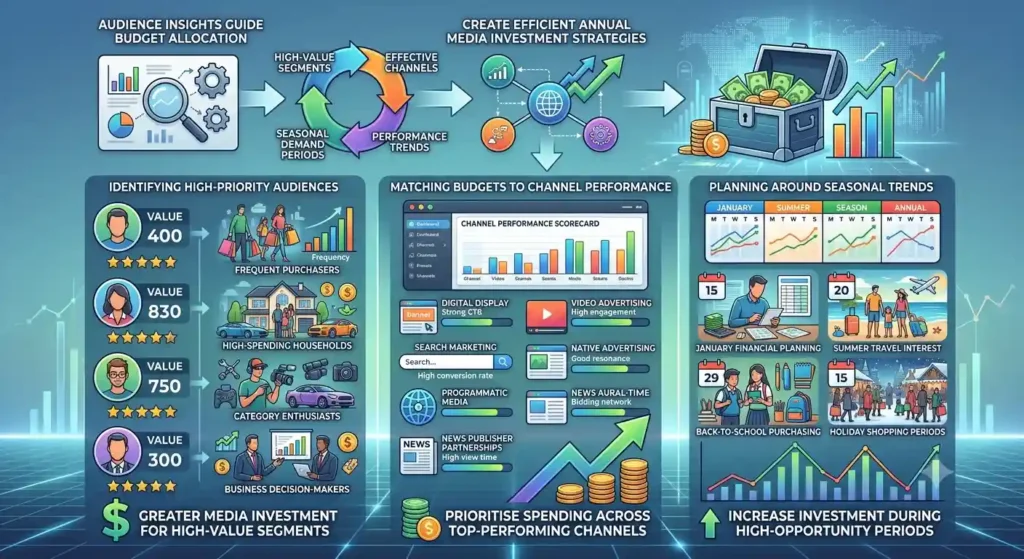
Audience insights guide budget allocation by identifying high-value segments, effective channels, seasonal demand periods, and performance trends. Brands distribute resources based on evidence rather than assumptions, creating more efficient annual media investment strategies across multiple channels.
Budget allocation represents one of the most important outcomes of audience analysis.
Identifying high-priority audiences
Brands determine which audience groups contribute the greatest commercial value.
Examples include:
- Frequent purchasers
- High-spending households
- Category enthusiasts
- Business decision-makers
These segments often receive greater media investment.
Matching budgets to channel performance
Audience data reveals which channels generate stronger engagement and conversions.
Brands use this information to prioritise spending across:
- Digital display
- Video advertising
- Search marketing
- Native advertising
- Programmatic media
- News publisher partnerships
Planning around seasonal trends
Audience behaviour changes throughout the year.
Examples include:
- January financial planning activity
- Summer travel interest
- Back-to-school purchasing
- Holiday shopping periods
Insights help brands increase investment during high-opportunity periods.
What benefits do UK brands gain from data-driven annual planning?
Data-driven planning improves targeting accuracy, budget efficiency, forecasting reliability, campaign relevance, and long-term performance measurement. UK brands use audience intelligence to reduce wasted spend and create more predictable marketing outcomes across the entire calendar year.
Audience-led planning produces measurable operational benefits.
Better targeting accuracy
Audience insights help brands reach consumers who demonstrate genuine interest in relevant products or services.
This reduces unnecessary exposure and improves efficiency.
Stronger budget control
Planning decisions become evidence-based.
Brands can justify investments using measurable audience data rather than assumptions.
Improved campaign relevance
Audience intelligence helps align messaging with consumer interests.
Relevant campaigns often generate stronger engagement and better business outcomes.
Enhanced performance measurement
Audience benchmarks provide a framework for evaluating campaign success throughout the year.
Performance tracking becomes more consistent and actionable.
Brands exploring trend discovery often connect these planning insights with findings discussed in:
91% of UK Consumers Discover Trends Through Media: What Brands Are Missing.
How are leading UK brands applying audience insights in real-world planning?
Leading UK brands integrate audience intelligence into every stage of media planning. They combine consumer behaviour data, market trends, channel analysis, and performance forecasting to create year-long strategies that maximise relevance, efficiency, and measurable business results.
A retail brand may analyse audience interests before allocating budgets across seasonal campaigns.
A financial services company may use behavioural signals to identify periods of increased consumer research activity.
A travel organisation may evaluate regional demand trends before determining annual media investment levels.
In each case, audience insights serve as the foundation for planning decisions.
The objective remains consistent: invest resources where audience attention and business opportunity align most effectively.
Dive Deeper With Our Expert Guides:
Why Advertisers Using News Audience Data See 3× Better Campaign Relevance Scores
Custom Audience Insight Reports: How They Are Built and What Brands Receive
Audience insights have become a core component of full-year media planning in the UK. Brands no longer rely solely on historical performance or broad demographic assumptions. Instead, they use audience intelligence to understand behaviour, forecast demand, identify opportunities, and allocate budgets with greater precision.
The transition from data to decision involves a structured process that connects audience analysis, segmentation, channel selection, budgeting, and performance measurement. By using audience insights throughout the planning cycle, UK brands create more relevant campaigns, improve media efficiency, and achieve stronger long-term marketing outcomes.



