

News audience data provides evidence about what people read, discuss, and engage with across trusted media environments. It helps creative teams align messaging, visuals, and campaign themes with real audience interests, improving relevance, engagement, and overall marketing performance in the UK.
Many creative briefs focus on demographics such as age, location, and income. These factors describe who the audience is, but they do not explain what captures attention at a specific moment.
News audience data fills this gap. It reveals the topics, categories, and narratives attracting audience engagement across news publishers and media platforms.
For UK marketers, this information helps connect campaigns to current consumer interests. A brief built on audience intelligence gives creative teams clearer direction and stronger context.
Businesses exploring broader media influence can also review:
91% of UK Consumers Discover Trends Through Media to understand how media consumption shapes audience behaviour.
What does news audience data include?
News audience data typically contains:
- Content consumption patterns
- Topic engagement levels
- Reader interests
- Geographic audience trends
- Device usage behaviour
- Content category preferences
- Engagement frequency metrics
These insights provide measurable evidence that informs creative development.
How does news audience data improve the creative briefing process?
News audience data transforms creative briefs from assumption-based documents into evidence-based planning tools. It provides audience context, identifies content opportunities, and gives creative teams specific information that guides messaging, imagery, and campaign execution.
A traditional brief often contains broad audience descriptions. A data-informed brief includes actual behavioural insights.
For example, a retail campaign targeting UK consumers may discover increased engagement with sustainability reporting, household budgeting content, and local economic news.
Creative teams can use this information to shape headlines, visual concepts, and supporting messages.
How does audience evidence reduce creative guesswork?
Audience evidence creates alignment between marketing objectives and creative execution.
Instead of asking:
“What message will resonate?”
The brief answers:
“These audience segments actively engage with these topics.”
This shift reduces revision cycles and improves campaign consistency.
How does audience context support creative decisions?
Audience context helps creative professionals understand:
- What audiences care about
- Which topics drive attention
- Which narratives generate engagement
- What content environments influence decisions
The result is more focused creative development.
What information should be included in a data-driven creative brief?
A data-driven creative brief combines campaign objectives with audience intelligence. It provides clear guidance on audience interests, content themes, behavioural signals, and performance goals so creative teams can develop assets that align with real audience behaviour.

Several components strengthen a modern creative brief.
Audience profile
Define key audience segments.
Include:
- Age groups
- Locations
- Interests
- Content consumption habits
- Media engagement patterns
Example:
A UK automotive audience may regularly engage with electric vehicle coverage, fuel-cost reporting, and transport policy news.
Content themes
Identify topics receiving high engagement.
Examples include:
- Personal finance
- Technology
- Sustainability
- Healthcare
- Travel
These themes provide creative direction.
Messaging priorities
Specify the core message.
The brief should explain:
- Primary campaign objective
- Key audience need
- Supporting proof points
Clear messaging reduces ambiguity.
Performance objectives
Define measurable outcomes.
Examples include:
- Click-through rate
- Engagement rate
- Lead generation
- Brand awareness metrics
- Conversion targets
Creative teams perform better when success criteria are clearly defined.
How can marketers translate audience insights into creative concepts?
Marketers translate audience insights into creative concepts by converting behavioural data into themes, messages, visuals, and storytelling directions. The process connects audience interests with campaign objectives while maintaining relevance throughout creative execution.
Audience insights become valuable only when transformed into actionable creative guidance.
Step 1: Identify dominant audience interests
Review engagement data.
Look for:
- High-performing content categories
- Trending news topics
- Consistent audience interests
Patterns reveal opportunities.
Step 2: Connect interests to campaign objectives
Find intersections between audience behaviour and business goals.
For example:
A financial services campaign targeting young professionals may align with growing interest in personal finance and economic planning content.
The creative direction becomes more relevant because it reflects existing audience interests.
Step 3: Develop messaging frameworks
Create messaging pillars based on audience intelligence.
Examples include:
- Financial confidence
- Sustainable living
- Career growth
- Health awareness
These frameworks guide content production.
Step 4: Build creative assets
Develop:
- Headlines
- Visual designs
- Video concepts
- Display advertisements
- Social content
Every asset should reflect audience insights identified during planning.
What role do audience segments play in creative development?
Audience segments help creative teams personalise messaging and visual execution. Different groups consume different content, respond to different themes, and engage with distinct narratives. Segment-level insights improve creative relevance and campaign effectiveness.
Not all readers engage with content in the same way.
News audience data helps identify meaningful audience groups.
Example: Technology audience
Common interests include:
- Artificial intelligence
- Digital innovation
- Cybersecurity
- Consumer technology
Creative assets can reflect these priorities.
Example: Finance audience
Common interests include:
- Savings
- Investments
- Inflation
- Household budgeting
Messaging can focus on financial outcomes.
Example: Sustainability audience
Common interests include:
- Climate reporting
- Renewable energy
- Environmental responsibility
Creative concepts can align with these values.
Segmentation helps creative teams build targeted assets instead of relying on one generic message.
How can creative teams use news audience data across different channels?
News audience data supports creative adaptation across display advertising, video, social media, native content, and content marketing channels. It ensures messaging remains consistent while adapting execution to different audience environments.
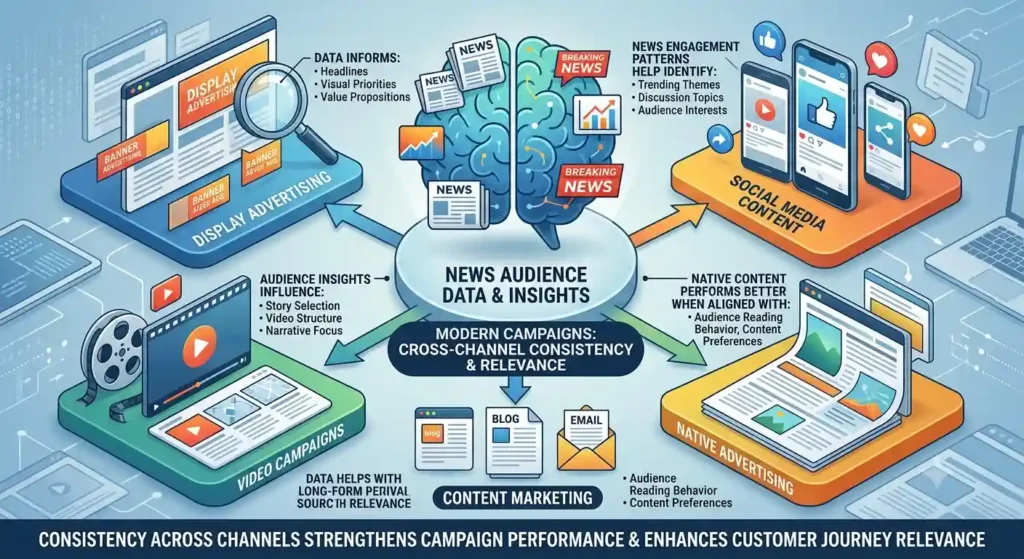
Modern campaigns operate across multiple channels.
Audience intelligence helps maintain relevance throughout the customer journey.
Display advertising
Data informs:
- Headlines
- Visual priorities
- Value propositions
Video campaigns
Audience insights influence:
- Story selection
- Video structure
- Narrative focus
Social media content
News engagement patterns help identify:
- Trending themes
- Discussion topics
- Audience interests
Native advertising
Native content performs better when aligned with audience reading behaviour and content preferences.
Consistency across channels strengthens campaign performance.
What are the benefits of using news audience data in creative briefs?
Using news audience data improves relevance, efficiency, audience understanding, and campaign performance. Creative teams gain clearer direction, while marketers reduce uncertainty and improve alignment between audience behaviour and campaign objectives.
Several measurable advantages emerge from a data-informed briefing process.
Improved relevance
Audience interests directly influence creative development.
Relevant campaigns generate stronger engagement.
Better collaboration
Creative and marketing teams work from the same evidence base.
This reduces misunderstandings and conflicting interpretations.
Faster decision-making
Clear audience insights reduce debate during concept development.
Teams spend less time validating assumptions.
Stronger performance outcomes
Data-informed creative assets align more closely with audience behaviour.
This improves engagement and campaign effectiveness.
Organisations seeking deeper audience planning frameworks often examine:
From Data to Decision: How UK Brands Use Audience Insights to Plan Full-Year Buys to understand how audience intelligence supports broader media investment decisions.
How are UK brands using news audience data today?
UK brands increasingly use news audience data to guide campaign planning, creative development, audience targeting, and media investment decisions. The approach connects audience behaviour with marketing execution across the entire campaign lifecycle.
Audience intelligence has become a strategic asset.
Brands use it to understand:
- Consumer interests
- Emerging trends
- Media consumption behaviour
- Content engagement patterns
Creative teams receive more detailed guidance than traditional demographic profiles provide.
This enables campaigns to reflect current audience priorities rather than historical assumptions.
As media environments become more fragmented, audience data helps unify decision-making across creative, media, and marketing teams.
Dive Deeper With Our Expert Guides:
7 Audience Insight Metrics That Predict UK Purchase Intent Before the Sale
Cross-Platform Audience Matching: How UK Brands Unify Fragmented Reader Data
News audience data gives creative teams a clearer understanding of what audiences read, engage with, and value. A well-structured brief transforms these insights into actionable creative direction, helping UK marketers develop more relevant campaigns, improve collaboration, and align creative execution with real audience behaviour.
By combining audience intelligence, segmentation, content themes, and performance objectives, marketers create stronger briefs that support better creative outcomes. As audience expectations continue to evolve, data-driven briefing processes provide a reliable framework for improving campaign relevance and effectiveness across the UK market.



