

Understanding audience intent is now a core requirement for successful digital advertising in the United Kingdom. News publishers collect large volumes of behavioural signals that reveal what readers consume, research, and engage with throughout the customer journey. By analysing audience composition across industry, age group, and intent stage, marketers gain a clearer view of where advertising budgets generate measurable results.
Why do UK news site audiences matter for campaign targeting?
UK news site audiences provide verified behavioural signals, demographic insights, and intent-stage indicators. These signals help advertisers match campaigns with relevant readers, reduce wasted impressions, improve conversion rates, and increase return on advertising spend across multiple industries.
News websites attract millions of readers every month. Unlike many social platforms, news environments capture active information-seeking behaviour.
A reader researching mortgage rates, electric vehicles, private healthcare, or business software demonstrates measurable interest through content consumption patterns. These actions create audience intelligence that advertisers can use for targeting.
Audience data from news publishers typically includes:
- Industry interests
- Age demographics
- Content engagement patterns
- Purchase intent indicators
- Geographic location signals
- Device behaviour
This audience intelligence supports more precise media buying decisions.
What industries show the strongest audience intent on UK news websites?

Finance, automotive, technology, healthcare, travel, retail, property, education, energy, and business services generate some of the strongest intent signals on UK news sites. Readers actively consume industry-specific content before making purchasing decisions.
Different industries attract distinct audience segments.
Finance audiences
Finance readers often consume content related to:
- Savings accounts
- Investments
- Mortgages
- Insurance
- Pension planning
These readers frequently sit in mid-to-late funnel buying stages because financial research often precedes decision-making.
Automotive audiences
Automotive content attracts readers researching:
- Electric vehicles
- Car finance
- Vehicle reviews
- Fleet management
Vehicle purchase journeys typically involve extensive information gathering, creating valuable intent signals.
Technology audiences
Technology readers engage with:
- Software reviews
- Artificial intelligence
- Cybersecurity
- Cloud computing
- Digital transformation
B2B technology buyers often consume multiple articles before vendor evaluation.
Healthcare audiences
Healthcare readers seek information about:
- Private healthcare services
- Wellness programmes
- Medical technology
- Health insurance
This behaviour creates strong category-level intent indicators.
How does age influence news audience behaviour?
Age significantly affects content consumption patterns, purchase priorities, and research behaviour. Different age groups interact with news content in distinct ways, producing unique audience segments for advertisers and media planners.
Age remains one of the strongest audience variables.
Ages 18–24
This audience typically engages with:
- Career development
- Technology trends
- Higher education
- Streaming services
- Personal finance basics
Content consumption often occurs through mobile devices.
Ages 25–34
This group frequently researches:
- Property purchases
- Family planning
- Vehicle ownership
- Career advancement
Commercial intent often increases substantially within this demographic.
Ages 35–44
Readers in this segment often engage with:
- Investment products
- Family healthcare
- Education planning
- Home improvement
Many purchasing decisions occur during this life stage.
Ages 45–54
This audience consumes content related to:
- Wealth management
- Insurance products
- Travel planning
- Retirement preparation
Intent signals frequently become more specific.
Ages 55+
Readers often focus on:
- Retirement solutions
- Healthcare services
- Travel opportunities
- Financial security
This audience segment often demonstrates high purchasing power.
What intent stages exist within UK news audiences?
News audience behaviour typically aligns with awareness, consideration, and decision stages. Content consumption patterns reveal where readers sit within the buying journey and which advertising messages match their current intent level.
Intent stage classification improves targeting accuracy.
Awareness stage
Readers are identifying problems or exploring topics.
Examples include:
- Understanding electric vehicles
- Learning about pension options
- Researching cybersecurity threats
These users require educational content.
Consideration stage
Readers compare available solutions.
Examples include:
- Mortgage provider comparisons
- Vehicle brand evaluations
- Software platform reviews
At this stage, audience qualification becomes stronger.
Decision stage
Readers evaluate specific providers and products.
Examples include:
- Insurance quote comparisons
- Software vendor assessments
- Healthcare provider selection
Decision-stage audiences often generate the highest conversion rates.
For a deeper understanding of audience qualification methods, marketers can explore:
What do 10 common UK news site audience segments look like?
Audience segments combine demographic characteristics, industry interests, and behavioural indicators. These segments help advertisers identify where campaigns align with business objectives and customer acquisition goals.
1. Financial Planners
Characteristics:
- Ages 35–64
- High engagement with investment content
- Strong retirement planning interest
Intent Stage:
- Consideration to Decision
2. First-Time Home Buyers
Characteristics:
- Ages 25–39
- Mortgage research activity
- Property market engagement
Intent Stage:
- Consideration
3. Electric Vehicle Researchers
Characteristics:
- Ages 30–55
- Automotive comparison behaviour
- Sustainability interests
Intent Stage:
- Consideration to Decision
4. Healthcare Decision Makers
Characteristics:
- Ages 35–65
- Health service research
- Insurance-related engagement
Intent Stage:
- Decision
5. Technology Evaluators
Characteristics:
- Ages 25–54
- Software comparison activity
- Business technology interests
Intent Stage:
- Consideration
6. Frequent Travellers
Characteristics:
- Ages 30–60
- Travel planning content consumption
- Airline and destination research
Intent Stage:
- Consideration
7. Business Leaders
Characteristics:
- Senior professionals
- Market analysis engagement
- Leadership content consumption
Intent Stage:
- Decision
8. Higher Education Researchers
Characteristics:
- Students and parents
- University-related content engagement
- Career-focused behaviour
Intent Stage:
- Awareness to Consideration
9. Energy-Conscious Consumers
Characteristics:
- Utility research activity
- Sustainability engagement
- Home energy interests
Intent Stage:
- Consideration
10. Retail Value Seekers
Characteristics:
- Product comparison behaviour
- Discount-focused content engagement
- Purchase research activity
Intent Stage:
- Decision
How can advertisers use audience intent data to improve campaign performance?
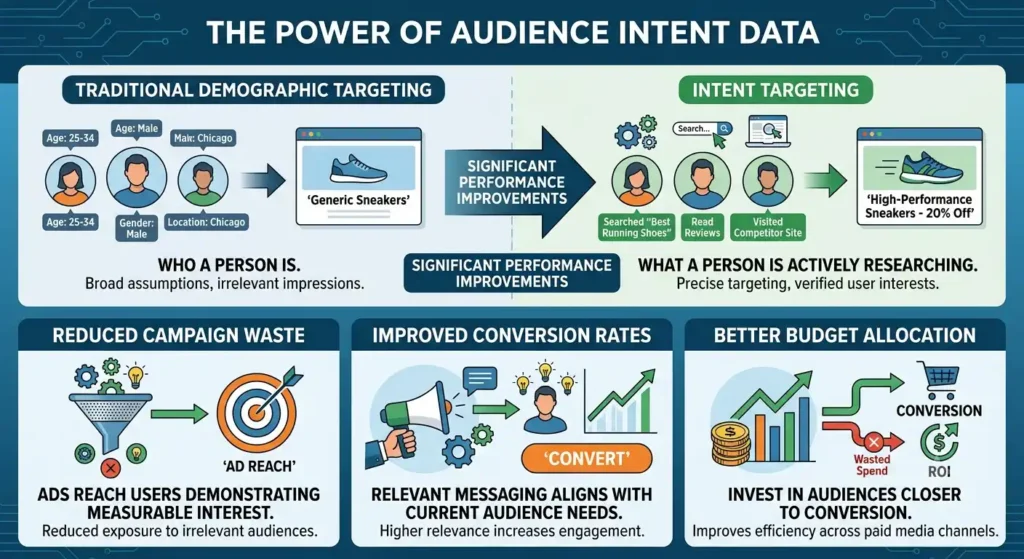
Audience intent data improves targeting precision, reduces irrelevant impressions, strengthens message relevance, and increases conversion efficiency. Advertisers align campaigns with verified user interests instead of relying solely on broad demographic assumptions.
Traditional demographic targeting identifies who a person is.
Intent targeting identifies what a person is actively researching.
This distinction produces significant performance improvements.
Key benefits include:
Reduced campaign waste
Ads reach users demonstrating measurable interest.
This reduces exposure to irrelevant audiences.
Improved conversion rates
Relevant messaging aligns with current audience needs.
Higher relevance typically increases engagement.
Better budget allocation
Advertisers invest in audiences closer to conversion.
This improves efficiency across paid media channels.
Many organisations using advanced audience segmentation frameworks report significant reductions in wasted spend through intent-led targeting strategies.
How do news publisher audiences compare with generic audience targeting?
News publisher audience data often provides stronger contextual relevance because behavioural signals originate from active content consumption. Generic targeting frequently relies on broader assumptions that produce lower audience precision.
News audience intelligence offers several advantages.
Context-rich behaviour
Readers actively engage with industry-specific content.
This behaviour generates reliable intent indicators.
Real-time audience signals
Interest categories update continuously as content consumption changes.
This supports timely campaign activation.
Verified engagement
Publisher environments capture direct user interaction with trusted editorial content.
This strengthens audience qualification.
Advertisers evaluating targeting options often compare publisher audience intelligence against broader third-party audience pools before investment decisions.
Readers seeking foundational understanding of audience behaviour can review:
How Gen Z in the UK Searches for Brands Completely Differently Than Millennials.
How can marketers choose the right UK news audience for their objectives?
The best audience selection process aligns business objectives, customer profiles, industry relevance, and intent-stage signals. Marketers achieve stronger outcomes when audience characteristics directly support campaign goals and conversion requirements.
A structured selection process improves results.
Step 1: Define the objective
Examples include:
- Lead generation
- Product sales
- Brand awareness
- Event registrations
Step 2: Identify relevant industries
Match audience interests with product categories.
A financial services campaign targets finance-related audiences rather than broad consumer groups.
Step 3: Select age demographics
Focus on age groups that historically convert.
Avoid unnecessary audience expansion.
Step 4: Prioritise intent stage
Decision-stage audiences support conversion campaigns.
Awareness-stage audiences support educational campaigns.
Step 5: Measure outcomes
Track:
- Click-through rates
- Lead quality
- Cost per acquisition
- Conversion rates
- Return on ad spend
These metrics reveal audience effectiveness.
Dive Deeper With Our Expert Guides:
News Site Audience Data vs DMP Platforms: A Head-to-Head UK Comparison
How Our Audience Insights Service Reduced One UK Brand’s CPL by 41% in Q1
UK news site audiences provide a powerful combination of demographic information, industry interest signals, and intent-stage insights. Across finance, automotive, healthcare, technology, travel, education, property, retail, energy, and business sectors, audience intelligence helps advertisers reach readers who actively demonstrate commercial interest.
By analysing age groups, behavioural patterns, and buying-stage indicators, marketers gain a clearer understanding of who their audiences are and where they sit within the customer journey. Organisations seeking stronger campaign efficiency increasingly use audience intent data to identify high-value prospects, reduce wasted media spend, and improve conversion performance across the UK market.



