

Social media platforms generate billions of interactions every year. In 2026, the analysis of 39.7 million social posts from UK users provides a detailed view of how audiences discover information, engage with content, and make decisions. These insights help explain changing digital behaviours, content preferences, and audience expectations across the United Kingdom.
What does the analysis of 39.7 million social posts reveal about UK audience behaviour in 2026?
The analysis of 39.7 million UK social posts reveals clear shifts in content consumption, platform usage, audience interests, engagement patterns, and purchasing influences. The data highlights increasing demand for authenticity, short-form content, personalised experiences, and community-driven interactions across digital channels.
Social media activity creates behavioural signals. These signals include likes, comments, shares, mentions, follows, searches, and content interactions.
The analysis of 39.7 million posts provides statistically significant insight into how UK audiences behave online. Large datasets reduce the impact of isolated trends and reveal broader behavioural patterns.
Several key findings emerge:
- Increased preference for video-first content
- Growth of community-based discussions
- Higher engagement with educational content
- Strong interest in personal finance and cost-saving topics
- Greater reliance on social platforms for product discovery
These behaviours affect media consumption, advertising effectiveness, and audience targeting strategies.
Why is a large social dataset important?
A dataset containing 39.7 million posts captures behaviour across multiple demographics, industries, and regions.
Examples include:
- London-based professionals discussing economic issues
- Students sharing educational resources
- Parents exchanging family recommendations
- Sports fans reacting to live events
The scale improves accuracy when identifying nationwide trends.
How are UK audiences consuming content differently in 2026?
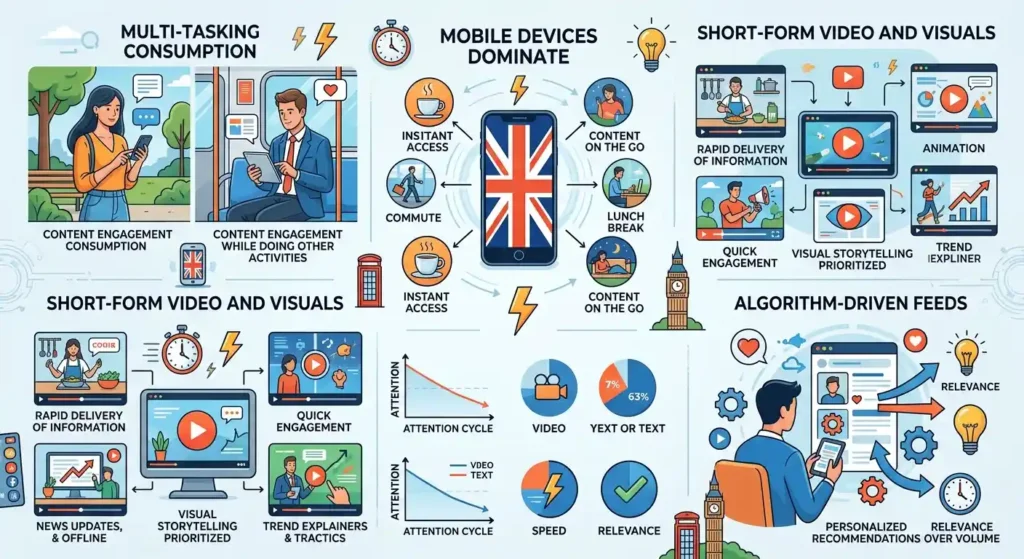
UK audiences consume content through shorter attention cycles, mobile-first experiences, video formats, and algorithm-driven feeds. Engagement increasingly depends on relevance, speed, visual storytelling, and direct value rather than content volume or publishing frequency alone across platforms.
Content consumption patterns have evolved significantly.
Users increasingly interact with content while multitasking. Mobile devices dominate content access throughout the day.
Short-form formats continue to attract strong engagement because they deliver information quickly.
Which content formats receive the most engagement?
Video content consistently generates higher interaction rates than static formats.
Examples include:
- Short educational clips
- Product demonstrations
- News summaries
- Expert interviews
- Behind-the-scenes videos
Visual content reduces information-processing time and increases retention.
Why are audiences favouring concise content?
Social feeds contain more content than users can realistically consume.
As a result, audiences prioritise:
- Fast information access
- Clear messaging
- Immediate relevance
- Visual clarity
Content that delivers value within seconds receives greater attention.
What topics are driving the highest levels of social conversation?
Personal finance, artificial intelligence, health, sustainability, consumer spending, housing, entertainment, and career development generate substantial social discussion. These topics reflect economic conditions, technological adoption, lifestyle priorities, and evolving public interests among UK audiences during 2026.
Topic popularity often reflects real-world events and economic conditions.
Consumers increasingly seek information that directly affects daily life.
Why is personal finance generating strong engagement?
Rising living costs continue to influence online discussions.
Popular subjects include:
- Household budgeting
- Savings strategies
- Energy costs
- Mortgage rates
- Investment education
People actively seek practical solutions and peer experiences.
How is artificial intelligence influencing conversations?
Artificial intelligence has become a mainstream topic.
Users discuss:
- AI-powered search
- Workplace automation
- Content creation tools
- Educational applications
- Productivity improvements
These conversations span multiple age groups and industries.
How do social communities influence audience decisions?
Social communities influence purchasing decisions, brand perception, information discovery, and trust formation. UK audiences increasingly rely on peer recommendations, group discussions, and community validation before making choices related to products, services, media consumption, and lifestyle decisions.
Community engagement continues to grow across social platforms.
Users often trust recommendations from peers more than direct promotional messages.
What role does social proof play?
Social proof refers to behavioural validation from other users.
Examples include:
- Product reviews
- User-generated content
- Testimonials
- Community recommendations
- Public discussions
Positive social proof increases confidence during decision-making.
Why are niche communities becoming more influential?
Smaller communities often provide specialised knowledge.
Examples include:
- Fitness groups
- Technology forums
- Travel communities
- Parenting networks
- Financial education groups
These communities create stronger engagement because discussions focus on shared interests.
How has audience trust changed across social platforms?
Audience trust increasingly depends on transparency, credibility, expertise, and authenticity. UK users evaluate information sources more carefully, favour verified expertise, and engage more with content that demonstrates accuracy, consistency, and clear evidence supporting its claims.
Trust remains a central factor in digital engagement.
Users encounter large volumes of content daily and increasingly assess credibility before interacting.
What factors increase audience trust?
Several factors contribute to trust development:
- Transparent communication
- Expert knowledge
- Data-backed information
- Consistent publishing
- Authentic user experiences
Audiences respond positively when information appears reliable and verifiable.
What reduces trust?
Trust decreases when content contains:
- Misleading headlines
- Unsupported claims
- Excessive promotion
- Inconsistent messaging
- Lack of transparency
Users quickly disengage when credibility becomes questionable.
What behavioural trends are shaping media consumption in the UK?
Media consumption increasingly reflects personalised experiences, cross-platform journeys, real-time engagement, and audience participation. UK consumers move between platforms rapidly, expecting consistent experiences and relevant content throughout their digital interactions and information discovery processes.
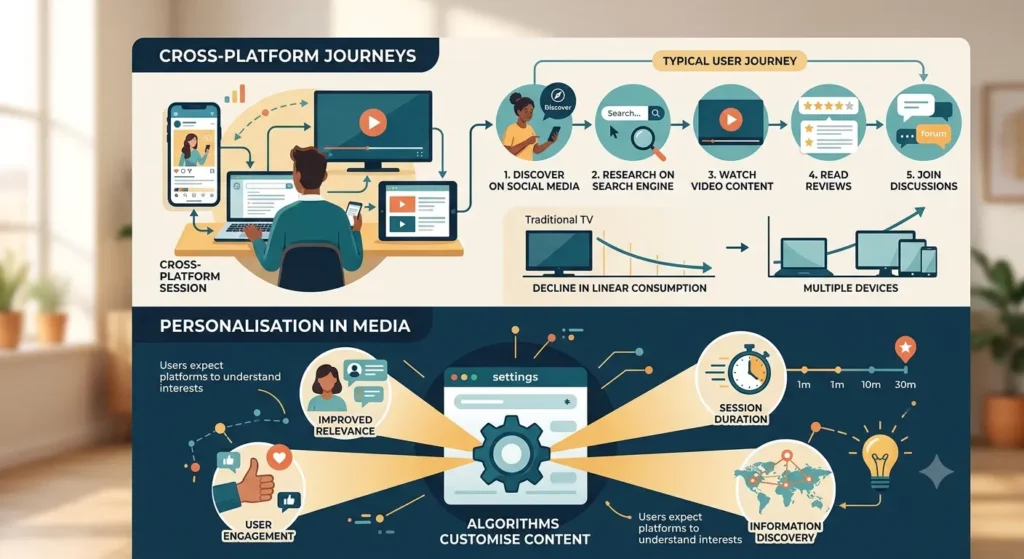
Traditional linear consumption patterns continue to decline.
Audiences now navigate multiple platforms during a single session.
How do audiences move across platforms?
A common journey includes:
- Discovering content on social media
- Researching through search engines
- Watching video content
- Reading reviews
- Joining discussions
This creates interconnected digital behaviour patterns.
Why is personalisation becoming more important?
Algorithms increasingly customise content experiences.
Personalisation improves:
- Content relevance
- User engagement
- Session duration
- Information discovery
Users expect platforms to understand their interests and preferences.
How can psychographic and behavioural insights improve audience understanding?
Psychographic insights explain motivations, values, and attitudes, while behavioural insights reveal actions and engagement patterns. Combining both approaches provides a more complete understanding of audience decision-making, content preferences, and media consumption behaviour within the UK market.
Audience analysis becomes stronger when motivations and actions are examined together.
Behavioural data explains what people do.
Psychographic data explains why they do it.
For a deeper comparison, see:
Psychographic vs Behavioural Segmentation.
What is behavioural segmentation?
Behavioural segmentation groups audiences according to actions.
Examples include:
- Purchase history
- Content engagement
- Website activity
- Platform usage
- Search behaviour
These measurable actions create observable audience patterns.
What is psychographic segmentation?
Psychographic segmentation focuses on:
- Values
- Interests
- Attitudes
- Lifestyle preferences
- Motivations
This approach provides deeper context behind audience actions.
What practical applications emerge from analysing 39.7 million social posts?
Large-scale social analysis supports audience research, content planning, media strategy, trend identification, customer understanding, and market forecasting. The findings help organisations understand evolving consumer expectations and behavioural patterns across different audience segments throughout the United Kingdom.
Social data offers measurable evidence of audience behaviour.
The insights support decision-making across multiple functions.
How does social analysis improve content strategy?
Content creators can identify:
- High-interest topics
- Preferred formats
- Engagement triggers
- Emerging trends
- Audience questions
This improves relevance and user engagement.
How does social analysis support media planning?
Audience behaviour data helps identify:
- Platform preferences
- Content consumption habits
- Engagement timing
- Topic interests
- Communication preferences
These insights strengthen audience understanding.
For readers interested in outcome-focused applications, see:
Audience Insights Service Reduced One UK Brand’s CPL by 41% in Q1.
What do these findings mean for understanding UK audiences in 2026?
The analysis of 39.7 million social posts demonstrates that UK audiences value relevance, authenticity, community participation, trusted information, and personalised experiences. Behavioural patterns increasingly reflect mobile-first consumption, cross-platform engagement, and demand for useful, evidence-based content across digital environments.
The 2026 social landscape reveals audiences that are more informed, selective, and engaged than previous years.
Content discovery increasingly occurs through social platforms. Community influence continues to shape decision-making. Trust remains a critical factor in engagement. Personalisation drives content consumption. Data-driven audience analysis provides a clearer understanding of these evolving behaviours.
Dive Deeper With Our Expert Guides:
UK Consumers Are Twice as Likely to Use Generative AI for Search as Americans
What Is Multi-Platform Audience Tracking?
The examination of 39.7 million social posts offers a detailed snapshot of how UK consumers communicate, learn, interact, and make decisions in an increasingly connected digital environment.



