

Sponsored content procurement is the formal process marketers use to buy editorial-style placements on UK publisher platforms, including negotiation, contracts, content approval, and measurement, governed by advertising and disclosure rules.
Sponsored content procurement is a structured purchasing workflow. It starts with audience and publisher selection. It continues through briefing, creative development, legal review, payment, and performance tracking. UK procurement includes regulatory compliance with the Advertising Standards Authority (ASA) requirements for transparency and the Committee of Advertising Practice (CAP) rules on clear labelling of paid-for content. Procurement teams define campaign objectives, budgets, and key performance indicators (KPIs) before contacting publishers or platforms.
What counts as a publisher in procurement? Publishers include national newspapers, regional news sites, specialist trade titles, lifestyle blogs with editorial teams, and large content networks. Digital publishers typically offer native article placements, sponsored features, or branded content hubs. Each publisher sets editorial standards, audience metrics, and disclosure formats. Marketers must confirm publisher traffic and audience demographics using third-party metrics such as Comscore, SimilarWeb, or publisher-provided analytics.
Which laws and self-regulatory codes apply? Advertising in the UK follows CAP codes and ASA enforcement. Content that promotes products or services must be clearly identified as paid-for when readers cannot otherwise tell it is advertising. Procurement teams document how a placement will be marked and store copies of proofs for audit. Tax and invoicing rules follow standard UK commercial practice; procurement keeps records for at least six years for VAT and audit purposes.
How do you set objectives and KPIs for sponsored content campaigns?
Set specific objectives tied to one measurable KPI such as 10,000 pageviews, 1,000 leads, or 20% lift in brand search within a 30-day period.
Define primary and secondary objectives before contacting publishers. Primary objectives address the campaign’s goal: awareness, consideration, lead generation, or direct conversion. Secondary objectives cover metrics such as dwell time, scroll depth, and on-site events. Use numerical targets and timeframes. For awareness, targets often use unique pageviews and viewable impressions. For lead generation, specify form-fill counts, cost-per-lead, and accepted lead quality standards.
Match objectives to KPI measurement methods. Use UTM parameters or publisher tracking pixels for attribution. Request baseline audience data from the publisher to set realistic targets. Include minimum guarantees in contracts where relevant: guaranteed views, click-through-rate thresholds, or minimum dwell time. Define reporting cadence and standardize metric definitions to avoid discrepancies across partners.
How do you select and evaluate UK publishers for sponsored content?
Select publishers by audience fit, verified metrics, editorial quality, and disclosure practice; require at least two verified traffic metrics and one audience demographic report.
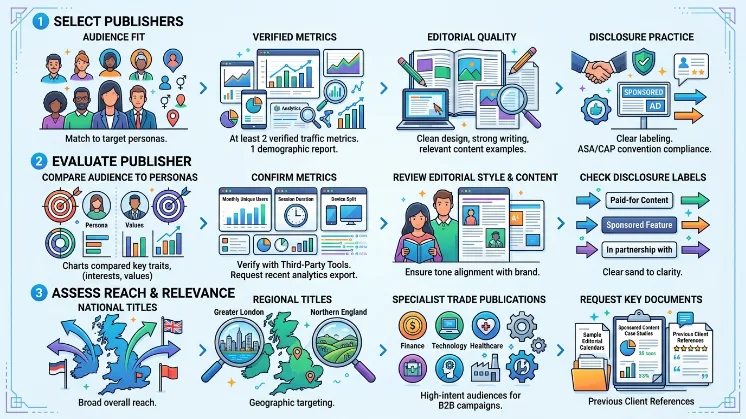
Evaluate publisher audience fit against campaign personas. Confirm monthly unique users, session duration, and device split. Verify metrics with third-party tools and ask for a recent analytics export. Review editorial style and content examples to ensure tone alignment. Check how the publisher labels sponsored content and whether examples follow ASA/CAP disclosure conventions.
Assess publisher reach and niche relevance. National titles offer broad reach; regional titles can target geographic segments such as Greater London or Northern England. Specialist trade publications offer high-intent audiences for B2B campaigns. For each shortlisted publisher, request sample editorial calendars, sponsored content case studies, and references from previous clients.
What is the procurement process step-by-step?
Procurement follows: briefing, publisher shortlisting, negotiation, legal contracting, content production, approval, publication, tracking, and post-campaign reconciliation.
Begin with a concise creative brief that includes objectives, target audience, key messages, brand compliance rules, mandatory disclaimers, budget, and timeline. Circulate the brief to shortlisted publishers and collect proposals. Compare proposals on audience reach, editorial approach, placement position, guaranteed metrics, and price.
Negotiate scope and deliverables. Specify editorial control boundaries, rights for republishing, and exclusivity if required. Finalise rates and payment terms. Use purchase orders and standard procurement documentation to authorise spend. Execute formal contracts or insertion orders that cover deliverables, timelines, cancellation terms, and data ownership.
During content production, supply brand assets and compliance requirements. Publishers typically draft the article; marketing teams provide factual checks and legal review. Ensure the contract clarifies rounds of edits and final sign-off authority. At publication, verify the sponsored label is visible and the placement matches the agreed position. Track performance with agreed measurement tools. After the campaign, reconcile invoices, compare results to KPIs, and document learnings for future procurement cycles.
How should content be briefed and approved?
Provide a 1–2 page brief with audience, objective, 3 key messages, mandatory legal text, visual assets, tone examples, and two rounds of edit allowance.
A tight brief reduces rework and speeds approval. Specify the required disclosure language and where the publisher should place it. Include sample headlines and meta descriptions for SEO alignment. Provide factual claims with sources and specify which claims require substantiation or legal sign-off.
Set clear approval timelines. Typical timelines: publisher draft within 5–7 working days, first-round edits within 48 hours, final approval within 48 hours. Define a maximum of two editorial revision rounds in the contract to avoid scope creep. Keep a change-log of edits and approvals for audit and creative rights records.
What pricing models and contract terms are common in the UK?
Common pricing models include fixed flat fees, cost-per-thousand viewable impressions (vCPM), cost-per-click (CPC), and performance-based bonuses; contracts usually state payment within 30 days and cancellation terms with a 14–30 day notice.
Fixed fees suit brand-awareness articles with guaranteed editorial placement. vCPM suits scale-driven awareness buys tied to viewability. CPC suits direct-response objectives when publishers provide click tracking. Some publishers offer hybrid models: a base flat fee plus performance bonuses for exceeding KPIs.
Contracts commonly specify content ownership rights, usage duration, geographic exclusivity, republishing rights, and archive removal options. Include indemnities, data protection terms aligned with UK GDPR, and confidentiality clauses. Require publisher to retain published proofs for at least 12 months and to provide campaign reports within agreed windows. Set payment milestones linked to publication and reporting deliverables.
How do you ensure ASA and CAP compliance for sponsored content?
Label paid content clearly using words such as “Paid content,” “Paid for by [Advertiser],” or “Sponsored” in a prominent place; keep records of disclosures and proofs.
Ensure disclosure is integrated into the article’s headline area, immediately visible on page load, and identified in mobile views. Use plain language that readers understand as advertising. Do not use ambiguous labels such as “Featured” without clarifying paid status. Keep documentation of the published proof and the publisher’s disclosure method.
Verify that claims in the content follow CAP rules on substantiation and unfair advertising. For example, health claims require scientific evidence cited within the brief. For product comparisons, avoid misleading comparisons and provide clear factual sourcing. Store all correspondence and signed proofs in procurement records for regulatory audit.
Explore More Expert Insights:
Sponsored Content Renewal Rates: Why 71% of UK Brands Extend After Month 3
How Times Intelligence Editorial Teams Produce Sponsored Content Without Losing Credibility
What measurement and reporting practices drive decision-making?
Measure against pre-set KPIs using consistent metrics, include raw data exports from publishers, and run a post-campaign analysis within 14 days of campaign end.
Collect both publisher reports and independent analytics. Cross-check unique pageviews, time on page, scroll depth, and referral sources. For lead campaigns, reconcile lead lists against CRM records and calculate cost-per-lead. Use pre-defined templates for reporting to standardise comparison across publishers and campaigns.
Perform a qualitative content audit: reader comments, social shares, and sentiment metrics. Document lessons learned and recommend adjustments for future procurement cycles, such as shifting budget to better-performing publishers or altering content length and format.
Click Here to Explore More:
Why UK Audiences Reject Overtly Promotional Content and What to Write Instead
What are key benefits and use cases for buying sponsored content?
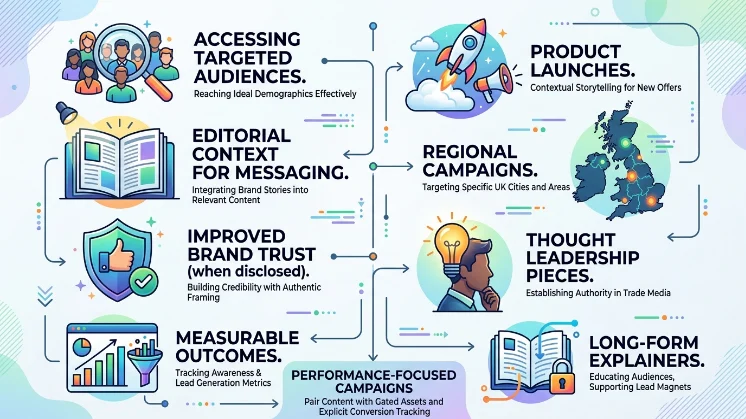
Benefits include targeted audience access, editorial context for messaging, improved brand trust when disclosed, and measurable outcomes across awareness and lead generation objectives.
Use cases include product launches requiring contextual storytelling, regional campaigns targeting UK cities, thought leadership pieces in trade media, and long-form explainers that support lead magnets. Sponsored content suits campaigns that need editorial framing rather than direct advertising. For performance-focused campaigns, pair content with gated assets and explicit conversion tracking.
Check the Complete Explanation:
How to Repurpose a Sponsored Article Into 6 UK Distribution Assets



