

Sponsored content is paid material created to inform or engage a target audience while aligning with a publisher’s editorial environment. It differs from display ads and paid search by blending informational value into editorial formats.
Sponsored content is paid editorial-style material placed within news sites, trade publications, or niche blogs. It appears like a regular article but is disclosed as sponsored. Publisher (host), sponsor (advertiser), creative producer (agency or in-house team), audience (readers). Examples: a health brand funds a feature on preventive care in a health section; a fintech sponsor runs an explainer on pension planning in a business site. Unlike display ads, sponsored content prioritises readership time and context. Unlike paid search, it targets interest and context rather than intent keywords.
How does sponsored content nurture middle-of-funnel leads in the UK?
Sponsored content educates and builds trust by addressing pain points and information gaps it moves UK leads from awareness to consideration through credibility and relevance.
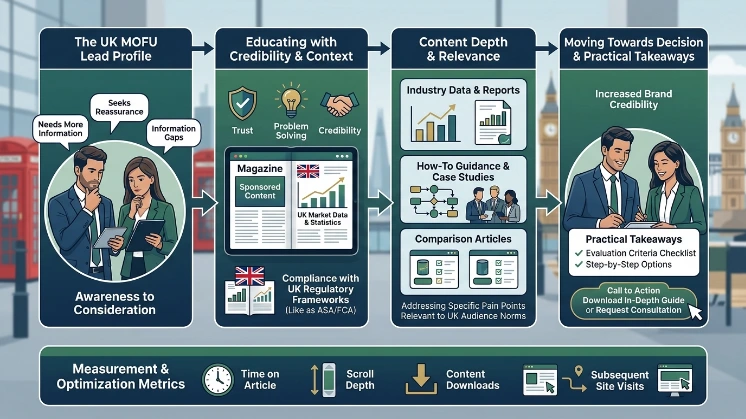
Leads require more information and reassurance than top-of-funnel audiences. Sponsored content supplies depth, including industry data, how-to guidance, and comparisons. For UK audiences, context matters: regulatory frameworks, consumer protections, and regional norms influence trust. Use local statistics, UK regulatory references, and publisher credibility. Include practical takeaways such as step-by-step options or evaluation criteria. Measurement tracks engagement metrics like time on article, scroll depth, content downloads, and subsequent site visits from the audience cohort.
Which audiences in the UK respond best to sponsored content for nurturing?
High-intent but undecided segments, professional decision-makers, and informed consumers respond best; tailor content by sector, role, and life stage to match their informational needs.
Define audience segments precisely: professionals aged 30–55 in roles such as procurement or HR, homeowners researching mortgages, parents seeking public-health guidance, or small business owners exploring software. Use publisher targeting in verticals that align with the segment: financial titles for personal finance audiences, healthcare outlets for health-related topics. Real examples: NHS-staff readership for workforce-engagement topics; regional business press for SME finance guidance. Targeting increases relevance and engagement rates.
What types of sponsored content formats work for nurturing?
Long-form explainers, expert interviews, case studies, and interactive tools work best because they deliver depth, evidence, and practical next steps for consideration.
Long-form explainers present detailed frameworks and data. Expert interviews provide authoritative perspectives; cite named experts or reputable institutions. Case studies show real outcomes and include measurable results such as percentages or cost savings. Interactive tools like simple calculators or checklists let users test scenarios, producing personalised outputs that increase engagement. For UK audiences, include localised inputs such as postcode-level indicators or UK-regime tax rules.
How do you plan a sponsored content campaign for UK audiences?
Plan by defining objectives, selecting matched publishers, creating audience-aligned content, setting measurable KPIs, and mapping user journeys to downstream touchpoints.
Objectives include education, lead capture, trial sign-ups, or webinar registrations. Publisher selection uses metrics: average monthly unique visitors, audience demographics, and topical fit. Content development begins with an editorial brief listing target questions, data sources, and UK-specific regulations or statistics. KPIs track engagement (time on page > 180 seconds), conversion events (resource download rate, form completions), and post-click behaviours (site pages per session). Map journeys that move readers from article to gated resource, then to nurture sequences.
Which measurements determine whether sponsored content nurtures leads effectively?
Engagement metrics, conversion events, audience cohort retention, and downstream outcomes measure effect; combine metrics for a full view.
Primary engagement metrics: average time on page, scroll depth, and unique engaged users. Conversion events: gated asset downloads, webinar sign-ups, and newsletter opt-ins. Cohort retention tracks repeat visits and interactions over 30, 60, and 90 days. Downstream outcomes include lead-scoring changes, marketing-qualified lead counts, and progression to sales conversations. Attribution models include first-touch, time-decay, and multi-touch; apply a multi-touch view to value sustained educational interactions.
What content components increase trust and drive engagement?
Credible sources, named experts, UK data points, clear citations, and transparent disclosures increase trust and drive engagement.
Cite academic research, government statistics (ONS, NHS, FCA), or industry bodies. Present named experts with credentials and affiliations. Use numbered data points like “27% of UK SMEs reported X in 2024” and link to the source. Include disclosure statements that the piece is sponsored to preserve publisher trust. Add clear next steps such as downloadable templates, checklists, or invitation to private briefings to capture interest while maintaining educational tone.
How should sponsored content align with UK regulatory and editorial norms?
Follow advertising and editorial disclosure rules, data-protection standards, and publisher guidelines; label sponsored content clearly and handle personal data under UK GDPR.
Advertising regulations require clarity that material is paid-for; use terms such as “Sponsored” or “Paid content.” For financial or healthcare topics, include regulatory disclaimers and avoid prescriptive advice. If collecting personal data via forms, implement lawful bases under UK GDPR, list retention periods, and provide privacy notices. Follow publisher style guides for tone and format to ensure seamless integration with editorial content.
What are typical budget components and timelines for sponsored content?
Budgets include publisher placement, content production, creative revisions, and measurement; timelines commonly run 6–12 weeks from brief to live.
Publisher placement fees vary by outlet and format; expect ranges from £2,000 to £30,000 per campaign based on reach and sponsorship prominence. Production costs include researcher and writer fees (£1,000–£6,000), design and interactive development (£1,000–£8,000), and analytics setup (£500–£2,500). Timeline phases: briefing (1 week), production (2–4 weeks), approvals and revisions (1–2 weeks), and live monitoring (ongoing). Campaign optimization cycles occur weekly for the first 4 weeks, then monthly.
What content workflows improve lead nurturing outcomes?
Use an editorial brief, data verification, staged approvals, and a distribution plan that includes follow-up assets and segmentation for nurture flows.
Start with a one-page brief listing audience, primary question, required UK sources, and desired actions. Verify data with primary sources and include citations. Implement staged approvals: editorial, legal/compliance, and publisher sign-off. Distribute through the publisher’s channels and augment with owned channels such as email and social. Segment leads by behaviour downloaded asset, time on article, and interaction with interactive tools and place them into tailored nurture sequences that expand on the initial topic.
Explore More Expert Insights:
Multi-Format Sponsored Campaigns: Combining Articles, Video and Infographics on UK Sites
How to Align Sponsored Content Themes With UK Audience Search Intent in 2026
What use cases show sponsored content working for UK audiences?
Use cases: complex B2B purchases, healthcare service awareness, and financial product consideration—each shows measurable progression from information to enquiry.
B2B example: a software vendor sponsors a detailed procurement guide in a trade publication, generating 120 downloads and 18 demo requests in 90 days. Healthcare example: a clinical information sponsor runs a workforce wellbeing feature that led to 600 engaged readers and 85 sign-ups for a policy brief. Financial example: a retirement-planning explainer on a national business site produced a 4.5% newsletter opt-in rate among readers aged 45–64. Each example uses UK-specific data and publisher credibility to nurture consideration.
How do you integrate sponsored content with wider nurture funnels?
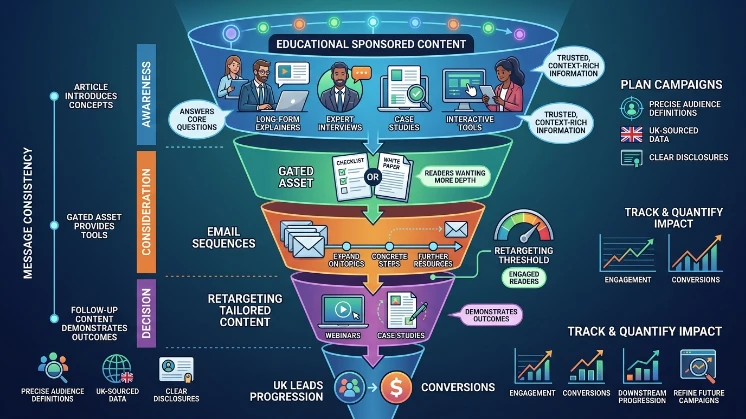
Link sponsored articles to gated assets, email sequences, and retargeting; use consistent messaging and progressive disclosure of detail across stages.
Start with educational sponsored content that answers core questions. Add a gated asset such as a checklist or white paper for readers who want more depth. Trigger email sequences that expand on the article’s topics with concrete steps and further resources. Apply retargeting to readers who engaged beyond a threshold to present tailored content such as webinars or case studies. Ensure message consistency the article introduces concepts, the gated asset provides tools, and follow-up content demonstrates outcomes.
Read the Detailed Explanation:
Context Is Everything: How UK Readers Respond Differently to News-Adjacent Content
Sponsored content nurtures UK leads by delivering trusted, context-rich information that progresses readers from awareness to consideration. Plan campaigns with precise audience definitions, UK-sourced data, clear disclosures, and measurable KPIs. Use long-form explainers, expert interviews, case studies, and interactive tools to build credibility. Track engagement, conversions, and downstream progression to quantify impact and refine future campaigns.
Read More for Better Understanding:
Sponsored Content ROI Calculator: Inputs, Outputs and UK Industry Averages



