A multi-format sponsored campaign uses at least two content formats articles, video, infographics published on UK news or topical sites to deliver a unified message to target audiences. A multi-format sponsored campaign combines editorial-style articles, short videos, and data-driven infographics. Each format targets a specific audience behaviour: reading for context, watching for engagement, and scanning visuals for facts.
Campaigns run on UK news sites, regional publishers, and topical platforms with measurable placement metrics: pageviews, viewability percentage, average watch time, and social shares. Entities involved include advertisers (brands), publishers (UK sites), content producers (writers, videographers, designers), and programmatic or direct-sales teams that handle placement and reporting.
How does a multi-format sponsored campaign work in the UK?
A campaign begins with objective setting, audience definition, content planning, production, placement on UK sites, and measurement of KPIs such as impressions, engagement time, and conversion events. First, stakeholders set objectives: brand awareness, leads, or product consideration. Second, they define audience segments by age, region, interest, and device.
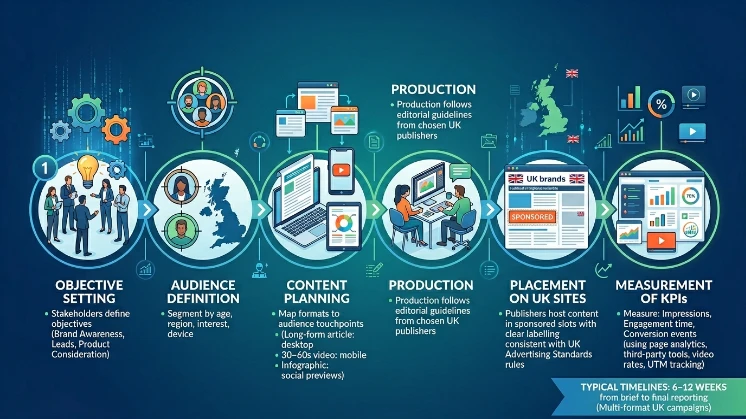
Third, the team maps content formats to audience touchpoints: a long-form article for desktop readers, 30–60 second video for mobile, and an infographic for social previews. Fourth, production follows editorial guidelines from chosen UK publishers. Fifth, publishers host the content in sponsored-content slots with clear labelling consistent with UK advertising standards rules. Finally, teams measure performance using page analytics, third-party viewability tools, video-completion rates, and UTM-tracked conversions. Typical timelines run 6–12 weeks from brief to final reporting for multi-format campaigns on national or regional UK sites.
What are the core components of multi-format campaigns?
Core components include a campaign brief, audience segmentation, content slate (articles, videos, infographics), publisher selection, distribution plan, and a measurement framework with defined KPIs. The campaign brief defines target metrics and budget allocation across formats. Audience segmentation uses first- and third-party data to create 2–6 audience cohorts. The content slate specifies number, length, and angle of assets: for example, two long articles (800–1,200 words), three short videos (30–60 seconds), and one hero infographic (A3 web-friendly).
Publisher selection focuses on UK news and topical sites with relevant verticals and verified monthly unique users. The distribution plan covers native placements, homepage features, and social amplification. Measurement uses impressions, viewability (measured as percentage of asset in view for at least one second for display, and 50% for video), average engaged time, scroll depth for articles, and click-through or conversion events. Example: a campaign might allocate 50% of budget to article placements, 30% to video runs, and 20% to infographic promotion on partner sites.
Why do brands publish on UK news sites rather than social-only channels?
Publishing on UK news sites provides third-party credibility, clearer context, longer content lifespans, and measurable editorial placement metrics not available on social-only channels. News sites host verified editorial environments. Third-party credibility arises because content appears alongside independent journalism and follows publisher content standards.
Articles on news sites remain discoverable in site archives and search indexes for 6–24 months, increasing long-term visibility. Sponsored articles offer structured reading experiences and allow for in-depth arguments supported by sources and quotes. Video hosted on publisher pages benefits from site-level trust and often achieves higher completion rates than social autoplay. Infographics on news sites gain direct article associations, which helps in attribution and SEO for queries related to facts or statistics. Measurement on news sites combines publisher analytics and independent verification tools, enabling accurate reporting for stakeholders and auditors.
How do content formats complement each other in a campaign?
Articles provide depth and SEO value, videos increase engagement and emotional connection, and infographics present facts quickly for scanning and sharing. Articles support search visibility and anchor the campaign narrative with quotes, sourced data, and structured sections. Videos deliver narrative and motion that raise attention; short-format videos of 30–60 seconds show the highest completion rates on article pages. Infographics condense data into visual hierarchies that readers scan in 5–15 seconds.
When combined, these formats cover the full attention spectrum: articles for readers who seek detail, video for passive audiences, and infographics for rapid fact-checking. Example: a health-awareness campaign could host a 1,000-word feature on a UK health site, embed a 45-second explainer video, and include an infographic summarising five key statistics—each asset links to the others for cross-engagement.
What legal and regulatory requirements apply to sponsored content on UK sites?
Sponsored content must follow the UK Advertising Standards rules, CMA guidance, and publisher labelling policies that require clear disclosure and non-misleading claims. The Advertising Standards Authority requires ads and sponsored native content to be clearly identifiable as paid-for material. Labels such as “Sponsored”, “Paid content”, or “Advertorial” must appear prominently.
The Competition and Markets Authority enforces rules against misleading comparative claims and requires evidence for factual assertions. Publishers add their own labelling policies and editorial standards. Compliance steps include retaining documentation of claims, source lists for statistics, and clearance from legal teams. Campaigns that include health or financial claims require verifiable sources and, where applicable, approval from regulatory bodies. Failure to label or substantiate claims can trigger publisher removal, ASA investigations, or reputational harm.
How are audiences targeted and measured across formats?
Teams use audience segments, contextual targeting on UK sites, and tracking frameworks with server-side tagging to measure reach, engagement, and downstream conversions. Targeting combines first-party CRM segments with publisher audiences and contextual categories (politics, finance, lifestyle). Contextual targeting places assets on pages matching the campaign theme.
Tracking uses page tags, video analytics, and server-to-server postbacks to record events while respecting privacy rules. Common KPIs include unique reach, viewability rate, average engaged time, video-completion rate, scroll-depth distribution, and attributed conversions within a 28-day window. For example, a news-site campaign may report 1,200,000 impressions, 45% viewability, average engaged time of 1 minute 40 seconds, and a 2.1% click-to-conversion rate.
What technical production standards ensure campaign quality?
Production standards define resolution, aspect ratios, file sizes, accessibility, and metadata: 1920×1080 H.264 MP4 for video, SVG or 1200×1600 PNG for infographics, and SEO-optimised HTML for articles. Videos must use H.264 codec, 1080p resolution, and bitrate that balances quality and load time. Infographics need web-optimised images (max 500 KB) and alt text for accessibility.
Articles require clean HTML, structured headings, schema markup for article types, and canonical tags. Publishers often provide technical specs for hero images, video embedding, and mobile-first design. Accessibility includes captions for video, transcriptions for audio, and alt descriptions for visuals. These standards ensure consistent rendering across desktop and mobile UK news sites and improve indexability by search engines.
What benefits do brands gain from multi-format sponsored campaigns on UK sites?
Benefits include increased trust via third-party placement, extended content lifespan, higher cross-format engagement, improved SEO signals, and clearer measurement for ROI decisions. Third-party placement improves perceived credibility. Extended lifespan occurs because publisher content persists in archives and search results.
Cross-format engagement increases the chance that audiences interact with at least one asset combined placements typically lift total engaged time by 25–60% compared with single-format runs. SEO benefits arise from publisher domain authority and contextual linking. Measurement clarity helps marketers compare cost-per-engaged-minute and cost-per-attributed-conversion across formats. These measurable benefits support budget allocation decisions and justify multi-format approaches on UK news and topical sites.
Explore More Expert Insights:
How to Align Sponsored Content Themes With UK Audience Search Intent in 2026
Headlines for Sponsored Articles: 9 Formulas That Drive UK News Reader Clicks
What real use cases show multi-format campaigns succeed on UK sites?
Use cases include public-health awareness drives, financial-education series, and product-explainer campaigns that use articles for context, videos for demonstrations, and infographics for key statistics. A public-health campaign on regional UK news sites can run a feature article with expert quotes, embed a 60-second prevention video, and present an infographic with incidence statistics by region.
A financial-education series can publish a 1,200-word explainer on tax changes, follow with a short animation breaking down steps, and deliver an infographic summarising deadlines and rates. Product-explainer campaigns use a detailed article for technical specs, a demo video for functionality, and an infographic comparing features. Each case uses publisher credibility and format-specific strengths to reach distinct audience behaviours.
How should teams plan budgets and timelines for these campaigns?
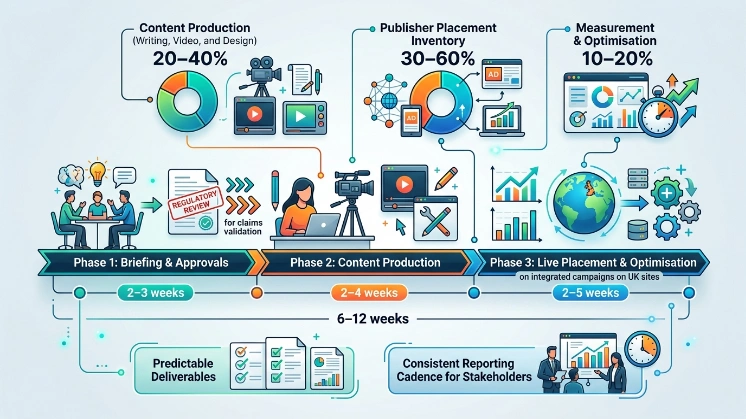
Budgets are split across content production, publisher placements, and measurement; timelines range 6–12 weeks for integrated campaigns on UK sites, with 2–4 weeks for production and 2–6 weeks for placements and optimisation.
Explore the Complete Guide:
Why Brands That Publish on News Sites Build Trust Faster Than Those on Social Only
Allocate 30–60% of budget to publisher placement inventory, 20–40% to production (writing, video, and design), and 10–20% to measurement and optimisation. Plan 2–3 weeks for briefing and approvals, 2–4 weeks for production, and 2–5 weeks for live placement plus mid-campaign optimisation. Allow additional time for regulatory review if claims require validation. These plans produce predictable deliverables and a consistent reporting cadence for stakeholders.
Discover More Insights:
What Makes a Sponsored Content Partner Worth Paying For in the UK in 2026