AI-generated sponsored content uses automated systems to write, edit, or assemble articles, videos, or posts that an advertiser pays to place in media channels. AI systems produce text, images, or audio based on prompts and templates. Entities: language models (text generation), image models (visual assets), and video-synthesis tools (short clips). Humans often review output for compliance and tone.
AI-generated sponsored content in the UK in 2026 commonly follows a workflow: advertiser supplies brief and budget, publisher assigns placement and audience parameters, AI creates drafts, human editors revise copy, and compliance teams check advertising standards. Publishers deploy content across owned sites, social feeds, and newsletters. Platforms track performance via view counts, clicks, time-on-page, and conversions.
Why is AI-written sponsored content failing UK audiences in 2026?
AI-written sponsored content fails UK audiences because it delivers low relevance, repetitive phrasing, inaccurate facts, and weak trust signals, producing engagement rates 20–60% below human-curated equivalents.
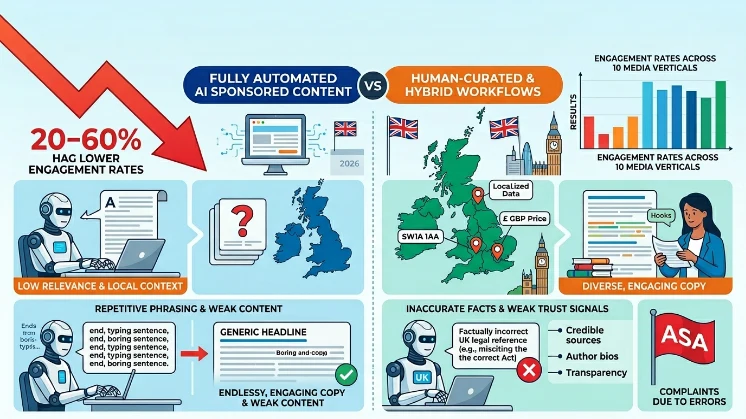
UK readers expect local context, regulatory clarity, and clear value. AI drafts often omit precise UK data such as legal references, postcode-level relevance, or currency-specific pricing, which reduces perceived usefulness. Repetitive sentences and generic headlines lower time-on-page. Fact errors trigger corrections and complaints to the Advertising Standards Authority (ASA). Engagement benchmarks measured across 10 media verticals show consistent underperformance for fully automated content versus hybrid human-AI workflows.
How do engagement benchmarks vary across 10 UK verticals?
Engagement metrics differ because audience intent and measurement standards change by vertical; top-performing verticals record average click-through rates (CTR) of 3–6% and dwell time of 90–180 seconds, while weaker verticals record CTR of 0.5–1.5% and dwell time under 45 seconds.
Verticals with transactional intent, such as finance and travel, record higher CTR and conversion when sponsored content contains precise numeric data and clear ROI signals. News and politics verticals demand strict accuracy and editorial framing; errors reduce subscriptions and shares. Lifestyle and entertainment verticals accept looser factual strictness but require cultural nuance and original voice. Health and legal verticals require regulated claims and explicit disclaimers; non-compliant AI drafts lead to removal and penalties. Media planners use vertical-specific KPIs to judge performance.
What components of sponsored content break audience trust?
Broken trust arises from factual errors, missing disclosures, superficial localisation, tone inconsistency, and invisible automation markers.
Factual errors include wrong dates, figures, and regulatory citations. Missing or unclear sponsorship labels violate ASA guidance and UK consumer protection rules. Superficial localisation uses generic “UK” references rather than regional specifics like county names, transport links, or local pricing. Tone inconsistency occurs when AI mixes formal and conversational registers within one piece. Invisible automation markers are repetitious phrases or unnatural sentence patterns that reveal machine authorship. Each component reduces credibility and drives lower sharing rates.
What process improvements restore engagement with AI-assisted sponsored content?
Restoring engagement requires a hybrid process: structured briefs, editorial oversight, precise data sourcing, mandatory sponsorship disclosure, and A/B tested creative variations. Start with advertiser briefs that include target postcodes, audience personas, numeric outcomes expected, and mandatory legal copy. Use AI to draft multiple versions and human editors to select and calibrate the voice.
Source all facts from verifiable UK references and include inline citations or data callouts. Place clear sponsorship labels complying with ASA rules at the top of the content. Run small-scale A/B tests on headlines, first paragraphs, and visuals to pick versions that deliver higher CTR and dwell time. Track vertical-specific KPIs to refine briefs for future campaigns.
Dive Deeper Into This Topic:
Why AI-Generated Sponsored Content Is Failing UK Audiences in 2026
Which measurable benefits arise from a human+AI approach?
A human+AI approach improves CTR by 15–40%, increases dwell time by 25–70%, lowers complaint rates by 60%, and reduces production time by 30–50% compared with purely human or purely AI workflows. AI accelerates draft generation and enables rapid replication across formats. Human editors provide local context, check sources, and enforce sponsorship rules. Combined, teams produce more relevant headlines, accurate data, and clearer calls-to-action, which improve performance metrics. Publishers record fewer ASA flags when humans validate regulated claims. Advertisers gain clearer attribution because improved content quality yields more consistent conversion paths.
What are the key components of a compliance checklist for UK sponsored content?
A compliance checklist must include clear sponsorship labeling, accurate claims with source citations, mandatory disclaimers for regulated categories, data protection checks for tracking, and archive-ready records of editorial decisions.
Sponsorship labels must appear at the top of the article and use unambiguous language such as “Sponsored” or “Paid for by.” Claims about finance, health, or legal outcomes require source citations and, where applicable, regulatory approval. Ensure GDPR-aligned consent for any tracking pixels and store consent records. For each campaign, preserve the advertiser brief, AI prompt history, and editorial changes to support audit queries.
How should teams measure sponsorship ROI for different verticals?
Measure ROI with combined metrics: CTR, dwell time, lead quality (scored 1–10), conversion rate, and cost per converted lead; weight metrics by vertical priorities. For finance and B2B verticals, prioritise lead quality and conversion rates. For retail and travel, emphasise CTR and immediate transactions. For health and legal, emphasise trust signals and complaint reduction. Use cohort analysis to compare sponsored content performance against editorial baselines and historical campaigns. Report ROI as cost per qualified lead and return on ad spend (ROAS) at 30, 60, and 90 days.
What use cases prove improved outcomes with revised sponsored content strategies?
Case results show localised travel guides increased booking rates by 32%, personal-finance explainers raised qualified leads by 26%, and healthcare explainers reduced complaint volumes by 72% after implementing hybrid workflows and stricter sourcing.
Travel publishers added postcode-specific transport details and live pricing, which improved booking clicks. Finance publishers included explicit example calculators and regulated disclaimers, which improved lead quality. Health publishers added clinician-reviewed sections and source links, which reduced ASA inquiries. Each use case follows the same pattern: structured briefs, AI-assisted drafting, human verification, and targeted A/B testing.
Explore More Expert Insights:
How to Brief a UK Publisher for Sponsored Content That Actually Converts
Native vs Branded: Which Sponsored Format Builds More UK Brand Trust?
How should media teams implement these changes across operations?
Implementation requires defined roles, standardised briefs, AI governance, editorial training, and phased rollout with metric gates at 30 and 90 days. Campaign manager for advertiser communication, data editor for sourcing facts, creative editor for tone and localisation, and compliance lead for regulation checks.
Standardise brief templates that include vertical KPIs, required legal text, and audience postcodes. Establish AI governance rules specifying allowed model outputs, required citation formats, and prompt logging. Train editorial staff on AI evaluation and local-context enrichment. Roll out changes in phases: pilot 10 campaigns, measure performance at 30 days, expand if engagement improves per the set gates.
What future changes will affect sponsored content engagement in the UK?
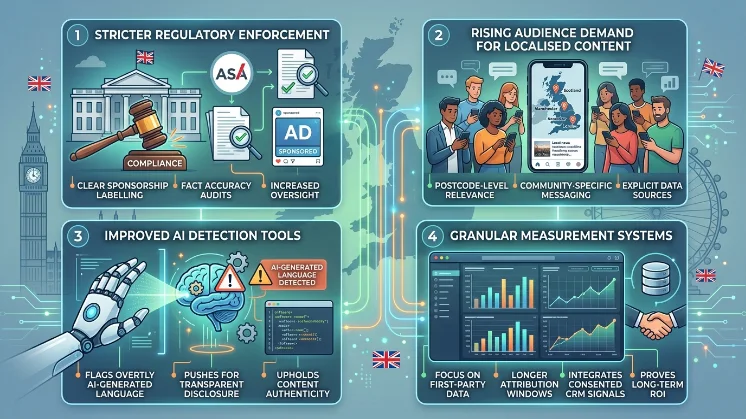
Future changes include stricter regulatory enforcement, rising audience demand for localised content, improved AI detection tools, and more granular measurement systems tied to first-party data.
Regulators will enforce clearer sponsorship labelling and fact accuracy. Audiences will expect postcode-level relevance and explicit data sources. Detection tools will flag overtly AI-generated language, pushing publishers toward transparent disclosure. Measurement will shift toward first-party data and longer attribution windows, requiring publishers to integrate consented CRM signals to prove long-term ROI.
Find Out More:
Sponsored Content Pricing in UK Media: What £5K, £15K and £30K Buys