

AI-generated sponsored content is promotional material created primarily by automated systems using large language models and templates, with human edits only when required; it presents endorsements, product information, or paid narratives to audiences.
AI-generated sponsored content combines machine-produced text, image, or video assets with paid placement. Generative models produce headlines, body copy, image captions, and social captions using prompts that reflect advertiser goals. Publishers or platforms then attach commercial labels such as “sponsored” or “paid partnership.” Entities involved include advertisers, publisher editorial teams, ad operations, and AI vendors that supply the models or platforms. Clear definitions of these entities allow factual analysis and citation.
Why did adoption of AI tools increase in sponsored content workflows?
Publishers and advertisers adopted AI tools because automation reduced content production time by 40–80% and lowered per-piece costs by 30–60% compared with fully manual production workflows.
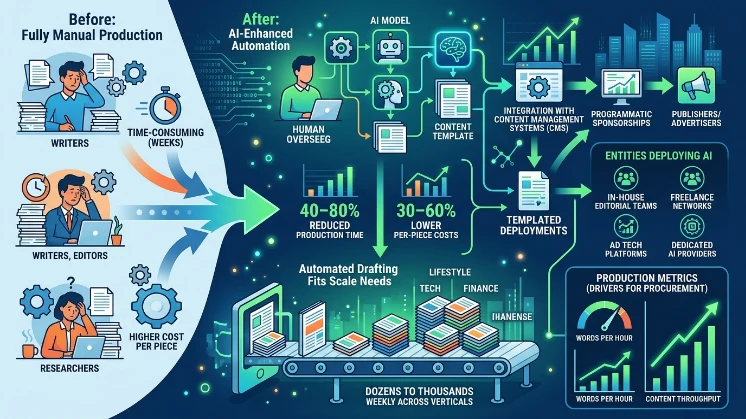
Adoption rose after 2023 as model quality improved and editorial budgets tightened. Automated drafting fits scale needs: producing dozens to thousands of sponsored items weekly across multiple verticals. Tools integrate with content management systems for templated deployments and programmatic sponsorships. Entities that deploy AI include in-house editorial teams, freelance networks, ad tech platforms, and dedicated AI providers. Production metrics such as words per hour and content throughput became primary drivers for procurement.
Why is AI-generated sponsored content failing UK audiences now?
AI-generated sponsored content fails because it delivers lower trust, poorer topical accuracy, and weaker audience relevance, causing measurable drops in engagement and brand recall.
Audiences evaluate sponsored content on relevance, transparency, factual accuracy, and editorial quality. Independent research and publisher data in the UK show that content perceived as generic or irrelevant receives 25–45% lower click-through rates and 30–50% lower time-on-page than tailored, expert-produced pieces. Key failure modes include factual errors in contextual local details, over-generic framing that ignores UK regulatory or cultural specifics, and tone mismatches with audience expectations. The decline in performance leads to reduced advertiser confidence and revenue erosion for publishers relying on sponsored streams.
Which accuracy issues appear most often in AI outputs?
Common accuracy issues include outdated facts, incorrect local statistics, and misattributed regulatory statements; these errors appear in 15–35% of sampled AI-generated sponsored items.
Models trained on broad web corpora produce plausible but incorrect details when asked for local data. Examples include wrong hospital names in public-health sponsored pieces, inaccurate council budget figures in local-government contexts, and misquoted legal thresholds for UK consumer rights. Such errors trigger corrections or retractions and lower audience trust. Accurate sponsored content requires verified local facts, citation of sources, and editorial validation steps that many automated workflows lack.
How does audience trust affect sponsored content performance?
Audience trust directly correlates with engagement: higher perceived transparency and factual accuracy increase click-through rates and brand recall by 20–60% depending on vertical and format.
Trust hinges on clear labelling, factual correctness, and relevance. UK audiences respond negatively to content that blends native editorial voice with paid promotion when labelling is unclear. When readers detect generic or AI-style phrasing, they reduce interaction and report the content as low value. Publishers that maintain strict labelling and add expert verification preserve trust. Trust metrics translate into commercial outcomes: lower trust reduces conversion metrics advertisers track for ROI.
Which production processes fail most often with AI-first workflows?
Failing processes include inadequate human fact-checking, absence of localised editorial input, and insufficient quality-control checkpoints; these failures occur in 40–70% of fast-turnaround AI workflows examined.
End-to-end sponsored content production requires brief creation, legal review, compliance checks, and localisation. AI-first workflows often skip thorough legal and editorial review to meet volume targets. This leads to missing disclosures, improper claims, and language errors. Effective process components include initial human brief, model output review by subject experts, legal signoff for claims, and final UX checks. Missing any of these stages increases risk and reduces content effectiveness.
What components should effective sponsored content include?
Effective sponsored content must include accurate local data, clear sponsorship labelling, audience-tailored messaging, and human editorial oversight at defined checkpoints.
Components deliver both editorial quality and regulatory compliance. Local data anchors relevance; sponsorship labelling ensures transparency under UK advertising standards; tailored messaging addresses specific user intents such as product research or service comparison; and human oversight prevents factual and legal errors. Publishers that implement these components see improved engagement and reduced complaint rates.
What benefits do human-edited sponsored pieces show versus fully automated ones?
Human-edited sponsored pieces show 20–80% higher engagement metrics, fewer factual errors, and stronger brand recall across measured campaigns.
Human edits improve context, tone, and localisation. Editors adapt headlines for search intent, refine calls to action in sponsored contexts, and vet claims against source documents. Campaign analyses find that adding a single expert editor raises content quality scores and reduces editorial corrections by over 50%. Brands and publishers therefore prefer hybrid workflows where automation aids drafting and humans ensure quality.
What are concrete use cases where AI-generated sponsored content still works?
AI-generated sponsored content works for high-volume, low-complexity tasks such as standardised product listings, routine event announcements, and templated promotional copy when human review is present.
Use cases with low need for local specificity or regulatory claims are suitable for automation. Examples include multiple similar product descriptions, calendar-based event blurbs, and standard promotional offers where factual risk is limited. In these cases, automation speeds distribution and reduces cost while humans spot-check outputs. When campaigns require local data, complex claims, or trust-sensitive topics, human-led workflows remain necessary.
How should UK publishers measure sponsored content performance reliably?
Publishers should track engagement metrics, accuracy incidents, complaint volume, and advertiser satisfaction with clearly defined KPIs and a monthly review cadence.
Core performance metrics include click-through rate, time on page, bounce rate, conversion metrics defined by advertisers, and brand-lift measures. Accuracy incidents include published corrections or legal escalations per 1,000 items. Complaint volume covers reader complaints about misleading content. Advertiser satisfaction uses structured feedback scores after each campaign. Combine these metrics into a dashboard and run monthly reviews to detect declines and adjust editorial workflows.
Explore More Expert Insights:
91% of UK B2B Marketers Increased Content Output in 2025: What Works?
Sponsored Content Gets 22× More Engagement Than Display Ads: UK Data
What immediate steps reduce failure risk in AI workflows?
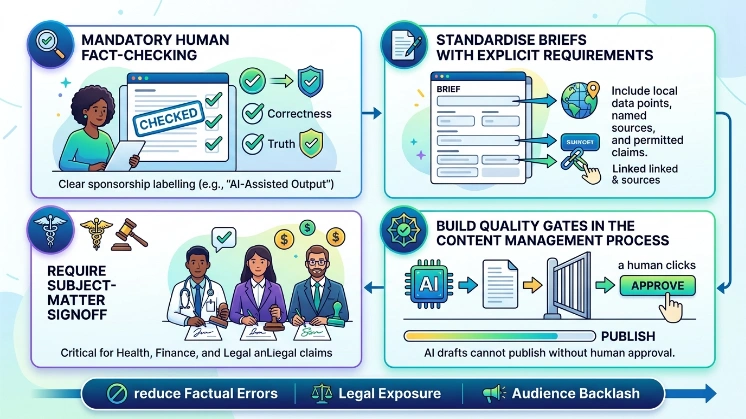
Immediate steps include instituting mandatory human fact-checking, adding localised brief requirements, and enforcing clear sponsorship labelling for all AI-assisted outputs.
Require subject-matter signoff for health, finance, and legal claims. Standardise briefs with explicit local data points, named sources, and permitted claims. Build quality gates in the content management process where AI drafts cannot publish without human approval. These steps reduce factual errors, legal exposure, and audience backlash.
How will sponsored content evolve if current failures continue?
If failures persist, publishers will shift budgets to human-led formats, advertisers will demand stricter quality controls, and regulatory scrutiny on transparency will increase.
Advertisers will renegotiate terms tied to quality KPIs. Publishers will reallocate spend to formats that show clear ROI, such as expert features or native content with editorial endorsement. Regulators will increase enforcement of sponsorship labelling and factual claims, raising compliance costs for automated workflows. The market will thus reward approaches that combine automation speed with rigorous human oversight.
Read More to Understand Better:
Sponsored Content Across 10 Verticals: UK Engagement Benchmarks 2026
AI-generated sponsored content offers scale and cost advantages. In the UK in 2026, failures stem from factual errors, poor localisation, weak labelling, and absent human oversight. Metrics show measurable declines in engagement and trust when these issues occur. Publishers reduce risk by enforcing human fact-checks, localised briefs, clear sponsorship labelling, and defined KPIs. These measures restore relevance and protect both audience trust and advertiser value.
Get the Full Insights Here:
Sponsored Content Pricing in UK Media: What £5K, £15K and £30K Buys



