

Sponsored content is paid editorial material that appears within a publisher’s environment and matches the site’s format, while display advertising uses separate creative units such as banners or rich media placed in ad slots.
Sponsored content presents information in the same structure as the host site’s articles, videos, or podcasts. It uses headline styles, long-form text, native video players, or gallery formats that readers expect from that publisher. Display advertising uses dedicated inventory: leaderboard banners, skyscrapers, MPUs, or interstitials. Those units load in fixed positions and use distinct creative dimensions and click-through mechanics. Publishers label sponsored content with terms such as “sponsored”, “paid-for content”, or “partner content” to disclose commercial origin. Advertisers supply goals, key messages, and sometimes creative guidance; publishers control placement and editorial framing to match audience interests.
Why does UK data show 22× higher engagement for sponsored content versus display ads?
UK measurement shows sponsored content drives deeper interactions because it aligns with editorial context, holds reader attention longer, and reduces ad avoidance compared with display creatives.
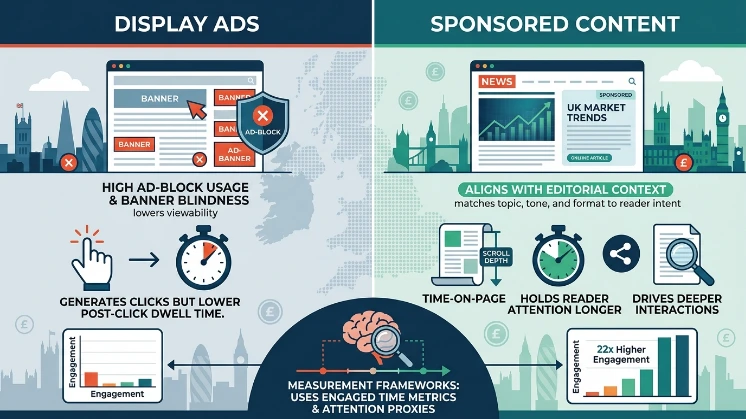
Research comparing behavioral metrics found readers engage with sponsored content longer on average. Time-on-page, scroll depth, and social sharing rates increase when content reads like editorial material. Display ads generate more short-form clicks but lower post-click dwell time. Sponsored content benefits from contextual relevance: matching topic, tone, and format to reader intent. The UK reading market shows high ad-block usage and banner blindness that lowers display ad viewability. Sponsored content appears inside editorial streams, bypasses some ad-avoidance behaviors, and encourages consumption instead of immediate dismissal. Measurement frameworks use engaged time metrics and attention proxies to capture this effect.
What metrics prove higher engagement for sponsored content?
Engagement metrics include average engaged time, scroll depth, social shares, comments, and view-through rates; UK comparisons show multiples in these metrics favoring sponsored content.
Engaged time measures active reading and interaction, not just passive page load duration. Scroll depth captures how far readers proceed through long-form sponsored pieces. Social shares and comments reflect reader intent to amplify or react. View-through and completion rates for native video within sponsored content exceed equivalent display video metrics. Click-through rate often remains higher for display ads initially, but sponsored content yields higher qualified interactions such as form completions or content downloads—because readers spend more time absorbing messages. Standardised reporting in the UK uses attention-weighted metrics and third-party viewability verification to validate these differences.
How is sponsored content created and integrated on UK publisher sites?
Creation combines advertiser brief, editorial planning, and production; integration places the content in relevant sections and uses clear commercial labels for disclosure.
Process steps start with an advertiser brief specifying objectives, target audience, and key messages. Editorial teams translate the brief into story angles, headlines, and formats that fit the publisher’s style guide. Production includes copywriting, photography, video shoots, and design that mirror site templates. Integration places the piece within topical sections news, business, lifestyle or inside the homepage feed to reach contextual audiences. Publishers add disclosure banners and metadata tags for transparency. Distribution can include email newsletters and social promotion from the publisher’s channels to expand reach beyond the article placement.
What components make sponsored content effective in the UK market?
Effectiveness depends on contextual relevance, editorial quality, disclosure clarity, measurement rigor, and tailored distribution to the publisher’s audience.
Contextual relevance aligns topic and tone with reader expectations in a given section. Editorial quality uses fact-based reporting, clear structure, and authoritative sources. Disclosure clarity uses explicit labels such as “sponsored” and consistent metadata so readers and regulators see the commercial nature. Measurement rigor applies attention metrics, viewability checks, and conversion tracking that attribute downstream actions to the sponsored experience. Tailored distribution leverages the publisher’s audience segments, homepage placements, and social channels to reach users with informed intent.
What benefits does sponsored content deliver compared with display advertising?
Sponsored content increases attention, supports storytelling, drives social amplification, and improves qualified conversions compared with standard display creatives.
Sponsored formats allow extended storytelling, which facilitates complex messaging and benefits communication. The extended dwell time correlates with higher message retention. Social amplification rises because editorial-style articles and videos are more shareable than banner creatives. Qualified conversions increase because engaged readers are more likely to perform meaningful actions such as subscribing, downloading, or requesting further information. Display ads still deliver scale for awareness and short direct-response clicks, but sponsored content shifts outcomes toward consideration and engagement metrics that measure deeper audience commitment.
Which UK use cases most benefit from sponsored content?
Complex products, public information campaigns, thought leadership, and issue-based awareness programs benefit most because they require explanation and sustained attention.
Complex financial services, multi-step healthcare guidance, and technology products use sponsored content to explain features, processes, and comparisons. Public information campaigns—for example, health advice or civic guidance use editorial formats to present facts and behavioral steps in a trusted context. Thought leadership from subject-matter experts uses long-form articles or interviews to build credibility. Issue-based reporting—such as climate impact or local infrastructure uses sponsored features to combine narrative, data, and visual evidence that readers consume thoroughly.
How do publishers measure ROI for sponsored content in the UK?
Publishers measure ROI with multi-metric frameworks: engaged time, viewable impressions, behavioral conversions, downstream revenue, and third-party attention validation.
Engaged time and scroll depth quantify content consumption. Viewable impressions confirm content exposure. Behavioral conversions include newsletter sign-ups, form submissions, and content downloads captured by tracking pixels or server-side events. Downstream revenue metrics attribute sales or leads back to content exposure using multi-touch attribution or last-engagement models. Third-party attention validation uses measurement providers that verify viewability, bot filtering, and attention signals to ensure data integrity. Combining these metrics creates a performance picture aligned to advertiser objectives.
What are regulation and disclosure requirements for sponsored content in the UK?
UK rules require clear, prominent disclosure of commercial content to prevent consumer confusion and ensure compliance with advertising standards.
Regulatory frameworks mandate that sponsored content carries explicit labels and does not mislead readers about its commercial origin. Industry codes require prominence of disclosure, such as visible “sponsored” tags and explanatory language within the content. Publishers include metadata that signals paid status to ad systems and search engines. Advertising regulators audit compliance and enforce corrective actions when content blurs editorial and paid lines.
Explore More Expert Insights:
How B2B Brands Use Sponsored Content to Build Trust with UK Decision Makers
A Guide to Sponsored Content in London Media
How does sponsored content affect brand trust in UK audiences?
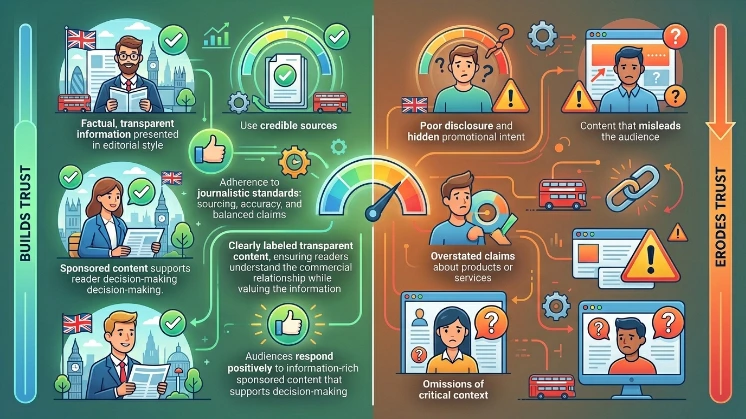
Sponsored content builds trust when it presents factual, transparent information in editorial style and uses credible sources; trust decreases when disclosure is poor or content misleads.
Trust increases when sponsored pieces follow journalistic standards: sourcing, accuracy, and balanced claims. Transparent labeling reinforces that readers understand the commercial relationship while still valuing the information. Trust erodes when content hides promotional intent, overstates claims, or omits context. The UK audience responds positively to clearly disclosed, information-rich sponsored content that supports decision-making.
When should marketers choose sponsored content over display ads in the UK?
Choose sponsored content for message complexity, audience education, consideration-stage targeting, and when long-term engagement matters; choose display for broad reach and direct-response objectives.
Sponsored content fits campaigns that require narrative, explanation, or credibility. Use it during awareness phases that need depth, such as policy explanations, product education, or sector thought leadership. Display ads suit campaigns that target immediate actions with short, direct creatives and require rapid, broad frequency.
Read More to Understand Better:
Multi-Site Sponsored Content: How 10 UK News Properties Multiply Reach
Sponsored content outperforms display advertising on attention, engagement, and qualified interactions in UK data because it aligns with editorial contexts, extends dwell time, and reduces ad-avoidance behaviors. Publishers create sponsored pieces through editorial collaboration, label them for transparency, and measure success using attention-weighted metrics and conversion tracking. Use sponsored content when campaigns require education, trust-building, or complex messaging; use display advertising for scale and short-response goals.
Get the Full Insights Here:
Native vs Branded: Which Sponsored Format Builds More UK Brand Trust?



