
A leaderboard is a 728×90 or 970×90 horizontal banner that appears at the top of desktop pages and delivers high viewability and click-through rates on news sites.
A leaderboard is a wide, shallow creative placed in the page header. Publishers use 728×90 for legacy inventory and 970×90 (large leaderboard) for higher-impact placements. On UK news sites, leaderboards run above-the-fold on 1024px+ viewports, ensuring 70–90% viewability for desktop users during typical sessions. Measured click-through rates (CTR) vary by campaign objective: 0.03–0.15% for brand awareness and 0.1–0.5% for direct-response headlines when ads include clear calls to action. Leaderboards drive visibility for time-constrained readers who scan headlines, making them efficient for mass reach.
Leaderboards serve top and middle funnel goals. Use them to deliver broad awareness and traffic-driving offers. They pair well with complementary mid-page formats that capture engaged readers who scroll.
What is an MPU and why does it engage readers on UK news sites?
An MPU (mid-page unit) is a 300×250 or 300×600 box placed inside article columns that achieves higher dwell-time engagement than horizontal banners.
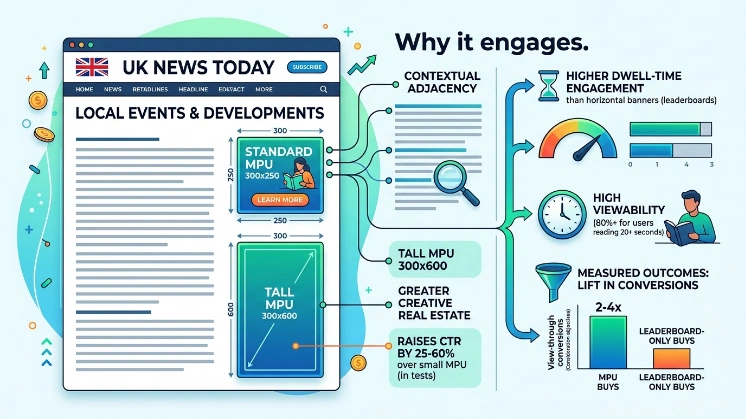
MPU stands for Mid Page Unit and usually appears within editorial columns or sidebars. The standard MPU is 300×250; tall MPUs (300×600) provide greater creative real estate and raise CTR by 25–60% over the small MPU in tests on UK news sites. MPUs benefit from contextual adjacency to headlines and paragraphs, which increases viewability to 80%+ for users who read articles for 20+ seconds. Measured outcomes show MPUs lift post-impression conversions for consideration objectives: view-through conversions increase 2–4x versus leaderboard-only buys.
Place MPUs within the article text or in the right-rail near related content. Use single-message creatives and concise copy to match reader attention windows.
What is a half-page ad and how does it rank for engagement?
A half-page ad (300×600) is a tall, prominent unit that records higher time-on-ad and interaction rates than leaderboards and standard MPUs.
The half-page ad occupies vertical space that dominates the viewport on desktop devices. Publishers report viewability of 85–95% when the half-page appears in-article or sticky alongside content. Interaction metrics show 0.2–0.8% CTR for rich creatives and interactive elements. Half-page units increase brand recall in measurement studies by 15–30% versus small MPUs. On UK news sites, advertisers use half-page units to secure sustained attention from readers who scroll and scan.
Choose half-page for mid-funnel and performance campaigns that require measurable engagement and creative impact. Combine with smaller flexible units to reach mobile audiences.
What is a site skin and how does it affect engagement on news portals?
A site skin wraps the visible page background with branded imagery and records the highest attention metrics per impression for desktop news audiences.
A site skin, also called a page skin, replaces the page background around editorial content. It does not change core article layout but frames the content with large-format branding. Site skins produce the highest viewability-per-impression because they occupy peripheral visual space across wide displays. Measured session-level lift shows 20–50% higher brand recall and a 30–70% increase in aided awareness compared with single-banner buys. CPMs for skins are 2–6x higher than standard leaderboard inventory on UK national news sites due to exclusivity and visual dominance.
Skins require creative adaptation for different page widths and must not obstruct navigation or content. Use logged impressions and brand-lift surveys to quantify impact.
What targeting and inventory factors influence engagement on UK news sites?
Inventory position, article context, device mix, and audience segments determine engagement; first-view positions and topical alignment increase performance.
Top positions during first view drive the strongest metrics. In-article MPUs placed near the top third of an article show 40–60% higher CTR than end-of-article placements. Device mix matters: desktop sessions deliver higher viewability for half-page and skin; mobile-native formats require responsive creative and different sizes (300×250 and 320×50). Audience targeting improves relevance: contextual targeting to specific sections (politics, business, technology) raises CTR and reduces wasted impressions. UK publishers with subscription audiences report higher conversion rates for behavioural targeting segments such as logged-in users and registered newsletters subscribers.
Use MRC viewability metrics, active view time, and standardised audience baselines. Pair viewability with brand-lift tests and post-impression conversion tracking for full attribution.
What creative elements increase engagement for each format?
Clear headlines, concise offers, single-call messaging, and high-contrast visuals increase engagement; interactions and video increase time-on-ad for half-page units.
Keep creatives under 200KB for static and 500KB for rich media on news sites. Ensure 3rd-party tags do not increase page load by more than 300ms.
How do formats perform across campaign objectives: awareness, consideration, and conversion?
Leaderboards drive awareness and reach MPUs, and half-pages drives consideration and engagement; skins amplify awareness and recall with measurable brand lift.
For awareness, measure CPM and viewable CPM. For consideration, track engagement metrics: time-on-ad and view-through rate. For conversion, track post-impression actions and assisted conversions. Combined buys that layer a leaderboard with in-article MPU and a short-run half-page produce predictable funnel flows: reach with leaderboards, contextual interest with MPUs, and actionable engagement with half-page units. Skins increase overall lift metrics across the funnel but require budget allocation for higher CPMs.
A UK-focused B2B campaign allocates 40% of the budget to leaderboards, 35% to MPUs, 20% to half-page, and 5% to skins for peak days. Measurement shows incremental reach and higher consideration lift than leaderboard-only buys.
Explore More Expert Insights:
How Entertainment Brands Improve Subscription Intent Using Retargeting Ads
How Music Platforms Build Listener Engagement Using Banner Ads
How should planners sequence these formats for best results?
Start with leaderboard and skin placements to secure reach and awareness, then deploy MPUs and half-page creatives to capture consideration and conversions.
Begin with high-reach, above-the-fold placements during the first 7–10 days to build awareness across target segments. Move budget toward MPUs and half-page units in the middle 10–20 days to leverage contextual engagement while frequency builds. Use skins for targeted peak dates such as product launches or industry events. Sequence supports efficient CPM distribution and measurable uplift in engagement metrics.
Cap frequency at 3–6 impressions per user per week to avoid fatigue. Increase half-page exposure for high-intent retargeted cohorts.
How do UK regulatory and publisher policies affect format choice?
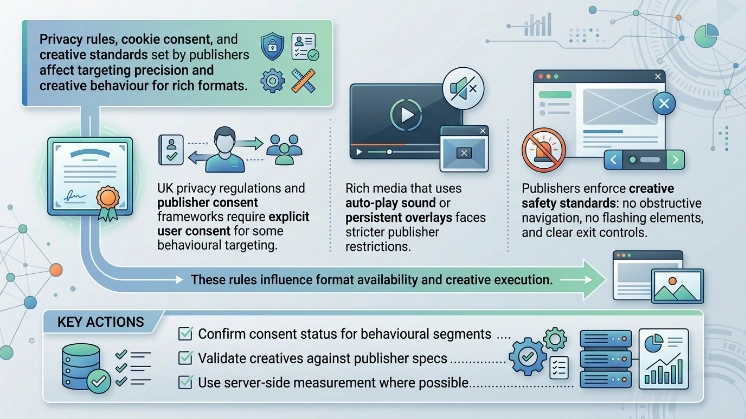
Privacy rules, cookie consent, and creative standards set by publishers affect targeting precision and creative behaviour for rich formats.
UK privacy regulations and publisher consent frameworks require explicit user consent for some behavioural targeting. Rich media that uses auto-play sound or persistent overlays faces stricter publisher restrictions. Publishers enforce creative safety standards: no obstructive navigation, no flashing elements, and clear exit controls. These rules influence format availability and creative execution.
Confirm consent status for behavioural segments, validate creatives against publisher specs, and use server-side measurement where possible.
Read More About This Topic:
Why B2B Banner Ads on UK News Sites Outperform LinkedIn Sponsored Posts for Intent
This ranking establishes engagement and cost trade-offs: leaderboards deliver broad reach and baseline CPMs; MPUs provide contextual engagement with higher CTR; half-page units generate sustained interaction and higher recall; site skins produce the strongest attention signals at the highest CPMs. Select formats based on precise objectives, allocate budget across the funnel, and measure with standard viewability and brand-lift metrics for robust outcomes.
Learn More Here:
Banner Advertising Across 10 UK News Sites: Combined Reach and CPM Figures