
Retargeting advertising uses cookie-based or identifier-based tracking to show ads to users who previously engaged with an entertainment property, aiming to re-engage them and increase subscription intent.
Retargeting identifies users who visited a website, watched a video, clicked an ad, or engaged on social channels. Entertainment entities use pixel tags, mobile advertising IDs, and logged-in user identifiers to build retargeting audiences. Platforms include web display networks, programmatic exchanges, social feeds, and connected TV (CTV) environments. Retargeting differs from prospecting because it targets known-engaged users instead of broad lookalike pools. Retargeting focuses budget on users with measurable prior intent signals, improving the likelihood of subscription conversion.
How does the retargeting process work for entertainment subscription intent?
The retargeting process captures intent signals, segments audiences, serves tailored creative, measures interactions, and optimises toward subscription actions.
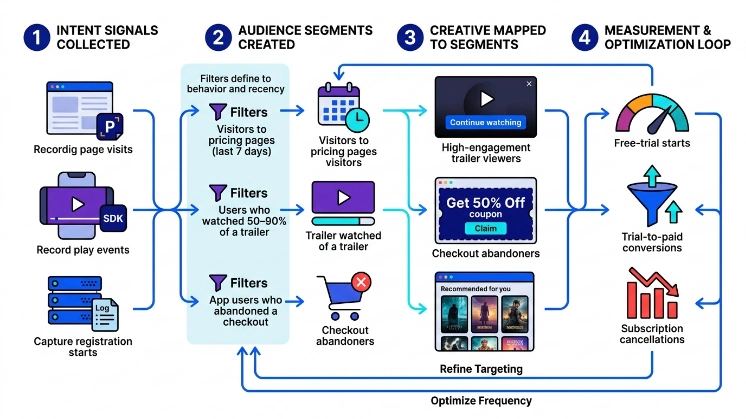
First, tracking components collect signals: page pixels record page visits, video SDKs record play events, and server-side logs capture registration starts. Next, brands create audience segments by behaviour and recency, Visitors to pricing pages in the last 7 days, users who watched 50–90% of a trailer, or app users who abandoned a checkout. Then the brand maps creative to segments: trailer reminders for high-engagement viewers, discount offers for checkout abandoners, and content recommendations for casual browsers. Finally, the campaign measures downstream events such as free-trial starts, trial-to-paid conversions, and subscription cancellations to refine targeting and frequency.
What audience segments do entertainment brands use for retargeting?
Common segments include content viewers, cart abandoners, pricing page visitors, lapsed subscribers, and lookback-engaged users defined by time and behaviour thresholds.
Content viewers are users who streamed 10–100% of a video asset; separate segments track short clips (10–30 seconds) and long-form episodes (30+ minutes). Cart or checkout abandoners include users who reached payment input but did not complete, often captured within 24–72 hours. Pricing page visitors are users who viewed subscription tiers or FAQs. Lapsed subscribers are users who churned within the last 30–180 days. Lookback-engaged users are those who engaged with any branded asset in the previous 7–90 days. Brands set frequency caps per segment, for example 3–8 impressions per week for high-intent segments, to balance reach and ad fatigue.
Which creative types improve subscription intent in retargeting ads?
Effective creative matches user intent: short trailers for high-engagement viewers, feature highlights for browsers, promotional offers for checkout abandoners, and personalised recommendations for lapsed users.
Short-form video of 6–15 seconds drives recognition for users who saw a trailer but did not convert. Mid-length clips of 30–60 seconds work for users who consumed several episodes and need a subscription prompt. Static banners summarise plan benefits and price for pricing-page visitors. Dynamic creative optimisation (DCO) assemblies combine content thumbnails, playtime triggers, and localised messaging to increase relevance. Personalised recommendations use catalogue IDs to show content similar to previously viewed titles. For lapsed subscribers, creative emphasises new releases, exclusive content counts, and limited-time pricing to raise re-subscription intent.
How do brands measure retargeting success for subscription intent?
Brands measure retargeting success by tracking direct subscription events, assisted conversion metrics, cost per subscription, and lift in intent signals such as trial starts and click-to-play rates.
Primary metrics include attribution of free-trial starts and paid subscriptions to retargeting campaigns using last-click and multi-touch models. Assisted conversions capture cases where retargeting influenced a later conversion through another channel. Cost-efficiency is assessed via cost per acquisition (CPA) and return on ad spend (ROAS) relative to subscriber lifetime value (LTV). Engagement metrics such as click-through rate (CTR), video completion rate (VCR), and post-click play rate indicate creative effectiveness. Brands test holdout groups to measure incremental lift: a 5–15% lift in trial starts in the exposed group signals effective retargeting depending on prior baseline conversion rates.
What targeting and attribution methods yield reliable results?
Deterministic matching with logged-in identifiers yields higher match rates and clearer attribution; probabilistic methods extend reach but require conservative attribution windows.
Deterministic approaches use hashed emails, device IDs tied to authenticated sessions, and CRM-linked identifiers to target users across devices. Deterministic matching typically achieves match rates of 40–80% for logged-in audiences on owned channels. Probabilistic approaches use fingerprinting and probabilistic modelling to infer the same user across devices; these methods increase audience size but lower confidence in attribution. For attribution, brands adopt unified event schemas and server-to-server conversion reporting to reduce duplication. Common windows are 7-day and 28-day post-impression attribution for subscription events, with separate analysis for trial starts and paid conversions.
How do frequency and timing affect subscription intent?
Optimal frequency limits ad fatigue while maintaining visibility timing matches recency of intent signals: immediate within 24–72 hours for checkouts, 7–14 days for pricing visitors, and 30–90 days for lapsed users.
High-intent segments such as checkout abandoners receive the tightest windows and higher frequency, for example up to 8 impressions across 3 days. Content viewers who watched trailers enter a 7–14 day window with 3–6 impressions to prompt trial starts. For lapsed subscribers, brands deploy drip sequences across 30–90 days to surface new content and special offers. Excessive frequency causes negative sentiment and increased opt-outs. Brands monitor frequency metrics, view-through rates, and unsubscribe rates to adjust caps.
Which campaign structures and channels drive conversion efficiency?
Campaigns that combine owned-channel retargeting with programmatic display, social feeds, and connected TV produce cross-device visibility and higher conversion efficiency.
Owned-channel retargeting includes email, in-app messages, and site banners using deterministic identifiers. Programmatic display expands reach across publisher inventory for web users. Social retargeting uses platform audiences and creative tailored to feed behaviour. Connected TV retargeting reaches streaming viewers with native full-screen video. Cross-channel sequencing places short reminders on social and display, and longer messaging on CTV. Attribution models should reconcile cross-channel touches to estimate incremental contribution.
What legal and privacy requirements must entertainment brands follow?
Brands must comply with data protection laws: obtain consent for cookies where law requires, provide clear privacy notices, and implement secure data handling and retention policies.
In the UK, brands follow the Data Protection Act and the UK GDPR. Consent for non-essential cookies requires clear opt-in mechanisms for web tracking. Brands using hashed identifiers must ensure lawful basis and transparency for processing. Data minimisation practices limit stored identifiers, and retention policies delete data once targeting objectives end, commonly within 90 days for most retargeting segments. Brands maintain audit logs for data sharing with partners and use contractual safeguards for DSPs and publishers.
Explore More Expert Insights:
How Music Platforms Build Listener Engagement Using Banner Ads
How Ticketing Platforms Nurture Buyers Using Event Reminder Ads
What are practical use cases and examples of retargeting driving subscriptions?
Use cases include converting trailer viewers into trial subscribers, recovering checkout abandoners, reactivating churned users with new-content messaging, and monetising engaged free-tier users.
A studio retargets viewers who watched 70% of a trailer, showing a 15-second call-to-action ad prompting a free trial. A streaming platform retargets checkout abandoners within 48 hours with a time-limited discount code. A service re-engages churned users with personalised lists of titles added since churn and a targeted reactivation discount over a 30-day sequence. A freemium app retargets heavy free users (20+ sessions in 14 days) with bundle-upgrade creative featuring price and feature differentials.
Explore More Useful Information:
How Entertainment Brands Grow Engagement Using Banner Advertising
How do brands optimise retargeting for long-term subscription value?
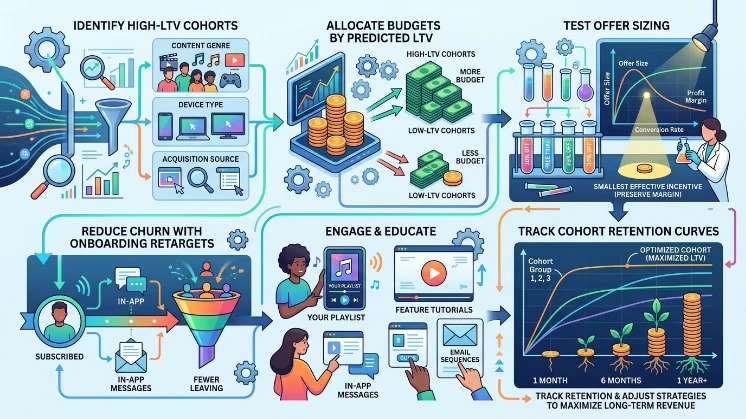
Optimisation aligns retargeting goals with lifetime value by prioritising high-LTV cohorts, testing offer sizing, and reducing churn through onboarding retargets.
Brands identify high-LTV cohorts by content genre, device type, and acquisition source. Retargeting budgets allocate more to cohorts with higher predicted LTV. Offer testing experiments evaluate the smallest necessary incentive to convert users while preserving margin. Post-conversion retargeting focuses on onboarding personalised playlists and feature tutorials delivered via in-app messages and email increase first-30-day retention. Brands track cohort retention curves and adjust creative and sequencing to maximise long-term revenue.
Check the Complete Explanation:
Entertainment Retargeting Ads That Turn Engagement Into Subscription Conversions