
Banner ads are rectangular visual ads placed within app or web interfaces that display an image, headline, and link, they trigger clicks or impressions and direct listeners to content or landing pages.
Banner ads are static or animated images shown in specific interface zones such as headers, footers, sidebars, and between content sections. They load with the platform page or app view and render within allocated pixel dimensions. Each banner records two core metrics: impressions (every time the ad displays) and clicks (every time a user taps or clicks). Platforms report viewability rates that measure ads actually seen on screen for a minimum time threshold. Inventory for banners uses placements allocated by page template, screen size, and device type. Platforms sell or allocate inventory via direct deals or programmatic auctions that match buyers’ targeting parameters with available placements.
Banner ads use clear visual hierarchy, an image, concise headline, and a click target. When a listener clicks, the platform executes one of several actions: open an artist page, queue a playlist, start a preview, or navigate to an external URL. Click tracking uses redirect URLs and tracking pixels to attribute downstream events such as stream starts. Impressions tracking uses SDK events for visibility and timestamps. Ad servers attach metadata to each event: placement ID, creative ID, user segment, device type, and timestamp. This metadata supports real-time bidding, reporting, and subsequent optimisation.
How do banner ads increase streams on music platforms?
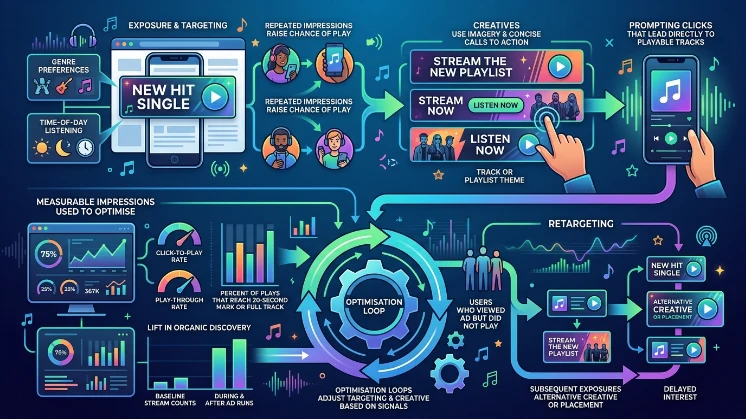
Banner ads increase streams by exposing content to targeted listeners, prompting clicks that lead directly to playable tracks, and by generating measurable impressions used to optimise placement and creative for higher play-through rates.
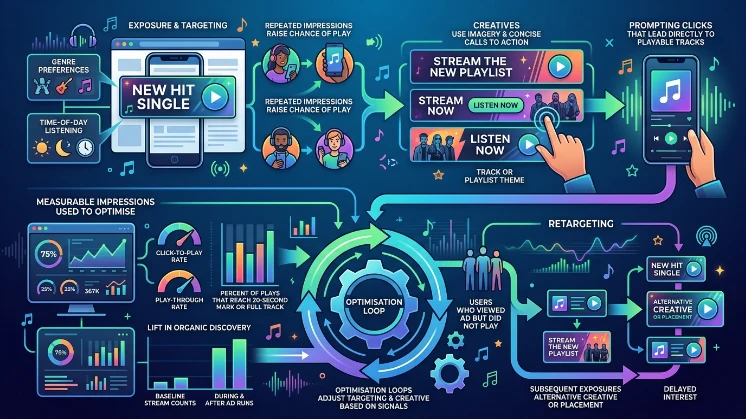
Exposure from repeated impressions raises the chance a listener will click to play. Targeting narrows the audience to listeners whose past behavior signals likely interest, for example, genre preferences or time-of-day listening. Creatives use imagery and concise calls to action that match the track or playlist theme. Platforms measure immediate conversion metrics: click-to-play rate and play-through rate (percent of plays that reach the song’s 30-second mark or full track). They also measure lift in organic discovery by comparing baseline stream counts with streams during and after ad runs. Optimisation loops adjust targeting and creative based on these signals. Retargeting uses users who viewed the ad but did not play; subsequent exposures use alternative creative or placement to capture delayed interest.
Banner ad frameworks integrate with the platform’s playback API. Click actions call playback endpoints with context parameters that instruct the player to start a specific track or playlist position. Measurement uses event logs: ad impression → ad click → playback request → playback started → playback completed. Platforms correlate these events using session identifiers and user IDs while respecting privacy constraints. These correlations produce conversion reports that show how many ad impressions and clicks resulted in actual streams.
What targeting methods do platforms use for banner ad placement?
Platforms use behavioral, contextual, demographic, and device-based targeting to place banner ads in front of listeners most likely to play promoted content.
Behavioral targeting uses prior listening history: top genres, recently played artists, and saved playlists. Contextual targeting uses current page context such as browsing a specific mood playlist or artist page. Demographic targeting uses declared or inferred age, gender, and region. Device targeting selects between mobile, desktop, and connected devices, with creatives tailored for each form factor. Time-based targeting schedules ads during high-engagement windows, for example commute hours. Platforms create audience segments from combinations of these signals. Segments drive bid adjustments and frequency caps to manage user fatigue.
Key signals include track-level skips, completion rates, session length, playlist follows, and search queries. Platforms use lookback windows, for example 7-day or 30-day behavior, to define current interests. They also use regional trends and time-of-day weighting to push ads when listeners are most active. Privacy controls aggregate or anonymise identifiers before use in targeting.
What creative elements drive listeners to click and stream from banner ads?
Effective creatives use a clear image, concise headline, and explicit play intent that match the promoted music’s mood or genre; creatives must align with the platform’s visual constraints and required file sizes.
Image selection relies on high-contrast photos or artwork sized to platform specifications. Headlines use short phrases of 3–7 words that state the action or theme. Visual cues like a play icon or duration badge signal immediate playback. File formats are optimised for bandwidth: compressed images or lightweight animated formats. Color palettes and typography match musical tone; for example, bright tones for pop and dark tones for ambient. A click target area is large enough for comfortable tapping on mobile. Accessibility includes alt text, readable font sizes, and sufficient contrast.
Platforms run A/B tests that compare creative variants with controlled sample sizes. Tests measure click-through rate, post-click play start rate, and play completion rate. Winning variants inform subsequent creative sets. Creative rotation uses performance thresholds such as a minimum of 5,000 impressions before concluding a variant’s effectiveness.
What measurement metrics show banner ads increased streams?
Key metrics are impressions, click-through rate (CTR), click-to-play rate, play-start count, play-through (completion) rate, and attribution lift compared to baseline stream counts.
Impressions count exposures. CTR equals clicks divided by impressions and measures immediate engagement. Click-to-play rate equals playback starts divided by clicks and measures post-click effectiveness. Play-through rate equals completed plays divided by play starts and measures how often a click leads to meaningful listening. Attribution lift compares stream counts during campaign windows against pre-campaign baseline windows, often using holdout groups to isolate ad effect. Cost-per-play equals total campaign cost divided by attributed play starts and provides efficiency insights. Viewability and view-through conversions capture plays that occurred after users saw but did not click the ad.
Platforms provide real-time dashboards and end-of-run reports. Third-party measurement can validate platform-reported conversions using sample datasets or panel analytics. Statistical significance criteria such as p < 0.05 or confidence intervals of 95% support claim validation when comparing control and exposed cohorts.
What are the main components of a banner ad campaign for streaming growth?
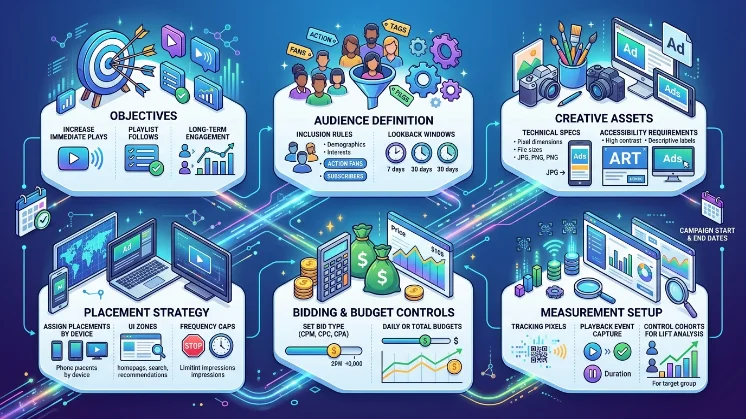
Campaign components include objectives, audience definition, creative assets, placement strategy, bidding and budget controls, and measurement setup.
Objectives specify whether the goal is to increase immediate plays, playlist follows, or longer-term engagement. Audience definition sets inclusion rules and lookback windows. Creative assets follow technical specs and accessibility requirements. Placement strategy assigns placements by device and UI zone with frequency caps. Bidding strategy sets bid type (CPM, CPC, or CPA) and daily or total budgets. Measurement setup configures tracking pixels, playback event capture, and control cohorts for lift analysis. Campaign start and end dates define the active delivery window.
During a campaign, platforms adjust bids and placements based on performance. Low-CTR placements see reduced spend. High-conversion creatives receive increased delivery. Retargeting engages non-converting viewers with alternative creatives. End-of-run analysis identifies durable effects, such as sustained uplift in organic streams.
Explore More Expert Insights:
How Ticketing Platforms Boost Sales Using Display Campaigns
How Event Organizers Increase Attendance Using Banner Ads
What benefits do banner ads deliver for music discovery and listener growth?
Banner ads deliver measurable exposure, targeted reach, immediate playback initiation, and datasets for optimising discovery strategies that increase stream counts.
Exposure expands awareness among listeners who fit targeted segments. Targeted reach places music in front of users actively browsing related content. Immediate playback initiation reduces friction between discovery and listening. Data from impressions, clicks, and play events gives platforms precise signals to refine future campaigns. Measured lift supports budget allocation decisions and informs programming choices for playlists and editorial features.
Sustained campaigns can increase playlist follows and artist saves, which in turn increase organic discovery through personalised recommendation systems. Consistent measurement links short-term ad-driven plays to long-term engagement metrics such as repeat listens over 14- and 30-day windows.
What use cases demonstrate banner ads increasing streams effectively?
Use cases include new releases promotion, playlist placement announcements, regional tours or events, and seasonal or thematic campaigns that align creative with listener intent.
Promoting a new release directs listeners to the track or album page to capture initial streams during launch windows. Announcing playlist placement drives listeners to a curated list that contains the promoted track, capturing both track plays and playlist follows. Regional tour campaigns surface tracks to users in tour cities to stimulate local listenership before shows. Seasonal campaigns tie music to holidays or events, leveraging high-search interest to drive plays. Each use case tracks immediate conversion and subsequent retention over 7-, 14-, and 30-day periods.
Campaign analysis shows increases in first-week stream counts, higher playlist follow rates, and improved play-through rates for targeted segments. Attribute models isolate ad-driven streams from organic growth using control groups or time-based baselines.
Explore More Expert Insights:
How Music Platforms Build Listener Engagement Using Banner Ads
Banner ads on music platforms function as targeted exposure mechanisms that link visual placements directly to playback actions. They use behavioral and contextual targeting, optimised creatives, and integrated measurement to convert impressions into play starts and measurable stream lift. Campaign components include clear objectives, audience definitions, creatives, placements, bidding, and robust measurement. Use cases such as new-release promotion and regional campaigns show practical pathways to increase streams and grow listener engagement.
Read More for Better Understanding:
Music Platform Ads That Convert Listening Interest Into Premium Users