Ticketing retargeting ads are targeted display or social ads that reach users who viewed event pages but did not buy, using cookies or user IDs to show tailored creative and offers.
Retargeting ads use visitor data to reconnect with event browsers. Platforms place a small tracker on event pages to record page views and actions. Advertisers build audience segments from that data, such as “viewed event page,” “selected ticket,” or “abandoned checkout.” Platforms then deliver ads to those segments across websites, apps, and social feeds. Typical channels include display advertising networks, social platforms, and programmatic exchanges. Ads present dynamic content: event details, remaining ticket counts, price tiers, or personalised reminders. Measurement uses click-through rates, view-through conversions, and attributed ticket purchases. Attribution windows often range from 1 to 30 days depending on campaign goals.
Why do ticketing retargeting ads increase conversion rates?
Retargeting ads increase conversions by focusing spend on users with demonstrated intent, reducing wasted impressions and improving message relevance.
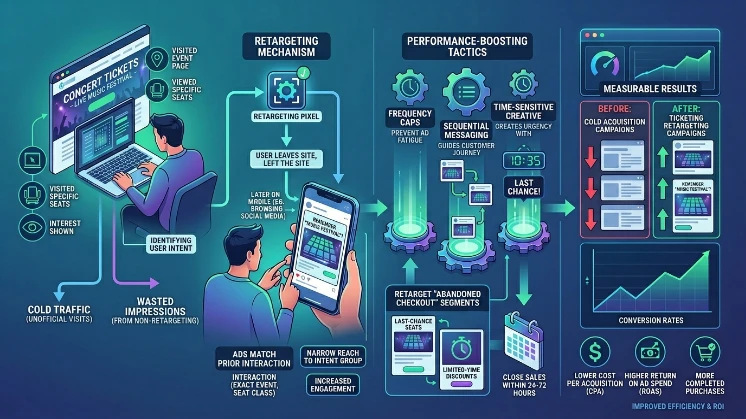
Event browsers show prior intent by visiting event pages. Retargeting narrows reach to that intent group, increasing the chance of purchase. Ads that match the user’s prior interaction—such as showing the exact event or the seat class they viewed—produce higher engagement. Performance improves when campaigns use frequency caps, sequential messaging, and time-sensitive creative. Key metrics that change include lower cost per acquisition, higher return on ad spend, and improved conversion rates compared with cold acquisition campaigns. Case examples include campaigns that retarget “abandoned checkout” segments with last-chance seats or limited-time discounts, which close sales within 24–72 hours.
What data and signals do platforms use for retargeting?
Platforms use page views, event interest actions, cart activity, ticket type selections, geolocation, and email list matches as primary signals for retargeting.
Page view trackers record which event pages users visited and how long they stayed. Interaction signals include clicks on “buy” buttons, seat map views, or ticket tier selections. Cart activity logs abandoned or partial checkouts. First-party data from newsletters or CRM lists lets advertisers create matched audiences using hashed emails or user IDs. Device and geolocation data enable localised messaging and delivery during peak purchase hours. Third-party data can supply demographic enrichment where permitted. Platforms combine these signals to prioritise high-intent users and to sequence messages: mild reminders for casual browsers, stronger incentives for those who abandoned checkout, and VIP offers for repeat buyers.
How do you structure a ticketing retargeting campaign for best results?
Structure campaigns by intent segments browsers, engaged viewers, cart abandoners, and past buyers—and assign tailored creative, frequency rules, and windows for each segment.
Start with audience segmentation. Create an audience for users who viewed an event page within 30 days. Create another for users who added tickets to cart but did not complete purchase within 7 days. Add a segment for past attendees to upsell related events. Assign campaign objectives aligned to each segment: reach and frequency for browsers, traffic and conversions for engaged viewers, and conversions for cart abandoners. Set frequency caps to avoid ad fatigue: 3–6 exposures per week for browsers, 6–12 exposures per week for cart abandoners during a short window. Use time-limited creative that reflects remaining inventory or deadlines. Monitor performance daily at launch, then weekly once stable. Adjust bids and budgets to allocate more spend to high-conversion segments.
What creative elements drive purchases in ticketing retargeting ads?
Creative must show event name, date, clear price or price tier, remaining ticket counts, and a direct purchase prompt tailored to the user’s last action.
Display the event headline and date in the first visual area. Include price bands or starting price to set expectations. Show urgency cues such as “X seats left” or “Sale ends in 48 hours” when accurate. Use dynamic creative to present the exact ticket type a user viewed. Provide a single, clear call to action that maps to the user’s next step, for example “Complete purchase” for cart abandoners or “Reserve seat” for browsers. Ensure visuals reflect the event tone formal imagery for theatre, energetic shots for concerts. For mobile creatives, prioritise legible text and a single tappable element. Test variations on headlines, imagery, and urgency language to identify the highest-converting combinations.
How does personalisation affect retargeting performance?
Personalisation increases relevance by matching ads to a user’s previous actions, which raises click-through rates and conversion likelihood.
Personalisation uses the exact event page, selected ticket tier, or viewed seating map in the ad. For users who viewed VIP or premium sections, show premium benefits and seat visuals. For price-sensitive users, display early-bird or discounted ticket options. Use location data to highlight local entry information or transport links. Match ad timing to behaviour, show immediate reminders within 24 hours to cart abandoners and staggered reminders over 14–30 days for casual browsers. Personalised messaging creates a direct path from ad to checkout, reducing friction and increasing conversion speed.
What measurement and KPIs prove retargeting success?
Key KPIs include return on ad spend (ROAS), cost per acquisition (CPA), conversion rate, click-through rate (CTR), and view-through conversions within the campaign attribution window.
Measure ROAS by attributing ticket revenue to retargeting campaigns across the selected window. Report CPA as ad cost divided by ticket purchases attributed to the campaign. Track conversion rate from ad click to completed purchase on the landing page. Use CTR to evaluate creative relevance. Use view-through conversions to capture conversions from users who saw but did not click an ad. Compare segment performance browsers versus cart abandoners by CPA and conversion rate. Use incremental lift tests or holdout groups to isolate the retargeting campaign’s incremental impact on sales. Report these KPIs weekly during active sale periods and after major adjustments.
What privacy and compliance requirements apply in the UK?
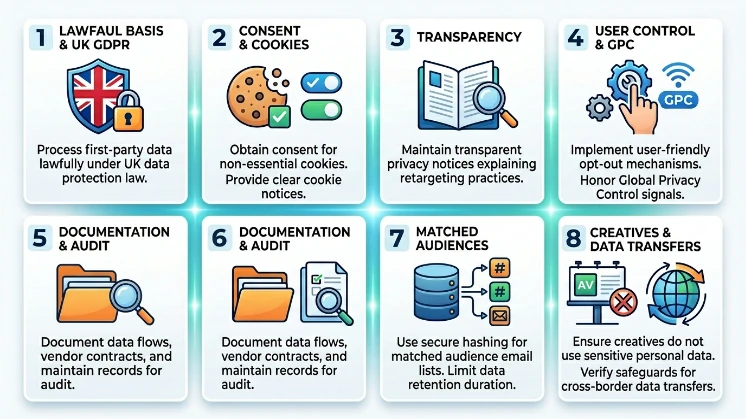
Advertisers must comply with UK data protection law, process first-party data lawfully with consent where required, and provide clear cookie notices and opt-outs.
Under UK data protection rules, trackers require lawful basis for processing. Use consent for non-essential cookies when required by guidance. Maintain transparent privacy notices that explain retargeting use. Implement user-friendly opt-out mechanisms and honour global privacy signals such as GPC. When using hashed email lists for matched audiences, use secure hashing and limit retention to necessary durations. Document data flows and vendor contracts, and keep records for audit. Ensure creatives do not include sensitive personal data. Verify that cross-border data transfers have appropriate safeguards.
Which targeting tactics improve ROI for event promoters?
Combine sequential messaging, dynamic creatives, lookalike expansion from high-value buyers, and time-bound incentives to optimise ROI.
Sequential messaging moves users through awareness to decision by changing content across exposures: initial reminder, social proof (reviews or attendance numbers), then a final offer. Dynamic creatives insert the specific event and ticket details viewed by each user. Create lookalike audiences from purchasers to scale reach responsibly. Introduce limited-time offers or early-bird discounts within short windows to accelerate purchase decisions. Allocate more budget to high-performing segments and reduce spend on low-converting cohorts. Use A/B testing for creative variants and landing pages to refine the highest-value path to purchase.
Explore More Expert Insights:
Event Display Ads That Convert Ticket Consideration Into Purchases
Gaming Banner Ads That Turn Interest Into Active Player Conversions
What are common use cases and success scenarios?
Common use cases include last-minute sales for concerts, early-bird conversions for festivals, seat upgrades for sports fixtures, and reminder-driven purchases for theatre runs.
For concerts, retargeting converts fans who viewed ticket tiers into buyers with countdown offers. For multi-day festivals, retargeting nudges campsite or VIP purchasers to complete add-ons. For sports fixtures, promotions convert viewers who checked premium seating into upgrades. For theatre, reminder ads convert browsers into purchases during discounted weekday slots. Successful campaigns report 20–60% higher conversion rates for cart abandoners and 10–30% uplift for general browsers compared with cold display campaigns.
How do you decide between retargeting channels?
Choose channels based on audience reach, device use, and purchase attribution: social for high-engagement audiences, display for wide reach, programmatic for scale, and email for highest conversion.
Use social platforms for users with strong social engagement and for creative formats like video. Use display networks to maintain visibility across content sites. Use programmatic buying to reach niche inventory and to apply frequency and placement controls. Use CRM-triggered email for the highest direct conversion rates, since email recipients already have a known identifier. Coordinate channels with a single attribution model to avoid double-counting. Allocate spend based on past channel ROAS and ongoing test results.
Explore the Advanced Guide:
How Ticketing Platforms Boost Sales Using Display Campaigns
Ticketing retargeting ads convert event browsers into buyers by using defined audience signals, personalised creative, and structured campaign sequencing. Follow intent-based segmentation, show precise event and ticket information, measure ROAS and CPA, and comply with UK data rules.
For operational setup and segment templates, see the following:
How Ticketing Platforms Nurture Buyers Using Event Reminder Ads